bundles / scipy 2.0.0.dev0+git20260907.41eeb59 /docs
Doc
Discrete Alias Urn (DAU)
docs/tutorial:stats:sampling_dau
Required: probability vector (PV) or the PMF along with a finite domain
Speed:
Set-up: slow (linear with the vector-length)
Sampling: very fast
DAU samples from distributions with arbitrary but finite probability vectors (PV) of length N. The algorithm is based on an ingenious method by A.J. Walker and requires a table of size (at least) N. It needs one random number and only one comparison for each generated random variate. The setup time for constructing the tables is O(N).
>>> import numpy as np
>>> from scipy.stats.sampling import DiscreteAliasUrn
>>>
>>> pv = [0.18, 0.02, 0.8]
>>> urng = np.random.default_rng()
>>> rng = DiscreteAliasUrn(pv, random_state=urng)
>>> rng.rvs()
0      # may vary
By default, the probability vector is indexed starting at 0. However, this can be changed by passing a domain parameter. When domain is given in combination with the PV, it has the effect of relocating the distribution from (0, len(pv)) to (domain[0], domain[0] + len(pv)). domain[1] is ignored in this case.
>>> rng = DiscreteAliasUrn(pv, domain=(10, 13), random_state=urng)
>>> rng.rvs()
12    # may vary
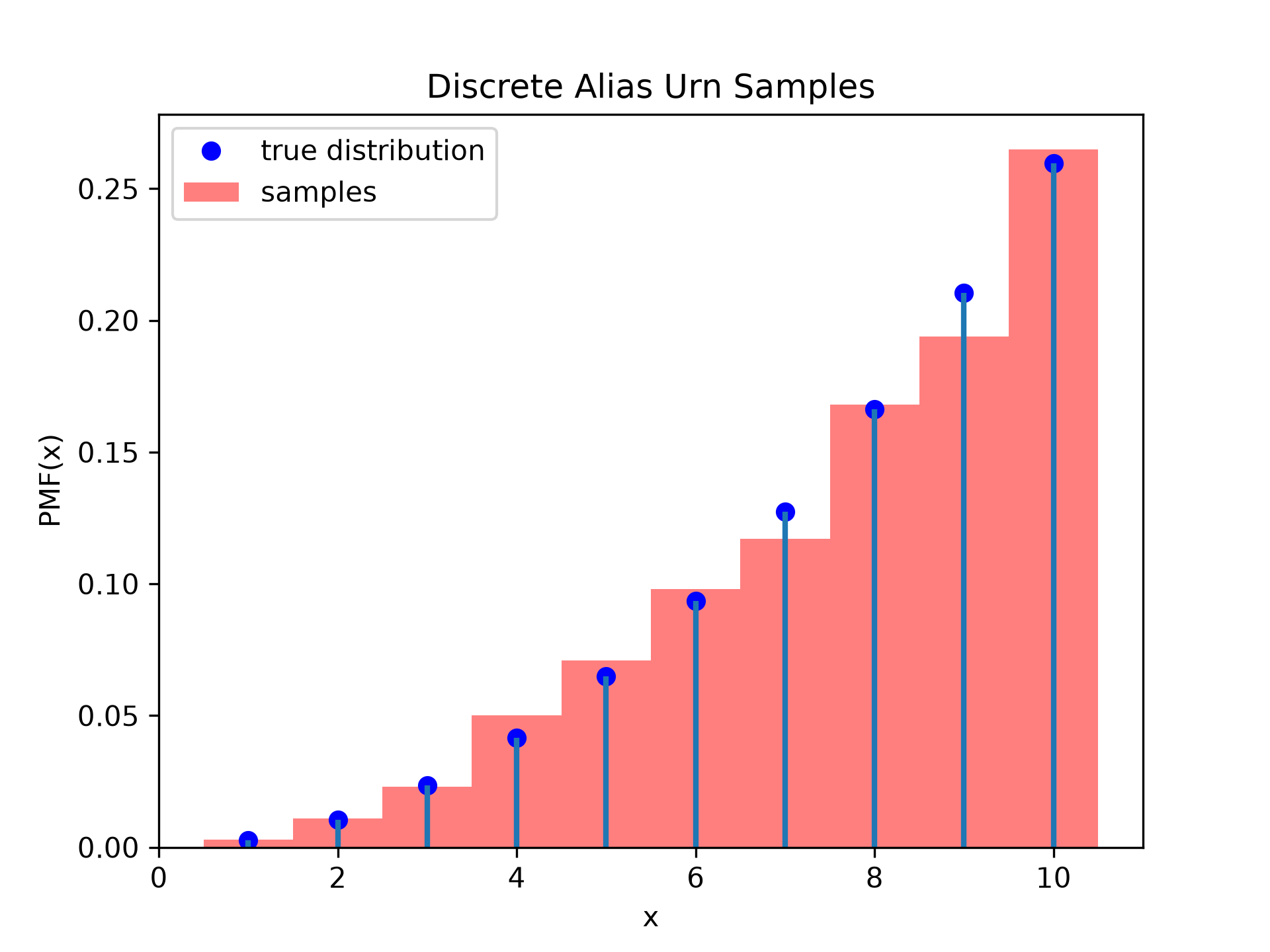
The method also works when no probability vector but a PMF is given. In that case, a bounded (finite) domain must also be given either by passing the domain parameter explicitly or by providing a support method in the distribution object:
>>> class Distribution:
...     def __init__(self, c):
...         self.c = c
...     def pmf(self, x):
...         return x**self.c
...     def support(self):
...         return (0, 10)
...
>>> dist = Distribution(2)
>>> rng = DiscreteAliasUrn(dist, random_state=urng)
>>> rng.rvs()
10    # may vary
>>> import matplotlib.pyplot as plt
>>> from scipy.stats.sampling import DiscreteAliasUrn
>>> class Distribution:
...     def __init__(self, c):
...         self.c = c
...     def pmf(self, x):
...         return x**self.c
...     def support(self):
...         return (0, 10)
...
>>> dist = Distribution(2)
>>> urng = np.random.default_rng()
>>> rng = DiscreteAliasUrn(dist, random_state=urng)
>>> rvs = rng.rvs(1000)
>>> fig = plt.figure()
>>> ax = fig.add_subplot(111)
>>> x = np.arange(1, 11)
>>> fx = dist.pmf(x)
>>> fx = fx / fx.sum()
>>> ax.plot(x, fx, 'bo', label='true distribution')
>>> ax.vlines(x, 0, fx, lw=2)
>>> ax.hist(rvs, bins=np.r_[x, 11]-0.5, density=True, alpha=0.5, color='r',
...         label='samples')
>>> ax.set_xlabel('x')
>>> ax.set_ylabel('PMF(x)')
>>> ax.set_title('Discrete Alias Urn Samples')
>>> plt.legend()
>>> plt.show()
The performance can be slightly influenced by setting the size of the used table which can be changed by passing a urn_factor parameter.
>>> # use a table twice the length of PV.
>>> urn_factor = 2
>>> rng = DiscreteAliasUrn(pv, urn_factor=urn_factor, random_state=urng)
>>> rng.rvs()
2    # may vary
References
UNU.RAN reference manual, Section 5.8.2, "DAU - (Discrete) Alias-Urn method", http://statmath.wu.ac.at/software/unuran/doc/unuran.html#DAU
A.J. Walker (1977). An efficient method for generating discrete random variables with general distributions, ACM Trans. Math. Software 3, pp. 253-256.