bundles / scipy 1.17.1 / scipy / fft / _fftlog / fht
_Function
scipy.fft._fftlog:fht
source: /scipy/fft/_fftlog.py:18
Signature
def fht(a, dln, mu, offset = 0.0, bias = 0.0)Summary
Compute the fast Hankel transform.
Extended Summary
Computes the discrete Hankel transform of a logarithmically spaced periodic sequence using the FFTLog algorithm [1], [2].
Parameters
a: array_like (..., n)Real periodic input array, uniformly logarithmically spaced. For multidimensional input, the transform is performed over the last axis.
dln: floatUniform logarithmic spacing of the input array.
mu: floatOrder of the Hankel transform, any positive or negative real number.
offset: float, optionalOffset of the uniform logarithmic spacing of the output array.
bias: float, optionalExponent of power law bias, any positive or negative real number.
Returns
A: array_like (..., n)The transformed output array, which is real, periodic, uniformly logarithmically spaced, and of the same shape as the input array.
Notes
This function computes a discrete version of the Hankel transform
where is the Bessel function of order . The index may be any real number, positive or negative. Note that the numerical Hankel transform uses an integrand of , while the mathematical Hankel transform is commonly defined using .
The input array a is a periodic sequence of length , uniformly logarithmically spaced with spacing dln,
centred about the point . Note that the central index is half-integral if is even, so that falls between two input elements. Similarly, the output array A is a periodic sequence of length , also uniformly logarithmically spaced with spacing dln
centred about the point .
The centre points and of the periodic intervals may be chosen arbitrarily, but it would be usual to choose the product to be unity. This can be changed using the offset parameter, which controls the logarithmic offset of the output array. Choosing an optimal value for offset may reduce ringing of the discrete Hankel transform.
If the bias parameter is nonzero, this function computes a discrete version of the biased Hankel transform
where is the value of bias, and a power law bias is applied to the input sequence. Biasing the transform can help approximate the continuous transform of if there is a value such that is close to a periodic sequence, in which case the resulting will be close to the continuous transform.
Array API Standard Support
fht has experimental support for Python Array API Standard compatible backends in addition to NumPy. Please consider testing these features by setting an environment variable SCIPY_ARRAY_API=1 and providing CuPy, PyTorch, JAX, or Dask arrays as array arguments. The following combinations of backend and device (or other capability) are supported.
====================  ====================  ====================
Library               CPU                   GPU
====================  ====================  ====================
NumPy                 ✅                     n/a
CuPy                  n/a                   ✅
PyTorch               ✅                     ✅
JAX                   ✅                     ✅
Dask                  ⚠️ computes graph     n/a
====================  ====================  ====================
See
dev-arrayapifor more information.
Examples
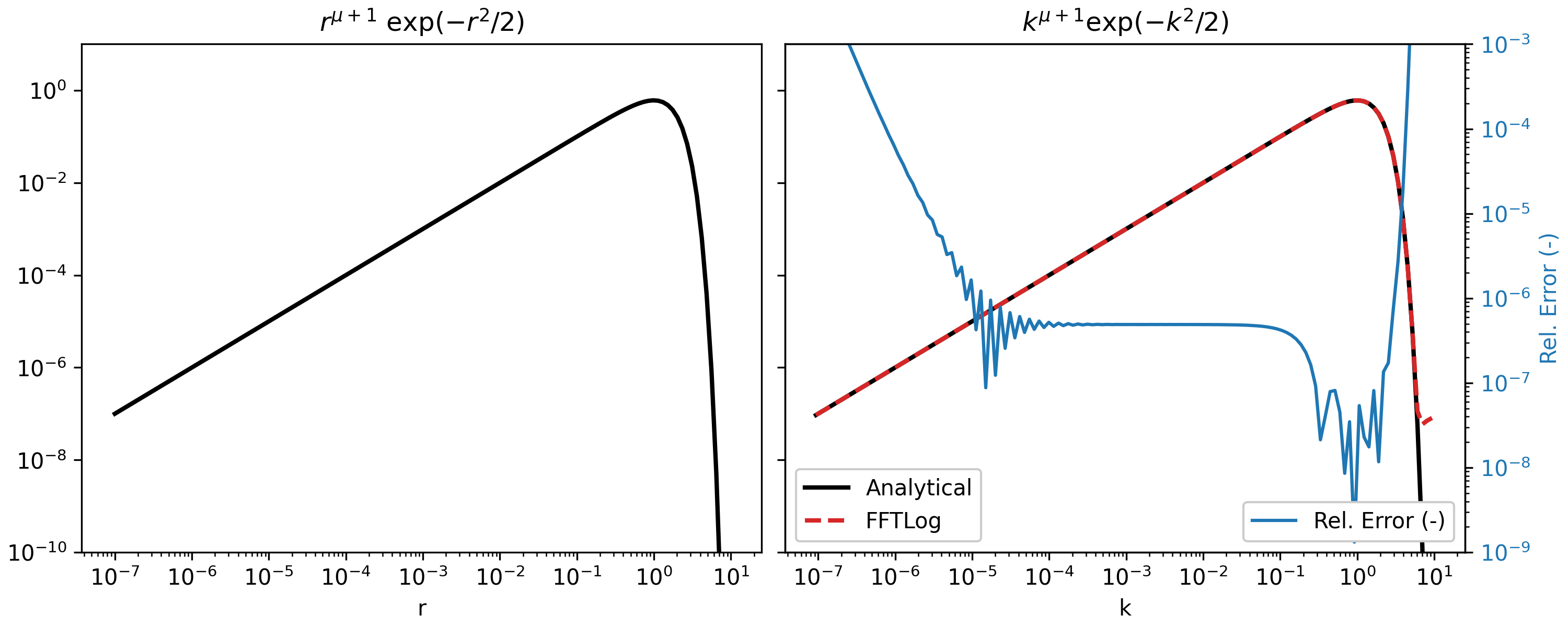
This example is the adapted version of ``fftlogtest.f`` which is provided in [2]_. It evaluates the integral .. math:: \int^\infty_0 r^{\mu+1} \exp(-r^2/2) J_\mu(kr) k dr = k^{\mu+1} \exp(-k^2/2) .import numpy as np from scipy import fft import matplotlib.pyplot as plt✓
mu = 0.0                     # Order mu of Bessel function
r = np.logspace(-7, 1, 128)  # Input evaluation points
dln = np.log(r[1]/r[0])      # Step size
offset = fft.fhtoffset(dln, initial=-6*np.log(10), mu=mu)
k = np.exp(offset)/r[::-1]   # Output evaluation points
✓
def f(x, mu):
    """Analytical function: x^(mu+1) exp(-x^2/2)."""
    return x**(mu + 1)*np.exp(-x**2/2)
✓
a_r = f(r, mu)
fht = fft.fht(a_r, dln, mu=mu, offset=offset)
✓
a_k = f(k, mu)
rel_err = abs((fht-a_k)/a_k)
✓
figargs = {'sharex': True, 'sharey': True, 'constrained_layout': True}
fig, (ax1, ax2) = plt.subplots(1, 2, figsize=(10, 4), **figargs)
✓
ax1.set_title(r'$r^{\mu+1}\ \exp(-r^2/2)$')
ax1.loglog(r, a_r, 'k', lw=2)
ax1.set_xlabel('r')
ax2.set_title(r'$k^{\mu+1} \exp(-k^2/2)$')
ax2.loglog(k, a_k, 'k', lw=2, label='Analytical')
ax2.loglog(k, fht, 'C3--', lw=2, label='FFTLog')
ax2.set_xlabel('k')
ax2.legend(loc=3, framealpha=1)
ax2.set_ylim([1e-10, 1e1])
✗
ax2b = ax2.twinx()
✓ax2b.loglog(k, rel_err, 'C0', label='Rel. Error (-)') ax2b.set_ylabel('Rel. Error (-)', color='C0')✗
ax2b.tick_params(axis='y', labelcolor='C0')
✓ax2b.legend(loc=4, framealpha=1) ax2b.set_ylim([1e-9, 1e-3])✗
plt.show()
✓
See also
- fhtoffset
Return an optimal offset for
fht.- ifht
The inverse of
fht.
Aliases
scipy.fft.fht