bundles / scipy 1.17.1 / scipy / interpolate / _dierckx / evaluate_all_bspl
built-in
scipy.interpolate._dierckx:evaluate_all_bspl
Summary
Evaluate the k+1 B-splines which are non-zero on interval m.
Parameters
t: ndarray, shape (nt + k + 1,)sorted 1D array of knots
k: intspline order
xval: floatargument at which to evaluate the B-splines
m: intindex of the left edge of the evaluation interval,
t[m] <= x < t[m+1]nu: int, optionalEvaluate derivatives order nu. Default is zero.
Returns
: ndarray, shape (k+1,)The values of B-splines if nu is zero, otherwise the derivatives of order nu.
Examples
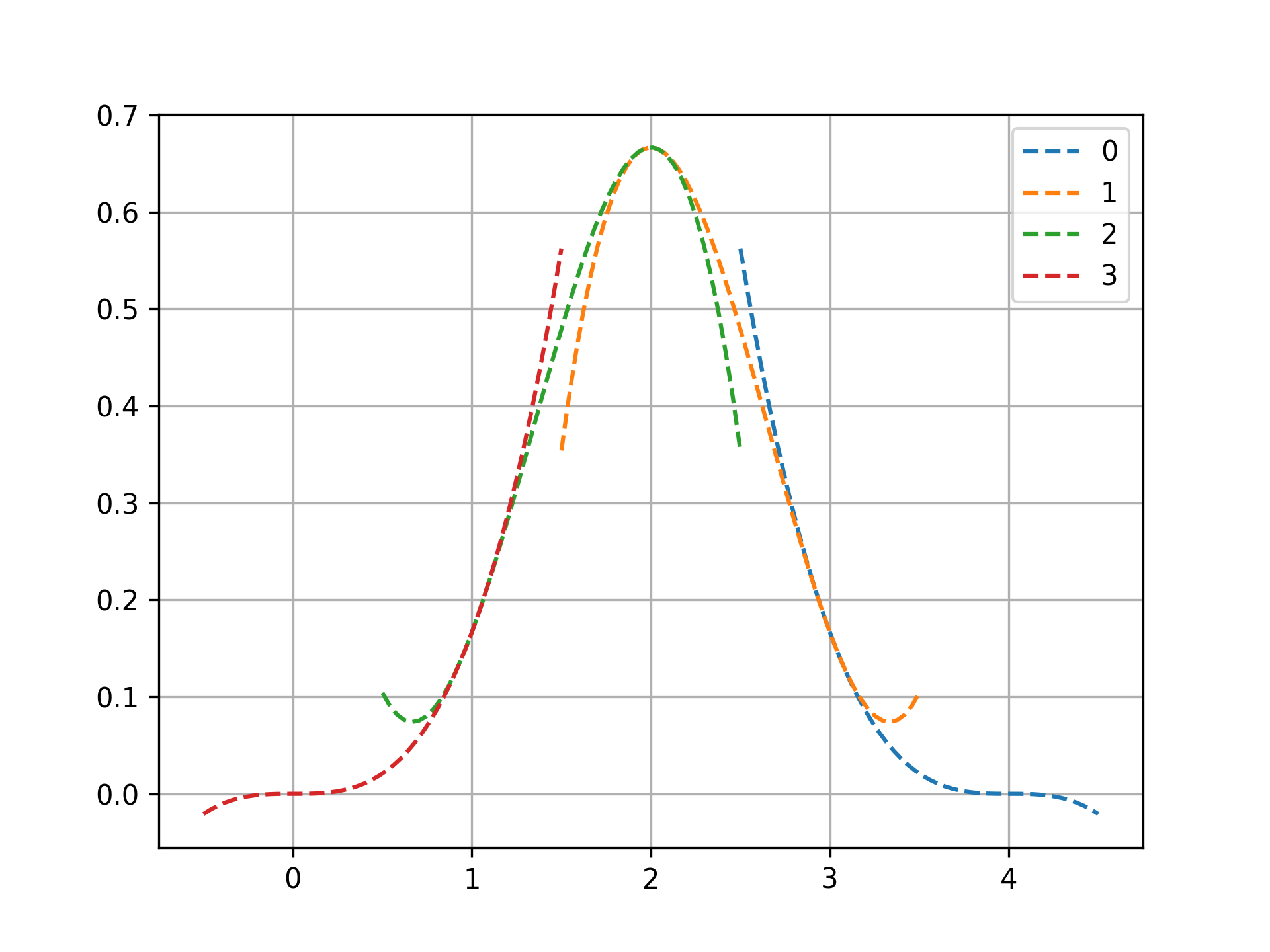
A textbook use of this sort of routine is plotting the ``k+1`` polynomial pieces which make up a B-spline of order `k`. Consider a cubic splinek = 3 t = [0., 1., 2., 3., 4.] # internal knots a, b = t[0], t[-1] # base interval is [a, b) t = np.array([a]*k + t + [b]*k) # add boundary knots✓
import matplotlib.pyplot as plt
xx = np.linspace(a, b, 100)
✓
plt.plot(xx, BSpline.basis_element(t[k:-k])(xx),
         lw=3, alpha=0.5, label='basis_element')
⚠
for i in range(k+1):
   x1, x2 = t[2*k - i], t[2*k - i + 1]
   xx = np.linspace(x1 - 0.5, x2 + 0.5)
   yy = [evaluate_all_bspl(t, k, x, 2*k - i)[i] for x in xx]
   plt.plot(xx, yy, '--', label=str(i))
✗
plt.grid(True)
✓plt.legend()
✗plt.show()
✓
Aliases
scipy.interpolate._dierckx.evaluate_all_bspl