bundles / scipy 1.17.1 / scipy / interpolate / _interpolate / lagrange
function
scipy.interpolate._interpolate:lagrange
Signature
def lagrange(x, w)Summary
Return a Lagrange interpolating polynomial.
Extended Summary
Given two 1-D arrays x and w, returns the Lagrange interpolating polynomial through the points (x, w).
Warning: This implementation is numerically unstable. Do not expect to be able to use more than about 20 points even if they are chosen optimally.
Parameters
x: array_likexrepresents the x-coordinates of a set of datapoints.w: array_likewrepresents the y-coordinates of a set of datapoints, i.e., f(x).
Returns
lagrange: `numpy.poly1d` instanceThe Lagrange interpolating polynomial.
Notes
The name of this function refers to the fact that the returned object represents a Lagrange polynomial, the unique polynomial of lowest degree that interpolates a given set of data [1]. It computes the polynomial using Newton's divided differences formula [2]; that is, it works with Newton basis polynomials rather than Lagrange basis polynomials. For numerical calculations, the barycentric form of Lagrange interpolation (scipy.interpolate.BarycentricInterpolator) is typically more appropriate.
Examples
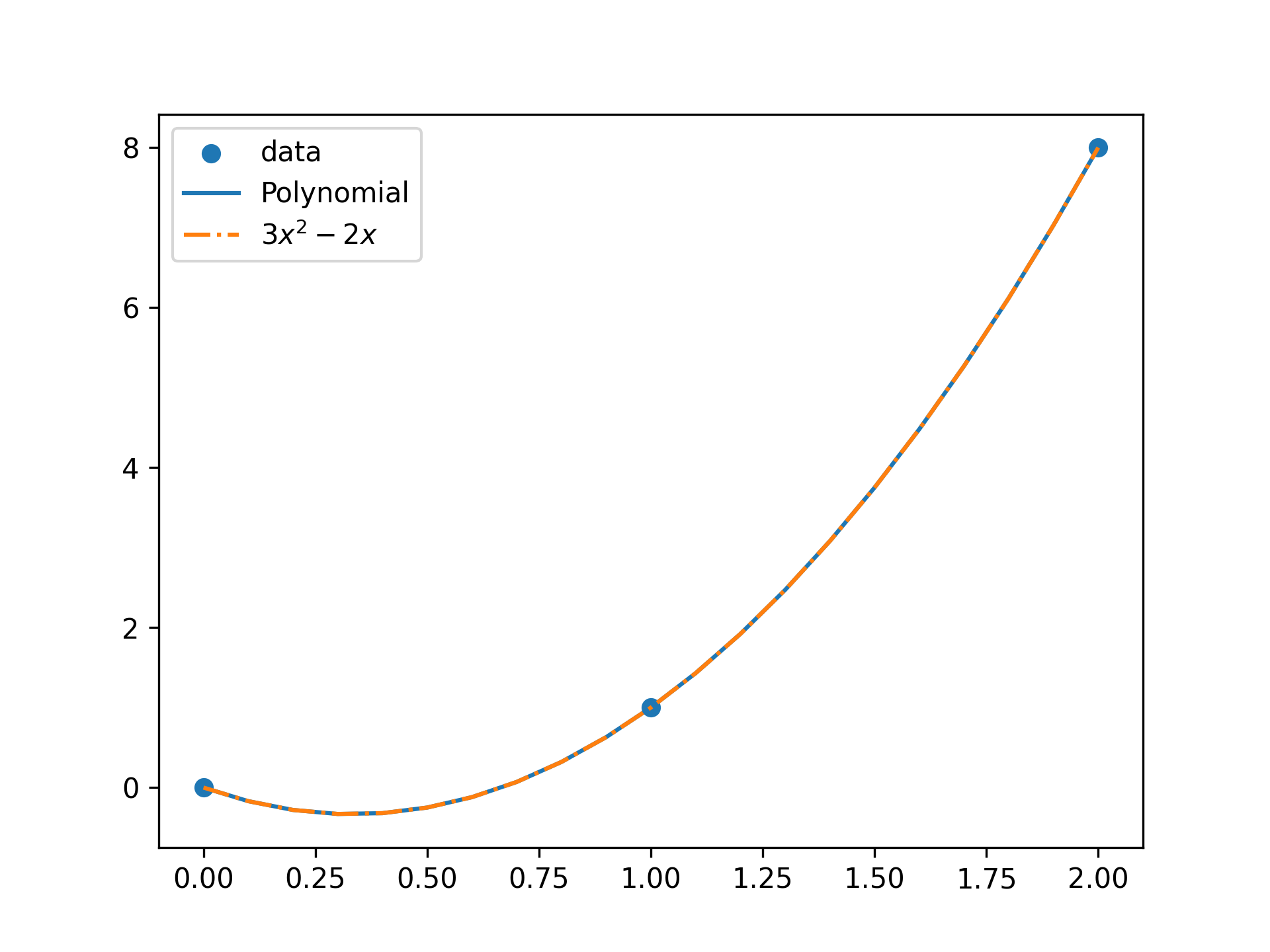
Interpolate :math:`f(x) = x^3` by 3 points.import numpy as np from scipy.interpolate import lagrange x = np.array([0, 1, 2]) y = x**3 poly = lagrange(x, y)✓
from numpy.polynomial.polynomial import Polynomial
Polynomial(poly.coef[::-1]).coef
✓
import matplotlib.pyplot as plt
x_new = np.arange(0, 2.1, 0.1)
✓
plt.scatter(x, y, label='data')
plt.plot(x_new, Polynomial(poly.coef[::-1])(x_new), label='Polynomial')
plt.plot(x_new, 3*x_new**2 - 2*x_new + 0*x_new,
         label=r"$3 x^2 - 2 x$", linestyle='-.')
plt.legend()
✗
plt.show()
✓
Aliases
scipy.interpolate.lagrange