bundles / scipy 1.17.1 / scipy / optimize / _zeros_py / newton
function
scipy.optimize._zeros_py:newton
source: /scipy/optimize/_zeros_py.py:109
Signature
def newton(func, x0, fprime = None, args = (), tol = 1.48e-08, maxiter = 50, fprime2 = None, x1 = None, rtol = 0.0, full_output = False, disp = True)Summary
Find a root of a real or complex function using the Newton-Raphson (or secant or Halley's) method.
Extended Summary
Find a root of the scalar-valued function func given a nearby scalar starting point x0. The Newton-Raphson method is used if the derivative fprime of func is provided, otherwise the secant method is used. If the second order derivative fprime2 of func is also provided, then Halley's method is used.
If x0 is a sequence with more than one item, newton returns an array: the roots of the function from each (scalar) starting point in x0. In this case, func must be vectorized to return a sequence or array of the same shape as its first argument. If fprime (fprime2) is given, then its return must also have the same shape: each element is the first (second) derivative of func with respect to its only variable evaluated at each element of its first argument.
newton is for finding roots of a scalar-valued functions of a single variable. For problems involving several variables, see root.
Parameters
func: callableThe function whose root is wanted. It must be a function of a single variable of the form
f(x,a,b,c,...), wherea,b,c,...are extra arguments that can be passed in theargsparameter.x0: float, sequence, or ndarrayAn initial estimate of the root that should be somewhere near the actual root. If not scalar, then
funcmust be vectorized and return a sequence or array of the same shape as its first argument.fprime: callable, optionalThe derivative of the function when available and convenient. If it is None (default), then the secant method is used.
args: tuple, optionalExtra arguments to be used in the function call.
tol: float, optionalThe allowable error of the root's value. If
funcis complex-valued, a largertolis recommended as both the real and imaginary parts ofxcontribute to|x - x0|.maxiter: int, optionalMaximum number of iterations.
fprime2: callable, optionalThe second order derivative of the function when available and convenient. If it is None (default), then the normal Newton-Raphson or the secant method is used. If it is not None, then Halley's method is used.
x1: float, optionalAnother estimate of the root that should be somewhere near the actual root. Used if
fprimeis not provided.rtol: float, optionalTolerance (relative) for termination.
full_output: bool, optionalIf
full_outputis False (default), the root is returned. If True andx0is scalar, the return value is(x, r), wherexis the root andris a RootResults object. If True andx0is non-scalar, the return value is(x, converged, zero_der)(see Returns section for details).disp: bool, optionalIf True, raise a RuntimeError if the algorithm didn't converge, with the error message containing the number of iterations and current function value. Otherwise, the convergence status is recorded in a RootResults return object. Ignored if
x0is not scalar. Note: this has little to do with displaying, however, the `disp` keyword cannot be renamed for backwards compatibility.
Returns
root: float, sequence, or ndarrayEstimated location where function is zero.
r: `RootResults`, optionalPresent if
full_output=Trueandx0is scalar. Object containing information about the convergence. In particular,r.convergedis True if the routine converged.converged: ndarray of bool, optionalPresent if
full_output=Trueandx0is non-scalar. For vector functions, indicates which elements converged successfully.zero_der: ndarray of bool, optionalPresent if
full_output=Trueandx0is non-scalar. For vector functions, indicates which elements had a zero derivative.
Notes
The convergence rate of the Newton-Raphson method is quadratic, the Halley method is cubic, and the secant method is sub-quadratic. This means that if the function is well-behaved the actual error in the estimated root after the nth iteration is approximately the square (cube for Halley) of the error after the (n-1)th step. However, the stopping criterion used here is the step size and there is no guarantee that a root has been found. Consequently, the result should be verified. Safer algorithms are brentq, brenth, ridder, and bisect, but they all require that the root first be bracketed in an interval where the function changes sign. The brentq algorithm is recommended for general use in one dimensional problems when such an interval has been found.
When newton is used with arrays, it is best suited for the following types of problems:
The initial guesses,
x0, are all relatively the same distance from the roots.Some or all of the extra arguments,
args, are also arrays so that a class of similar problems can be solved together.The size of the initial guesses,
x0, is larger than O(100) elements. Otherwise, a naive loop may perform as well or better than a vector.
Examples
import numpy as np
import matplotlib.pyplot as plt
from scipy import optimize
✓
def f(x):
    return (x**3 - 1)  # only one real root at x = 1
✓
root = optimize.newton(f, 1.5)
✓root
✗root = optimize.newton(f, 1.5, fprime2=lambda x: 6 * x)
✓root
✗root = optimize.newton(f, 1.5, fprime=lambda x: 3 * x**2)
✓root
✗root = optimize.newton(f, 1.5, fprime=lambda x: 3 * x**2, fprime2=lambda x: 6 * x)✓
root
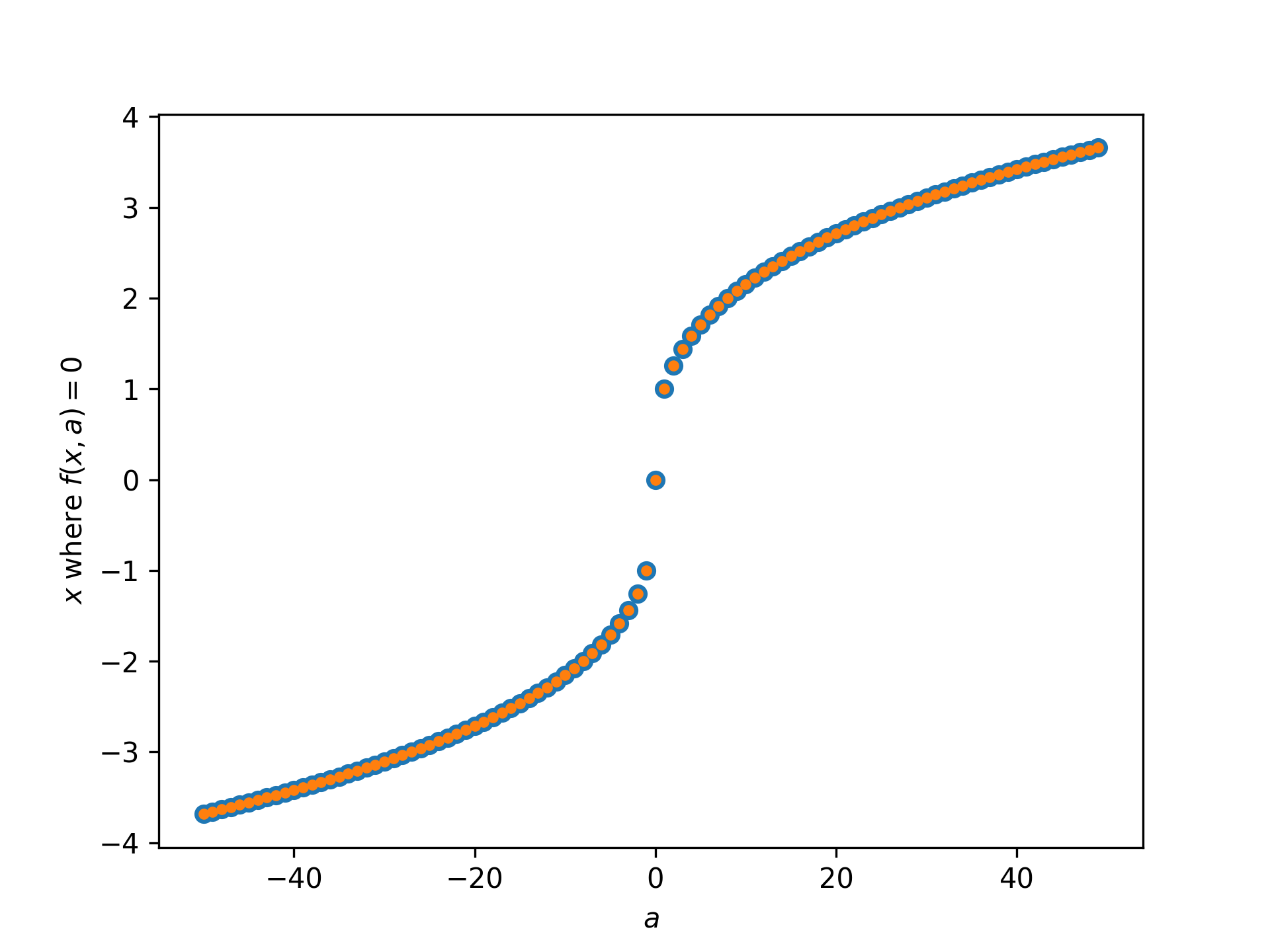
✗f = lambda x, a: x**3 - a fder = lambda x, a: 3 * x**2 rng = np.random.default_rng() x = rng.standard_normal(100) a = np.arange(-50, 50) vec_res = optimize.newton(f, x, fprime=fder, args=(a, ), maxiter=200)✓
loop_res = [optimize.newton(f, x0, fprime=fder, args=(a0,),
                            maxiter=200)
            for x0, a0 in zip(x, a)]
np.allclose(vec_res, loop_res)
✓
analytical_result = np.sign(a) * np.abs(a)**(1/3)
fig, ax = plt.subplots()
✓
ax.plot(a, analytical_result, 'o')
ax.plot(a, vec_res, '.')
ax.set_xlabel('$a$')
ax.set_ylabel('$x$ where $f(x, a)=0$')
✗
plt.show()
✓
See also
- root
interface to root solvers for multi-input, multi-output functions
- root_scalar
interface to root solvers for scalar functions
Aliases
scipy.optimize.newton