bundles / scipy 1.17.1 / scipy / signal / _fir_filter_design / firwin_2d
function
scipy.signal._fir_filter_design:firwin_2d
Signature
def firwin_2d(hsize, window, *, fc = None, fs = 2, circular = False, pass_zero = True, scale = True)Summary
2D FIR filter design using the window method.
Extended Summary
This function computes the coefficients of a 2D finite impulse response filter. The filter is separable with linear phase; it will be designed as a product of two 1D filters with dimensions defined by hsize. Additionally, it can create approximately circularly symmetric 2-D windows.
Parameters
hsize: tuple or list of length 2Lengths of the filter in each dimension.
hsize[0]specifies the number of coefficients in the row direction andhsize[1]specifies the number of coefficients in the column direction.window: tuple or list of length 2 or stringDesired window to use for each 1D filter or a single window type for creating circularly symmetric 2-D windows. Each element should be a string or tuple of string and parameter values. The generated windows will be symmetric, unless a suffix
'_periodic'is appended to the window name (e.g.,'hamming_perodic'). Consult get_window for a list of windows and required parameters.fc: float or 1-D array_like, optionalCutoff frequency of the filter in the same units as
fs. This defines the frequency at which the filter's gain drops to approximately -6 dB (half power) in a low-pass or high-pass filter. For multi-band filters,fccan be an array of cutoff frequencies (i.e., band edges) in the range [0, fs/2], with each band specified in pairs. Required ifcircularis False.fs: float, optionalThe sampling frequency of the signal. Default is 2.
circular: bool, optionalWhether to create a circularly symmetric 2-D window. Default is
False.pass_zero: {True, False, 'bandpass', 'lowpass', 'highpass', 'bandstop'}, optionalThis parameter is directly passed to firwin for each scalar frequency axis. Hence, if
True, the DC gain, i.e., the gain at frequency (0, 0), is 1. IfFalse, the DC gain is 0 at frequency (0, 0) ifcircularisTrue. IfcircularisFalsethe frequencies (0, f1) and (f0, 0) will have gain 0. It can also be a string argument for the desired filter type (equivalent tobtypein IIR design functions).scale: bool, optionalThis parameter is directly passed to firwin for each scalar frequency axis. Set to
Trueto scale the coefficients so that the frequency response is exactly unity at a certain frequency on one frequency axis. That frequency is either:0 (DC) if the first passband starts at 0 (i.e. pass_zero is
True)fs/2 (the Nyquist frequency) if the first passband ends atfs/2 (i.e., the filter is a single band highpass filter); center of first passband otherwise
Returns
filter_2d: (hsize[0], hsize[1]) ndarrayCoefficients of 2D FIR filter.
Raises
: ValueErrorIf
hsizeandwindoware not 2-element tuples or lists.If
cutoffis None whencircularis True.If
cutoffis outside the range [0,fs/2] andcircularisFalse.If any of the elements in
windoware not recognized.
: RuntimeErrorIf firwin fails to converge when designing the filter.
Notes
Array API Standard Support
firwin_2d has experimental support for Python Array API Standard compatible backends in addition to NumPy. Please consider testing these features by setting an environment variable SCIPY_ARRAY_API=1 and providing CuPy, PyTorch, JAX, or Dask arrays as array arguments. The following combinations of backend and device (or other capability) are supported.
====================  ====================  ====================
Library               CPU                   GPU
====================  ====================  ====================
NumPy                 ✅                     n/a
CuPy                  n/a                   ⛔
PyTorch               ⛔                     ⛔
JAX                   ⛔                     ⛔
Dask                  ⛔                     n/a
====================  ====================  ====================
See
dev-arrayapifor more information.
Examples
Generate a 5x5 low-pass filter with cutoff frequency 0.1:import numpy as np from scipy.signal import get_window from scipy.signal import firwin_2d hsize = (5, 5) window = (("kaiser", 5.0), ("kaiser", 5.0)) fc = 0.1 filter_2d = firwin_2d(hsize, window, fc=fc) filter_2d✓
filter_2d = firwin_2d((5, 5), 'hamming', fc=fc, circular=True)
filter_2d
✓
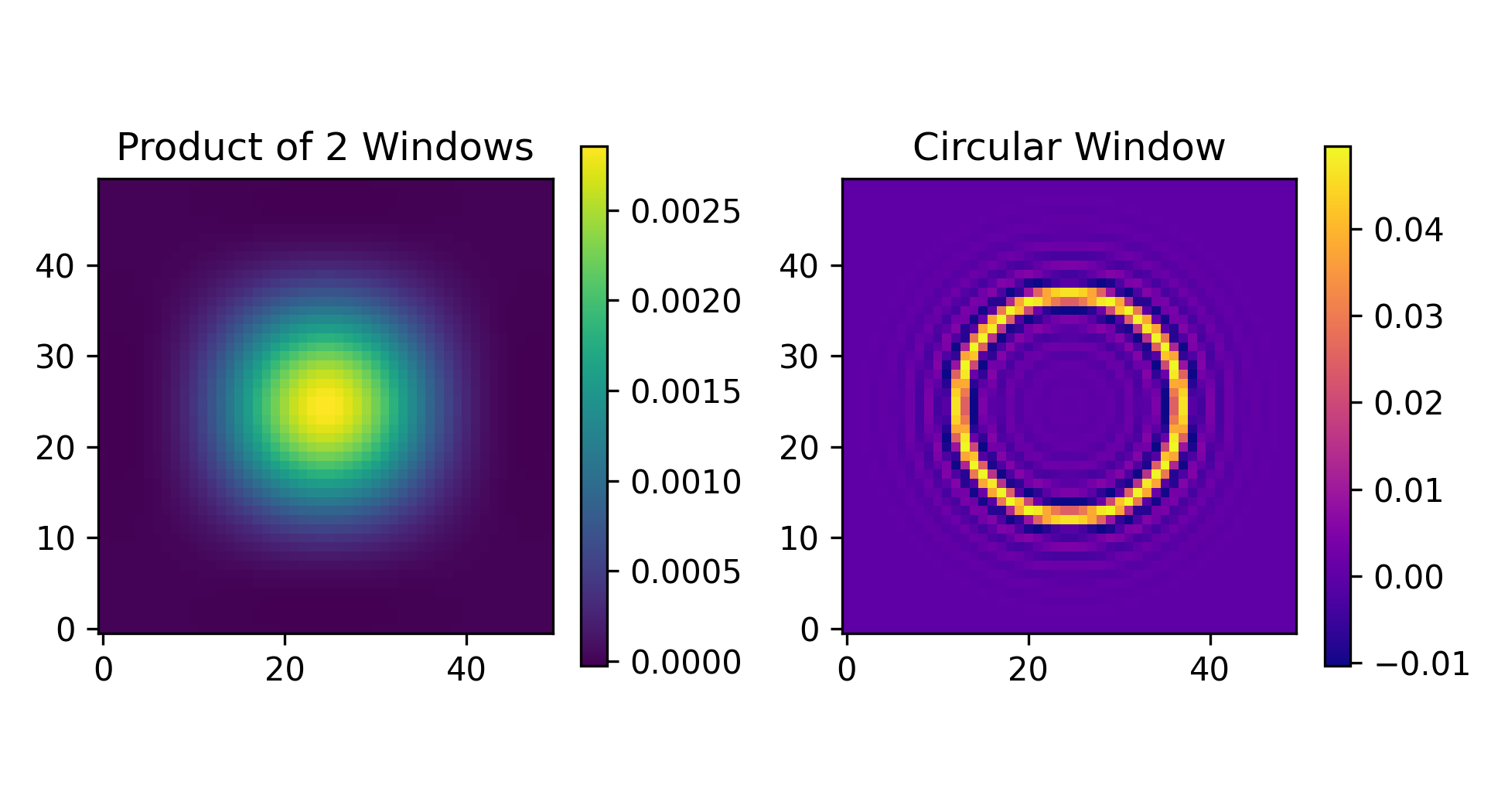
import matplotlib.pyplot as plt
hsize, fc = (50, 50), 0.05
window = (("kaiser", 5.0), ("kaiser", 5.0))
filter0_2d = firwin_2d(hsize, window, fc=fc)
filter1_2d = firwin_2d((50, 50), 'hamming', fc=fc, circular=True)
fg, (ax0, ax1) = plt.subplots(1, 2, tight_layout=True, figsize=(6.5, 3.5))
✓
ax0.set_title("Product of 2 Windows")
✗im0 = ax0.imshow(filter0_2d, cmap='viridis', origin='lower', aspect='equal')
✓fg.colorbar(im0, ax=ax0, shrink=0.7) ax1.set_title("Circular Window")✗
im1 = ax1.imshow(filter1_2d, cmap='plasma', origin='lower', aspect='equal')
✓fg.colorbar(im1, ax=ax1, shrink=0.7)
✗plt.show()
✓
See also
- firwin
FIR filter design using the window method for 1d arrays.
- get_window
Return a window of a given length and type.
Aliases
scipy.signal.firwin_2d