bundles / scipy 1.17.1 / scipy / signal / _lti_conversion / cont2discrete
function
scipy.signal._lti_conversion:cont2discrete
Signature
def cont2discrete(system, dt, method = zoh, alpha = None)Summary
Transform a continuous to a discrete state-space system.
Parameters
system: a tuple describing the system or an instance of `lti`The following gives the number of elements in the tuple and the interpretation:
1: (instance of lti)
2: (num, den)
3: (zeros, poles, gain)
4: (A, B, C, D)
dt: floatThe discretization time step.
method: str, optionalWhich method to use:
gbt: generalized bilinear transformation
bilinear: Tustin's approximation ("gbt" with alpha=0.5)
euler: Euler (or forward differencing) method ("gbt" with alpha=0)
backward_diff: Backwards differencing ("gbt" with alpha=1.0)
zoh: zero-order hold (default)
foh: first-order hold (versionadded: 1.3.0)
impulse: equivalent impulse response (versionadded: 1.3.0)
alpha: float within [0, 1], optionalThe generalized bilinear transformation weighting parameter, which should only be specified with method="gbt", and is ignored otherwise
Returns
sysd: tuple containing the discrete systemBased on the input type, the output will be of the form
(num, den, dt) for transfer function input
(zeros, poles, gain, dt) for zeros-poles-gain input
(A, B, C, D, dt) for state-space system input
Notes
By default, the routine uses a Zero-Order Hold (zoh) method to perform the transformation. Alternatively, a generalized bilinear transformation may be used, which includes the common Tustin's bilinear approximation, an Euler's method technique, or a backwards differencing technique.
The Zero-Order Hold (zoh) method is based on [1], the generalized bilinear approximation is based on [2] and [3], the First-Order Hold (foh) method is based on [4].
Array API Standard Support
cont2discrete has experimental support for Python Array API Standard compatible backends in addition to NumPy. Please consider testing these features by setting an environment variable SCIPY_ARRAY_API=1 and providing CuPy, PyTorch, JAX, or Dask arrays as array arguments. The following combinations of backend and device (or other capability) are supported.
====================  ====================  ====================
Library               CPU                   GPU
====================  ====================  ====================
NumPy                 ✅                     n/a
CuPy                  n/a                   ✅
PyTorch               ⛔                     ⛔
JAX                   ⛔                     ⛔
Dask                  ⛔                     n/a
====================  ====================  ====================
See
dev-arrayapifor more information.
Examples
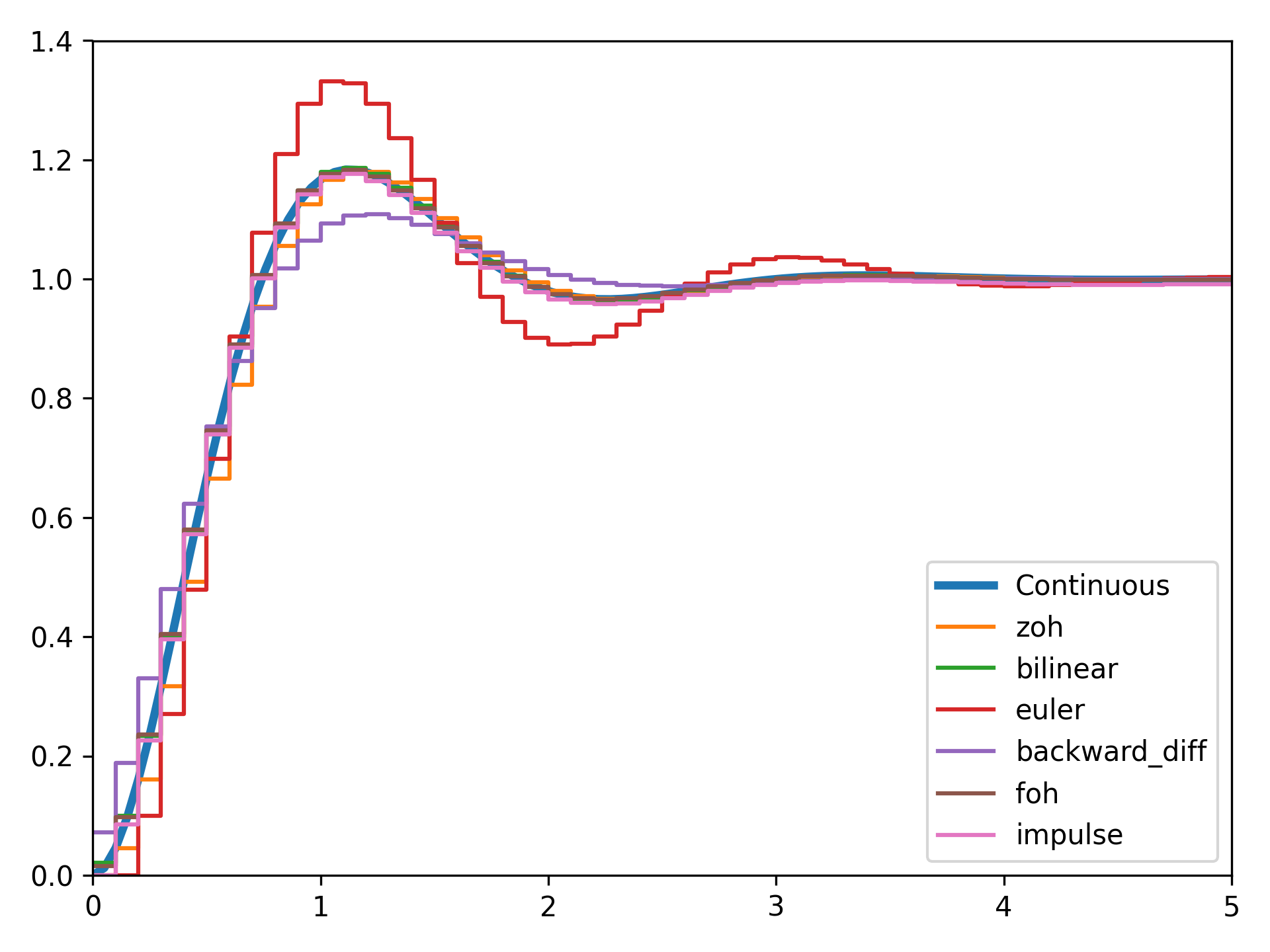
We can transform a continuous state-space system to a discrete one:import numpy as np import matplotlib.pyplot as plt from scipy.signal import cont2discrete, lti, dlti, dstep✓
A = np.array([[0, 1],[-10., -3]])
B = np.array([[0],[10.]])
C = np.array([[1., 0]])
D = np.array([[0.]])
l_system = lti(A, B, C, D)
t, x = l_system.step(T=np.linspace(0, 5, 100))
fig, ax = plt.subplots()
✓
ax.plot(t, x, label='Continuous', linewidth=3)
✗dt = 0.1
✓for method in ['zoh', 'bilinear', 'euler', 'backward_diff', 'foh', 'impulse']: d_system = cont2discrete((A, B, C, D), dt, method=method) s, x_d = dstep(d_system) ax.step(s, np.squeeze(x_d), label=method, where='post') ax.axis([t[0], t[-1], x[0], 1.4]) ax.legend(loc='best')✗
fig.tight_layout()
plt.show()
✓
Aliases
scipy.signal.cont2discrete