bundles / scipy 1.17.1 / scipy / signal / _spline_filters / cspline1d
function
scipy.signal._spline_filters:cspline1d
Signature
def cspline1d(signal, lamb = 0.0)Summary
Compute cubic spline coefficients for rank-1 array.
Extended Summary
Find the cubic spline coefficients for a 1-D signal assuming mirror-symmetric boundary conditions. To obtain the signal back from the spline representation mirror-symmetric-convolve these coefficients with a length 3 FIR window [1.0, 4.0, 1.0]/ 6.0 .
Parameters
signal: ndarrayA rank-1 array representing samples of a signal.
lamb: float, optionalSmoothing coefficient, default is 0.0.
Returns
c: ndarrayCubic spline coefficients.
Notes
Array API Standard Support
cspline1d has experimental support for Python Array API Standard compatible backends in addition to NumPy. Please consider testing these features by setting an environment variable SCIPY_ARRAY_API=1 and providing CuPy, PyTorch, JAX, or Dask arrays as array arguments. The following combinations of backend and device (or other capability) are supported.
====================  ====================  ====================
Library               CPU                   GPU
====================  ====================  ====================
NumPy                 ✅                     n/a
CuPy                  n/a                   ✅
PyTorch               ✅                     ⛔
JAX                   ⚠️ no JIT             ⛔
Dask                  ⚠️ computes graph     n/a
====================  ====================  ====================
See
dev-arrayapifor more information.
Examples
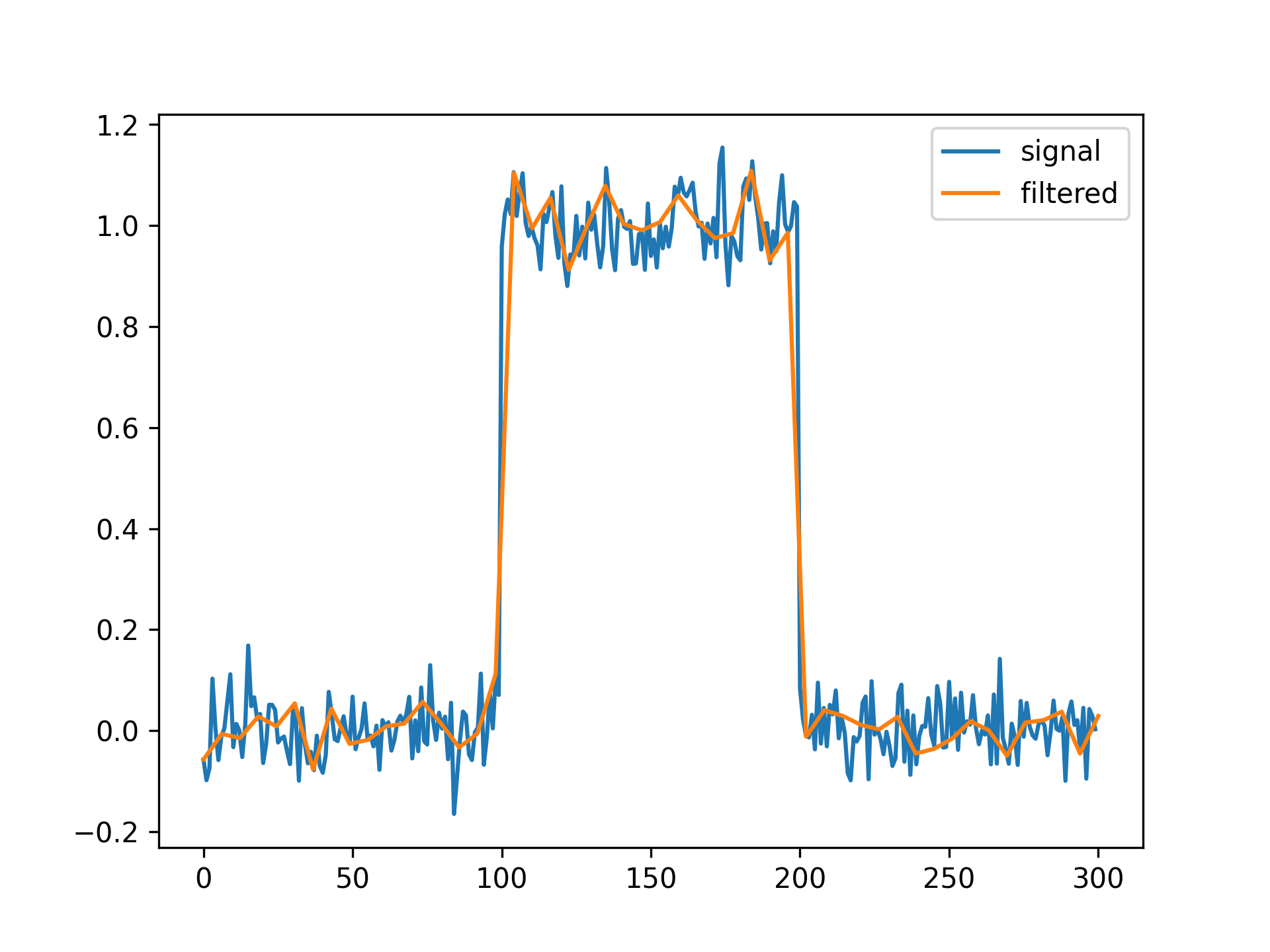
We can filter a signal to reduce and smooth out high-frequency noise with a cubic spline:import numpy as np import matplotlib.pyplot as plt from scipy.signal import cspline1d, cspline1d_eval rng = np.random.default_rng() sig = np.repeat([0., 1., 0.], 100) sig += rng.standard_normal(len(sig))*0.05 # add noise time = np.linspace(0, len(sig)) filtered = cspline1d_eval(cspline1d(sig), time)✓
plt.plot(sig, label="signal")
plt.plot(time, filtered, label="filtered")
plt.legend()
✗
plt.show()
✓
See also
- cspline1d_eval
Evaluate a cubic spline at the new set of points.
Aliases
scipy.signal.cspline1d