bundles / scipy 1.17.1 / scipy / spatial / _kdtree / KDTree / query_ball_point
function
scipy.spatial._kdtree:KDTree.query_ball_point
source: /scipy/spatial/_kdtree.py:486
Signature
def query_ball_point(self, x, r, p = 2.0, eps = 0.0, workers = 1, return_sorted = None, return_length = False)Summary
Find all points within distance r of point(s) x.
Parameters
x: array_like, shape tuple + (self.m,)The point or points to search for neighbors of.
r: array_like, floatThe radius of points to return, must broadcast to the length of x.
p: float, optionalWhich Minkowski p-norm to use. Should be in the range [1, inf]. A finite large p may cause a ValueError if overflow can occur.
eps: nonnegative float, optionalApproximate search. Branches of the tree are not explored if their nearest points are further than
r / (1 + eps), and branches are added in bulk if their furthest points are nearer thanr * (1 + eps).workers: int, optionalNumber of jobs to schedule for parallel processing. If -1 is given all processors are used. Default: 1.
return_sorted: bool, optionalSorts returned indices if True and does not sort them if False. If None, does not sort single point queries, but does sort multi-point queries which was the behavior before this option was added.
return_length: bool, optionalReturn the number of points inside the radius instead of a list of the indices.
Returns
results: list or array of listsIf
xis a single point, returns a list of the indices of the neighbors ofx. Ifxis an array of points, returns an object array of shape tuple containing lists of neighbors.
Notes
If you have many points whose neighbors you want to find, you may save substantial amounts of time by putting them in a KDTree and using query_ball_tree.
Examples
import numpy as np
from scipy import spatial
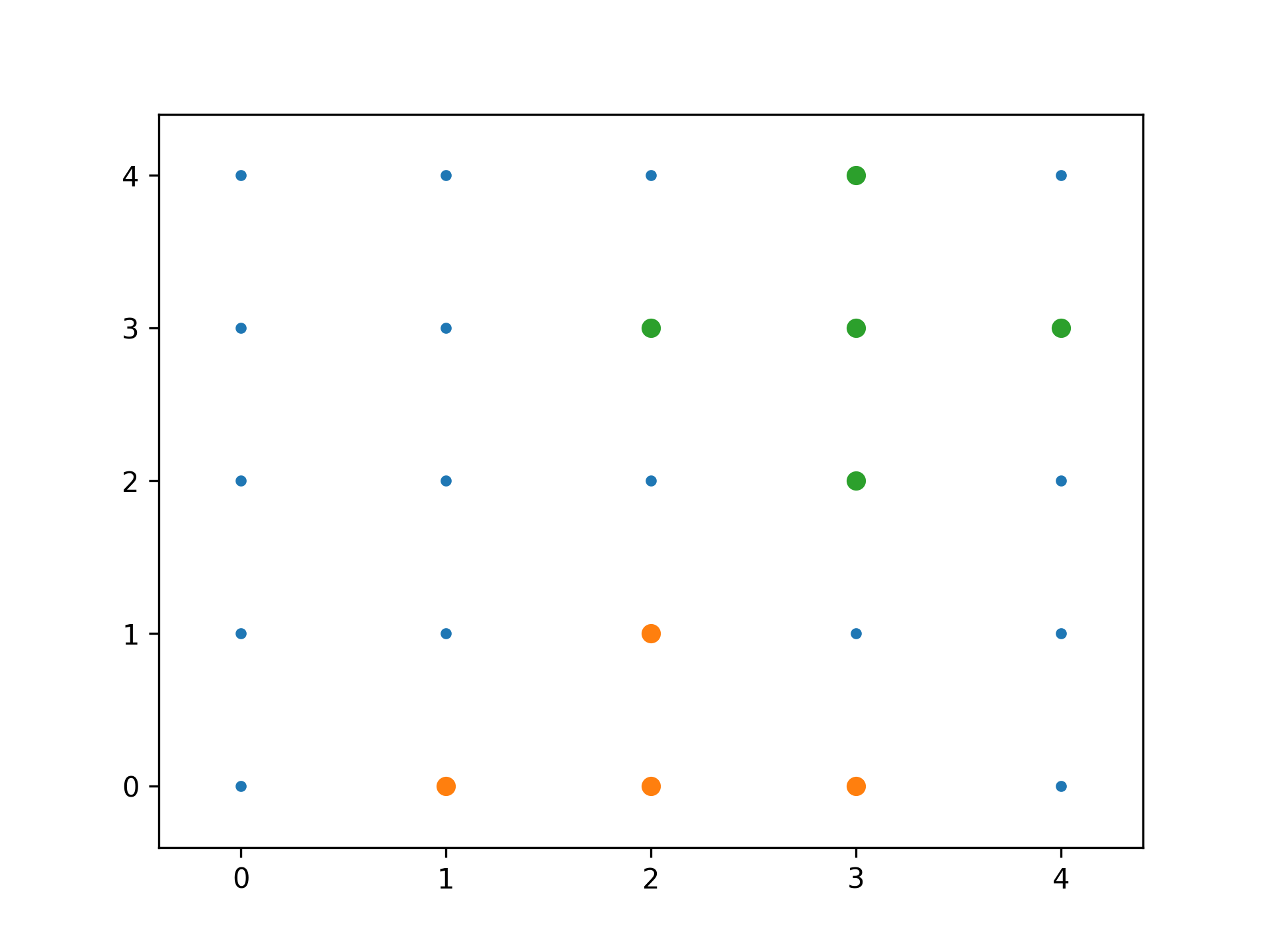
x, y = np.mgrid[0:5, 0:5]
points = np.c_[x.ravel(), y.ravel()]
tree = spatial.KDTree(points)
sorted(tree.query_ball_point([2, 0], 1))
✓
import matplotlib.pyplot as plt
points = np.asarray(points)
✓
plt.plot(points[:,0], points[:,1], '.')
for results in tree.query_ball_point(([2, 0], [3, 3]), 1):
    nearby_points = points[results]
    plt.plot(nearby_points[:,0], nearby_points[:,1], 'o')
✗
plt.margins(0.1, 0.1)
plt.show()
✓
Aliases
scipy.spatial.KDTree.query_ball_point