bundles / scipy 1.17.1 / scipy / special / _spherical_bessel / spherical_yn
function
scipy.special._spherical_bessel:spherical_yn
Signature
def spherical_yn(n, z, derivative = False)Summary
Spherical Bessel function of the second kind or its derivative.
Extended Summary
Defined as [1],
where is the Bessel function of the second kind.
Parameters
n: int, array_likeOrder of the Bessel function (n >= 0).
z: complex or float, array_likeArgument of the Bessel function.
derivative: bool, optionalIf True, the value of the derivative (rather than the function itself) is returned.
Returns
yn: ndarray
Notes
For real arguments, the function is computed using the ascending recurrence [2]. For complex arguments, the definitional relation to the cylindrical Bessel function of the second kind is used.
The derivative is computed using the relations [3],
Examples
The spherical Bessel functions of the second kind :math:`y_n` accept both real and complex second argument. They can return a complex type:from scipy.special import spherical_yn
✓spherical_yn(0, 3+5j)
✗type(spherical_yn(0, 3+5j))
✓import numpy as np x = np.arange(1.0, 2.0, 0.01) np.allclose(spherical_yn(3, x, True), spherical_yn(2, x) - 4/x * spherical_yn(3, x))✓
import matplotlib.pyplot as plt
x = np.arange(0.0, 10.0, 0.01)
fig, ax = plt.subplots()
✓
ax.set_ylim(-2.0, 1.0)
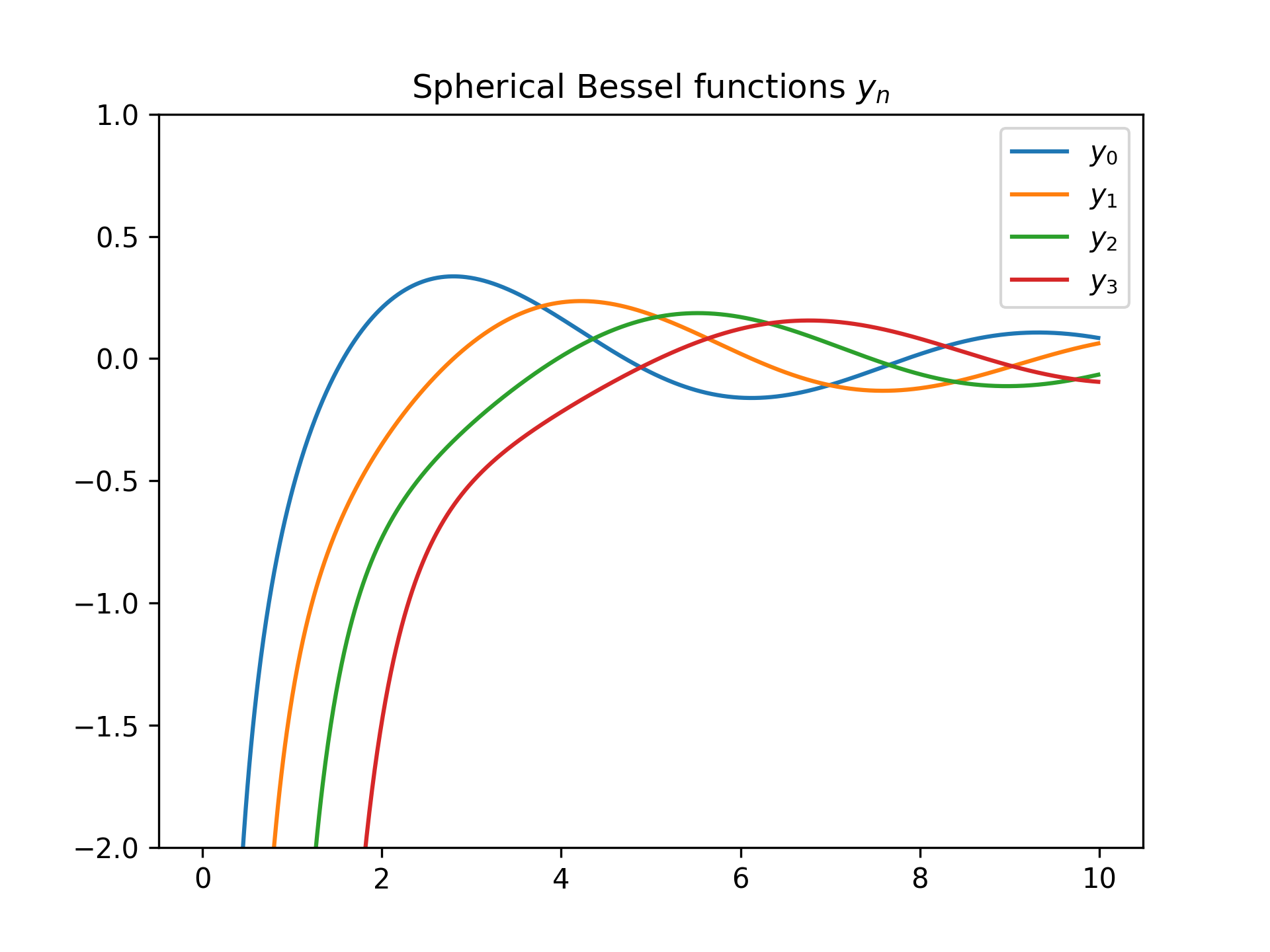
ax.set_title(r'Spherical Bessel functions $y_n$')
for n in np.arange(0, 4):
    ax.plot(x, spherical_yn(n, x), label=rf'$y_{n}$')
plt.legend(loc='best')
✗
plt.show()
✓
Aliases
scipy.special.spherical_yn