bundles / scipy 1.17.1 / scipy / stats / _sensitivity_analysis / sobol_indices
function
scipy.stats._sensitivity_analysis:sobol_indices
Signature
def sobol_indices(*, func, n, dists = None, method = saltelli_2010, rng = None, random_state = None)Summary
Global sensitivity indices of Sobol'.
Parameters
func: callable or dict(str, array_like)If
funcis a callable, function to compute the Sobol' indices from. Its signature must befunc(x: ArrayLike) -> ArrayLikewith
xof shape(d, n)and output of shape(s, n)where:dis the input dimensionality offunc(number of input variables),sis the output dimensionality offunc(number of output variables), andnis the number of samples (seenbelow).
Function evaluation values must be finite.
If
funcis a dictionary, contains the function evaluations from three different arrays. Keys must be:f_A,f_Bandf_AB.f_Aandf_Bshould have a shape(s, n)andf_ABshould have a shape(d, s, n). This is an advanced feature and misuse can lead to wrong analysis.n: intNumber of samples used to generate the matrices
AandB. Must be a power of 2. The total number of points at whichfuncis evaluated will ben*(d+2).dists: list(distributions), optionalList of each parameter's distribution. The distribution of parameters depends on the application and should be carefully chosen. Parameters are assumed to be independently distributed, meaning there is no constraint nor relationship between their values.
Distributions must be an instance of a class with a
ppfmethod.Must be specified if
funcis a callable, and ignored otherwise.method: Callable or str, default: 'saltelli_2010'Method used to compute the first and total Sobol' indices.
If a callable, its signature must be
func(f_A: np.ndarray, f_B: np.ndarray, f_AB: np.ndarray)
-> Tuple[np.ndarray, np.ndarray]
with
f_A, f_Bof shape(s, n)andf_ABof shape(d, s, n). These arrays contain the function evaluations from three different sets of samples. The output is a tuple of the first and total indices with shape(s, d). This is an advanced feature and misuse can lead to wrong analysis.rng: `numpy.random.Generator`, optionalPseudorandom number generator state. When
rngis None, a new numpy.random.Generator is created using entropy from the operating system. Types other than numpy.random.Generator are passed to numpy.random.default_rng to instantiate aGenerator.
Returns
res: SobolResultAn object with attributes:
first_order
first_order
total_order
total_order
And method:
bootstrap(confidence_level: float, n_resamples: int) -> BootstrapSobolResult
A method providing confidence intervals on the indices. See scipy.stats.bootstrap for more details.
The bootstrapping is done on both first and total order indices, and they are available in BootstrapSobolResult as attributes
first_orderandtotal_order.
Notes
The Sobol' method [1], [2] is a variance-based Sensitivity Analysis which obtains the contribution of each parameter to the variance of the quantities of interest (QoIs; i.e., the outputs of func). Respective contributions can be used to rank the parameters and also gauge the complexity of the model by computing the model's effective (or mean) dimension.
It uses a functional decomposition of the variance of the function to explore
introducing conditional variances:
Sobol' indices are expressed as
corresponds to the first-order term which apprises the contribution of the i-th parameter, while corresponds to the second-order term which informs about the contribution of interactions between the i-th and the j-th parameters. These equations can be generalized to compute higher order terms; however, they are expensive to compute and their interpretation is complex. This is why only first order indices are provided.
Total order indices represent the global contribution of the parameters to the variance of the QoI and are defined as:
First order indices sum to at most 1, while total order indices sum to at least 1. If there are no interactions, then first and total order indices are equal, and both first and total order indices sum to 1.
Array API Standard Support
sobol_indices has experimental support for Python Array API Standard compatible backends in addition to NumPy. Please consider testing these features by setting an environment variable SCIPY_ARRAY_API=1 and providing CuPy, PyTorch, JAX, or Dask arrays as array arguments. The following combinations of backend and device (or other capability) are supported.
====================  ====================  ====================
Library               CPU                   GPU
====================  ====================  ====================
NumPy                 ✅                     n/a
CuPy                  n/a                   ⛔
PyTorch               ⛔                     ⛔
JAX                   ⛔                     ⛔
Dask                  ⛔                     n/a
====================  ====================  ====================
See
dev-arrayapifor more information.
Examples
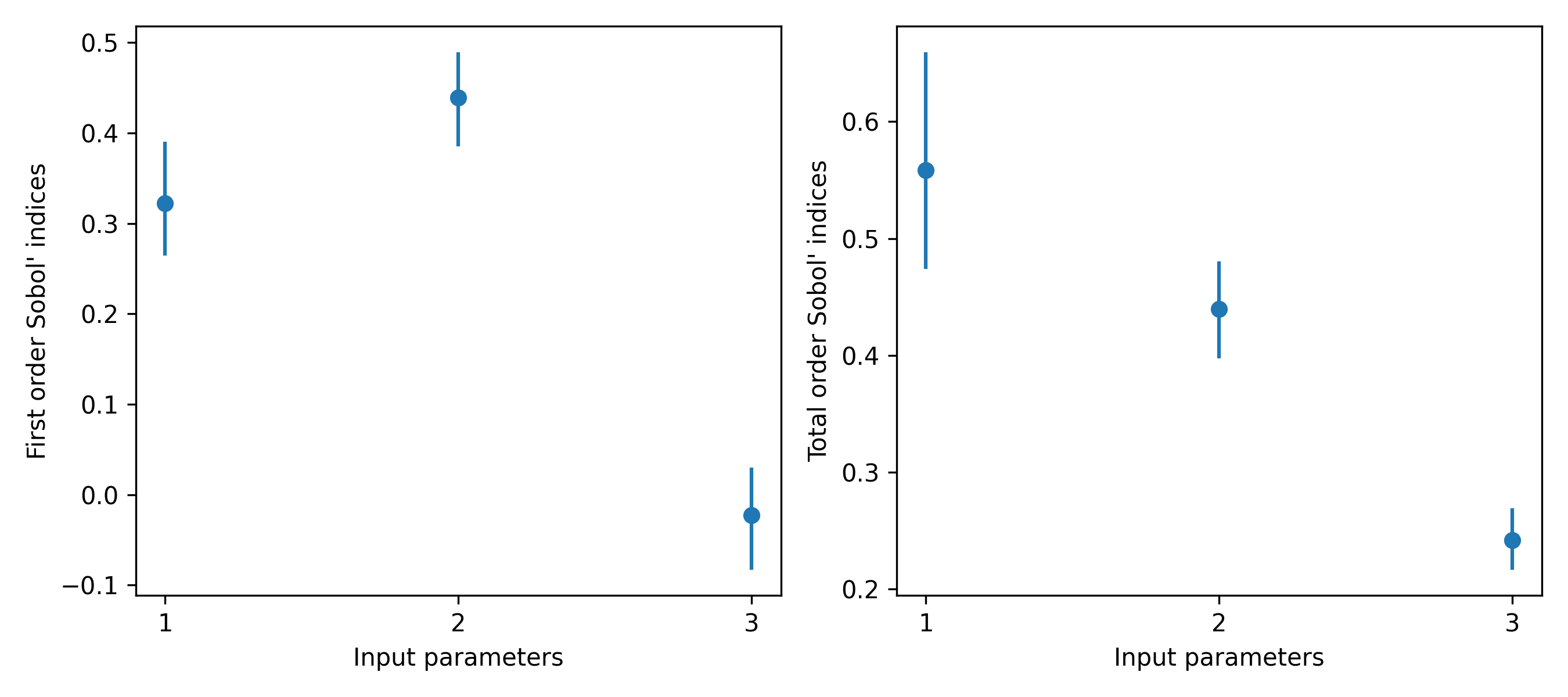
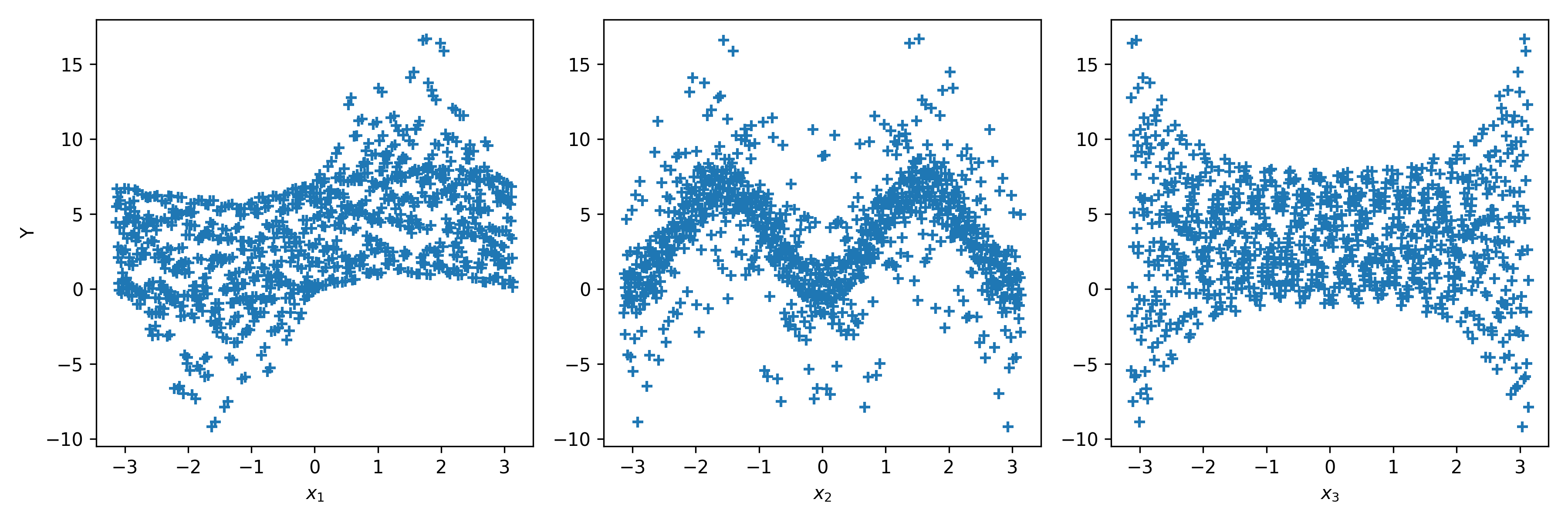
The following is an example with the Ishigami function [6]_ .. math:: Y(\mathbf{x}) = \sin x_1 + 7 \sin^2 x_2 + 0.1 x_3^4 \sin x_1, with :math:`\mathbf{x} \in [-\pi, \pi]^3`. This function exhibits strong non-linearity and non-monotonicity. Remember, Sobol' indices assumes that samples are independently distributed. In this case we use a uniform distribution on each marginals.import numpy as np from scipy.stats import sobol_indices, uniform rng = np.random.default_rng() def f_ishigami(x): f_eval = ( np.sin(x[0]) + 7 * np.sin(x[1])**2 + 0.1 * (x[2]**4) * np.sin(x[0]) ) return f_eval indices = sobol_indices( func=f_ishigami, n=1024, dists=[ uniform(loc=-np.pi, scale=2*np.pi), uniform(loc=-np.pi, scale=2*np.pi), uniform(loc=-np.pi, scale=2*np.pi) ], rng=rng )✓
indices.first_order
indices.total_order
✗
boot = indices.bootstrap()
✓import matplotlib.pyplot as plt fig, axs = plt.subplots(1, 2, figsize=(9, 4)) _ = axs[0].errorbar( [1, 2, 3], indices.first_order, fmt='o', yerr=[ indices.first_order - boot.first_order.confidence_interval.low, boot.first_order.confidence_interval.high - indices.first_order ], )✓
axs[0].set_ylabel("First order Sobol' indices")
axs[0].set_xlabel('Input parameters')
axs[0].set_xticks([1, 2, 3])
✗
_ = axs[1].errorbar(
    [1, 2, 3], indices.total_order, fmt='o',
    yerr=[
        indices.total_order - boot.total_order.confidence_interval.low,
        boot.total_order.confidence_interval.high - indices.total_order
    ],
)
✓
axs[1].set_ylabel("Total order Sobol' indices")
axs[1].set_xlabel('Input parameters')
axs[1].set_xticks([1, 2, 3])
✗
plt.tight_layout()
plt.show()
✓
from scipy.stats import qmc
n_dim = 3
p_labels = ['$x_1$', '$x_2$', '$x_3$']
sample = qmc.Sobol(d=n_dim, seed=rng).random(1024)
sample = qmc.scale(
    sample=sample,
    l_bounds=[-np.pi, -np.pi, -np.pi],
    u_bounds=[np.pi, np.pi, np.pi]
)
output = f_ishigami(sample.T)
✓
fig, ax = plt.subplots(1, n_dim, figsize=(12, 4))
✓for i in range(n_dim): xi = sample[:, i] ax[i].scatter(xi, output, marker='+') ax[i].set_xlabel(p_labels[i]) ax[0].set_ylabel('Y')✗
plt.tight_layout()
plt.show()
✓
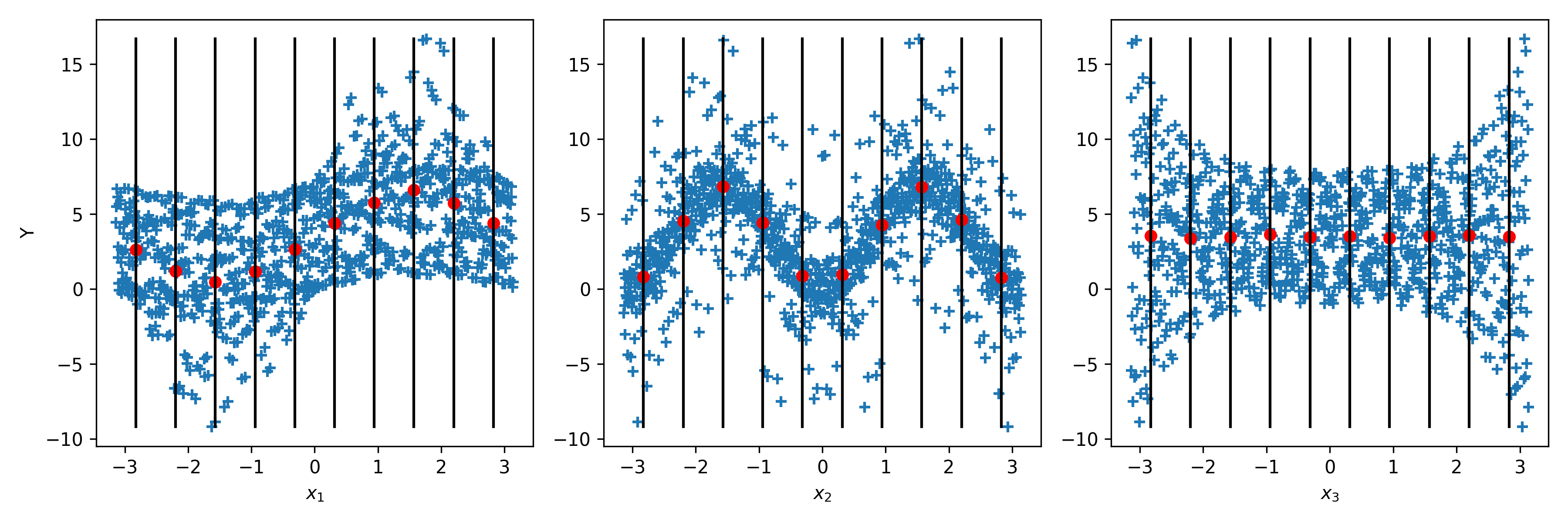
mini = np.min(output)
maxi = np.max(output)
n_bins = 10
bins = np.linspace(-np.pi, np.pi, num=n_bins, endpoint=False)
dx = bins[1] - bins[0]
fig, ax = plt.subplots(1, n_dim, figsize=(12, 4))
✓
for i in range(n_dim):
    xi = sample[:, i]
    ax[i].scatter(xi, output, marker='+')
    ax[i].set_xlabel(p_labels[i])
    for bin_ in bins:
        idx = np.where((bin_ <= xi) & (xi <= bin_ + dx))
        xi_ = xi[idx]
        y_ = output[idx]
        ave_y_ = np.mean(y_)
        ax[i].plot([bin_ + dx/2] * 2, [mini, maxi], c='k')
        ax[i].scatter(bin_ + dx/2, ave_y_, c='r')
ax[0].set_ylabel('Y')
✗
plt.tight_layout()
plt.show()
✓
Aliases
scipy.stats.sobol_indices