bundles / scipy 1.18.0 / scipy / spatial / transform / _rotation / Rotation
class
scipy.spatial.transform._rotation:Rotation
Signature
class Rotation(quat: ArrayLike, normalize: bool = True, copy: bool = True, scalar_first: bool = False)Members
__bool____getitem____getstate____init____iter____len____mul____pow____repr____setitem____setstate___from_raw_quatalign_vectorsapplyapprox_equalas_davenportas_euleras_matrixas_mrpas_quatas_rotvecconcatenatecreate_groupfrom_davenportfrom_eulerfrom_matrixfrom_mrpfrom_quatfrom_rotvecidentityinvmagnitudemeanrandomreduce
Summary
Rotation in 3 dimensions.
Extended Summary
This class provides an interface to initialize from and represent rotations with:
Quaternions
Rotation Matrices
Rotation Vectors
Modified Rodrigues Parameters
Euler Angles
Davenport Angles (Generalized Euler Angles)
The following operations on rotations are supported:
Application on vectors
Rotation Composition
Rotation Inversion
Rotation Indexing
A Rotation instance can contain a single rotation transform or rotations of multiple leading dimensions. E.g., it is possible to have an N-dimensional array of (N, M, K) rotations. When applied to other rotations or vectors, standard broadcasting rules apply.
Indexing within a rotation is supported to access a subset of the rotations stored in a Rotation instance.
To create Rotation objects use from_... methods (see examples below). Rotation(...) is not supposed to be instantiated directly.
Parameters
quat: array_like, shape (..., 4)Quaternion representing the rotation.
normalize: bool, optionalIf True, orthonormalize the rotation matrix using singular value decomposition. If False, the rotation matrix is not checked for orthogonality or right-handedness.
copy: bool, optionalIf True, copy the input matrix. If False, a reference to the input matrix is used. If normalize is True, the input matrix is always copied regardless of the value of copy.
scalar_first: bool, optionalIf
Truethenquatis expect in scalar-first format otherwise it is expected in scalar-last format. Defaults toFalse.
Attributes
single
Methods
__len__from_quatfrom_matrixfrom_rotvecfrom_mrpfrom_eulerfrom_davenportas_quatas_matrixas_rotvecas_mrpas_euleras_davenportconcatenateapply__mul____pow__invmagnitudeapprox_equalmeanreducecreate_group__getitem__identityrandomalign_vectors
Notes
Array API Standard Support
Rotation has experimental support for Python Array API Standard compatible backends in addition to NumPy. Please consider testing these features by setting an environment variable SCIPY_ARRAY_API=1 and providing CuPy, PyTorch, JAX, or Dask arrays as array arguments. The following combinations of backend and device (or other capability) are supported.
====================  ====================  ====================
Library               CPU                   GPU
====================  ====================  ====================
NumPy                 ✅                     n/a
CuPy                  n/a                   ✅
PyTorch               ✅                     ✅
JAX                   ✅                     ✅
Dask                  ⛔                     n/a
====================  ====================  ====================
The methods as_davenport, apply, and align_vectors are not supported with cupy<14.*.
See dev-arrayapi for more information.
Examples
from scipy.spatial.transform import Rotation as R
import numpy as np
✓
r = R.from_quat([0, 0, np.sin(np.pi/4), np.cos(np.pi/4)])
✓r.as_matrix() r.as_rotvec() r.as_euler('zyx', degrees=True)✗
array([90., 0., -0.])The same rotation can be initialized using a rotation matrix:
r = R.from_matrix([[0, -1, 0],
                   [1, 0, 0],
                   [0, 0, 1]])
✓
r.as_quat()
r.as_rotvec()
r.as_euler('zyx', degrees=True)
✗
array([90., 0., -0.])The rotation vector corresponding to this rotation is given by:
r = R.from_rotvec(np.pi/2 * np.array([0, 0, 1]))
✓r.as_quat() r.as_matrix() r.as_euler('zyx', degrees=True)✗
array([90., 0., -0.])The ``from_euler`` method is quite flexible in the range of input formats it supports. Here we initialize a single rotation about a single axis:
r = R.from_euler('z', 90, degrees=True)
✓r.as_quat() r.as_matrix() r.as_rotvec()✗
array([0. , 0. , 1.5708])It is also possible to initialize multiple rotations in a single instance using any of the ``from_...`` functions. Here we initialize a stack of 3 rotations using the ``from_euler`` method:
r = R.from_euler('zyx', [
[90, 0, 0],
[0, 45, 0],
[45, 60, 30]], degrees=True)
✓
r.as_quat()
✗array([[0. , 0. , 0.70711, 0.70711],
[0. , 0.38268, 0. , 0.92388],
[0.3919 , 0.36042, 0.43968, 0.72332]])
Applying the above rotations onto a vector:
v = [1, 2, 3]
✓r.apply(v)
✗array([[-2. , 1. , 3. ],
[ 2.82843, 2. , 1.41421],
[ 2.24452, 0.78093, 2.89003]])
A `Rotation` instance can be indexed and sliced as if it were an ND array:
r.as_quat()
✗array([[0. , 0. , 0.70711, 0.70711],
[0. , 0.38268, 0. , 0.92388],
[0.3919 , 0.36042, 0.43968, 0.72332]])
p = r[0]
✓p.as_matrix()
✗array([[ 0., -1., 0.],
[ 1., 0., 0.],
[ 0., 0., 1.]])
q = r[1:3]
✓q.as_quat()
✗array([[0. , 0.38268, 0. , 0.92388],
[0.3919 , 0.36042, 0.43968, 0.72332]])
In fact it can be converted to numpy.array:
r_array = np.asarray(r)
r_array.shape
✓
(3,)
r_array[0].as_matrix()
✗array([[ 0., -1., 0.],
[ 1., 0., 0.],
[ 0., 0., 1.]])
Multiple rotations can be composed using the ``*`` operator:
r1 = R.from_euler('z', 90, degrees=True)
r2 = R.from_rotvec([np.pi/4, 0, 0])
v = [1, 2, 3]
✓
r2.apply(r1.apply(v))
✗array([-2. , -1.41421, 2.82843])
r3 = r2 * r1 # Note the order
✓r3.apply(v)
✗array([-2. , -1.41421, 2.82843])A rotation can be composed with itself using the ``**`` operator:
p = R.from_rotvec([1, 0, 0])
q = p ** 2
q.as_rotvec()
✓
array([2., 0., 0.])Finally, it is also possible to invert rotations:
r1 = R.from_euler('z', [[90], [45]], degrees=True)
r2 = r1.inv()
✓
r2.as_euler('zyx', degrees=True)
✗array([[-90., 0., -0.],
[-45., 0., -0.]])
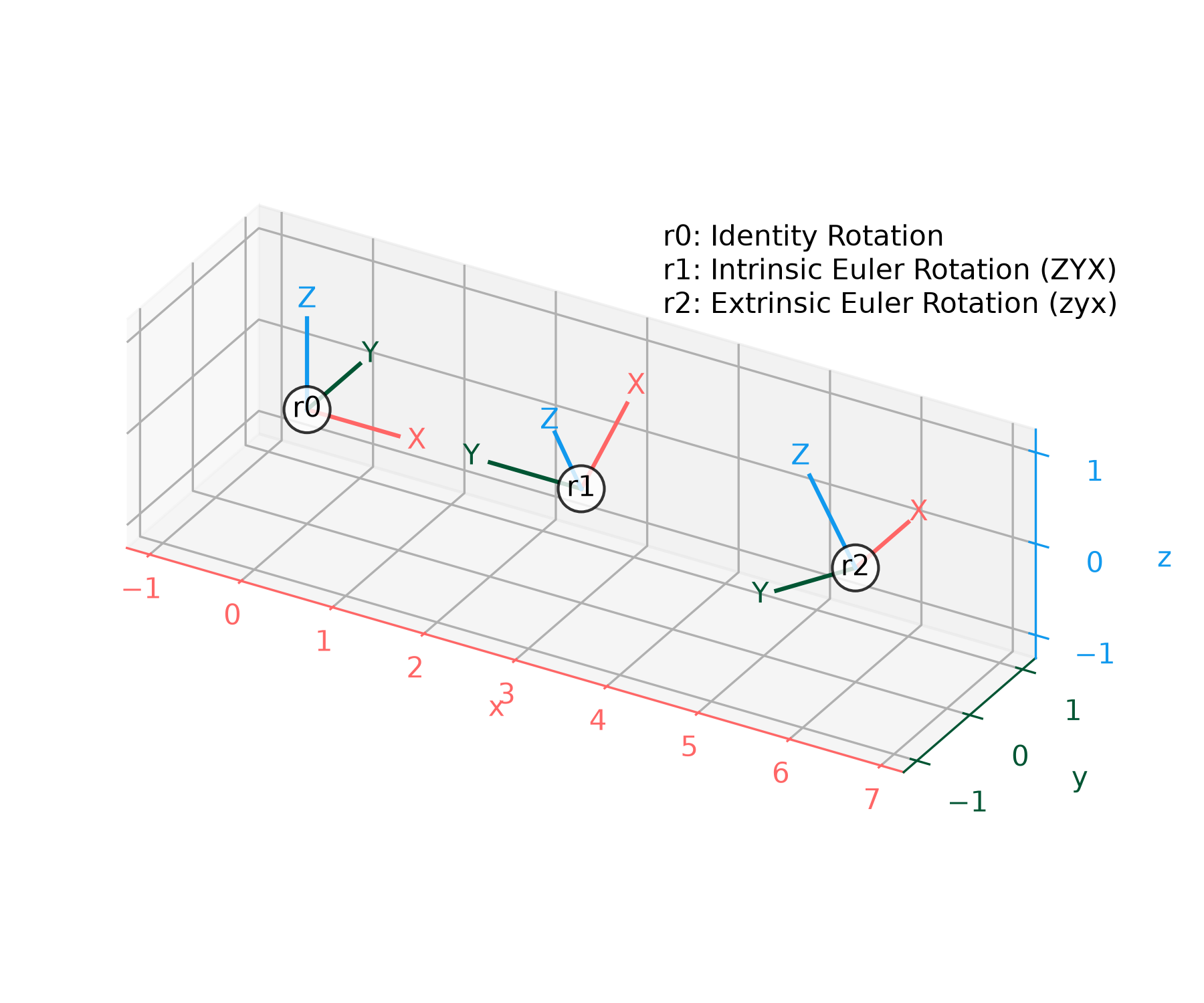
The following function can be used to plot rotations with Matplotlib by
showing how they transform the standard x, y, z coordinate axes:
import matplotlib.pyplot as plt
✓def plot_rotated_axes(ax, r, name=None, offset=(0, 0, 0), scale=1): colors = ("#FF6666", "#005533", "#1199EE") # Colorblind-safe RGB loc = np.array([offset, offset]) for i, (axis, c) in enumerate(zip((ax.xaxis, ax.yaxis, ax.zaxis), colors)): axlabel = axis.axis_name axis.set_label_text(axlabel) axis.label.set_color(c) axis.line.set_color(c) axis.set_tick_params(colors=c) line = np.zeros((2, 3)) line[1, i] = scale line_rot = r.apply(line) line_plot = line_rot + loc ax.plot(line_plot[:, 0], line_plot[:, 1], line_plot[:, 2], c) text_loc = line[1]*1.2 text_loc_rot = r.apply(text_loc) text_plot = text_loc_rot + loc[0] ax.text(*text_plot, axlabel.upper(), color=c, va="center", ha="center") ax.text(*offset, name, color="k", va="center", ha="center", bbox={"fc": "w", "alpha": 0.8, "boxstyle": "circle"})✓
r0 = R.identity()
r1 = R.from_euler("ZYX", [90, -30, 0], degrees=True)  # intrinsic
r2 = R.from_euler("zyx", [90, -30, 0], degrees=True)  # extrinsic
✓
ax = plt.figure().add_subplot(projection="3d", proj_type="ortho")
plot_rotated_axes(ax, r0, name="r0", offset=(0, 0, 0))
plot_rotated_axes(ax, r1, name="r1", offset=(3, 0, 0))
plot_rotated_axes(ax, r2, name="r2", offset=(6, 0, 0))
_ = ax.annotate(
    "r0: Identity Rotation\n"
    "r1: Intrinsic Euler Rotation (ZYX)\n"
    "r2: Extrinsic Euler Rotation (zyx)",
    xy=(0.6, 0.7), xycoords="axes fraction", ha="left"
)
✓
ax.set(xlim=(-1.25, 7.25), ylim=(-1.25, 1.25), zlim=(-1.25, 1.25))
ax.set(xticks=range(-1, 8), yticks=[-1, 0, 1], zticks=[-1, 0, 1])
✗
[[<matplotlib.axis.XTick object at 0x7fa8e471f390>, <matplotlib.axis.XTick object at 0x7fa8fc21aad0>, <matplotlib.axis.XTick object at 0x7fa8fc218910>, <matplotlib.axis.XTick object at 0x7fa8fc21ac10>, <matplotlib.axis.XTick object at 0x7fa8fc218e10>, <matplotlib.axis.XTick object at 0x7fa8fc218690>, <matplotlib.axis.XTick object at 0x7fa8fc21b9d0>, <matplotlib.axis.XTick object at 0x7fa8fc21a350>, <matplotlib.axis.XTick object at 0x7fa8fc21b4d0>], [<matplotlib.axis.XTick object at 0x7fa8e471ce10>, <matplotlib.axis.XTick object at 0x7fa8fc218b90>, <matplotlib.axis.XTick object at 0x7fa8f43f11d0>], [<matplotlib.axis.XTick object at 0x7fa8e471c550>, <matplotlib.axis.XTick object at 0x7fa8f43f0190>, <matplotlib.axis.XTick object at 0x7fa8f43f0690>]]
ax.set_aspect("equal", adjustable="box")
ax.figure.set_size_inches(6, 5)
plt.tight_layout()
✓
plt.show()
✓
See also
Aliases
scipy.spatial.transform.Rotation