bundles / scipy 2.0.0.dev0+git20260907.41eeb59 / scipy / signal / _arraytools / odd_ext
function
scipy.signal._arraytools:odd_ext
source: build-install/usr/lib/python3.14/site-packages/scipy/signal/_arraytools.py:57
Signature
def odd_ext(x, n, axis = -1)Summary
Odd extension at the boundaries of an array
Extended Summary
Generate a new ndarray by making an odd extension of x along an axis.
Parameters
x: ndarrayThe array to be extended.
n: intThe number of elements by which to extend
xat each end of the axis.axis: int, optionalThe axis along which to extend
x. Default is -1.
Examples
import numpy as np
from scipy.signal._arraytools import odd_ext
a = np.array([[1, 2, 3, 4, 5], [0, 1, 4, 9, 16]])
odd_ext(a, 2)
✓
array([[-1,  0,  1,  2,  3,  4,  5,  6,  7],
       [-4, -1,  0,  1,  4,  9, 16, 23, 28]])
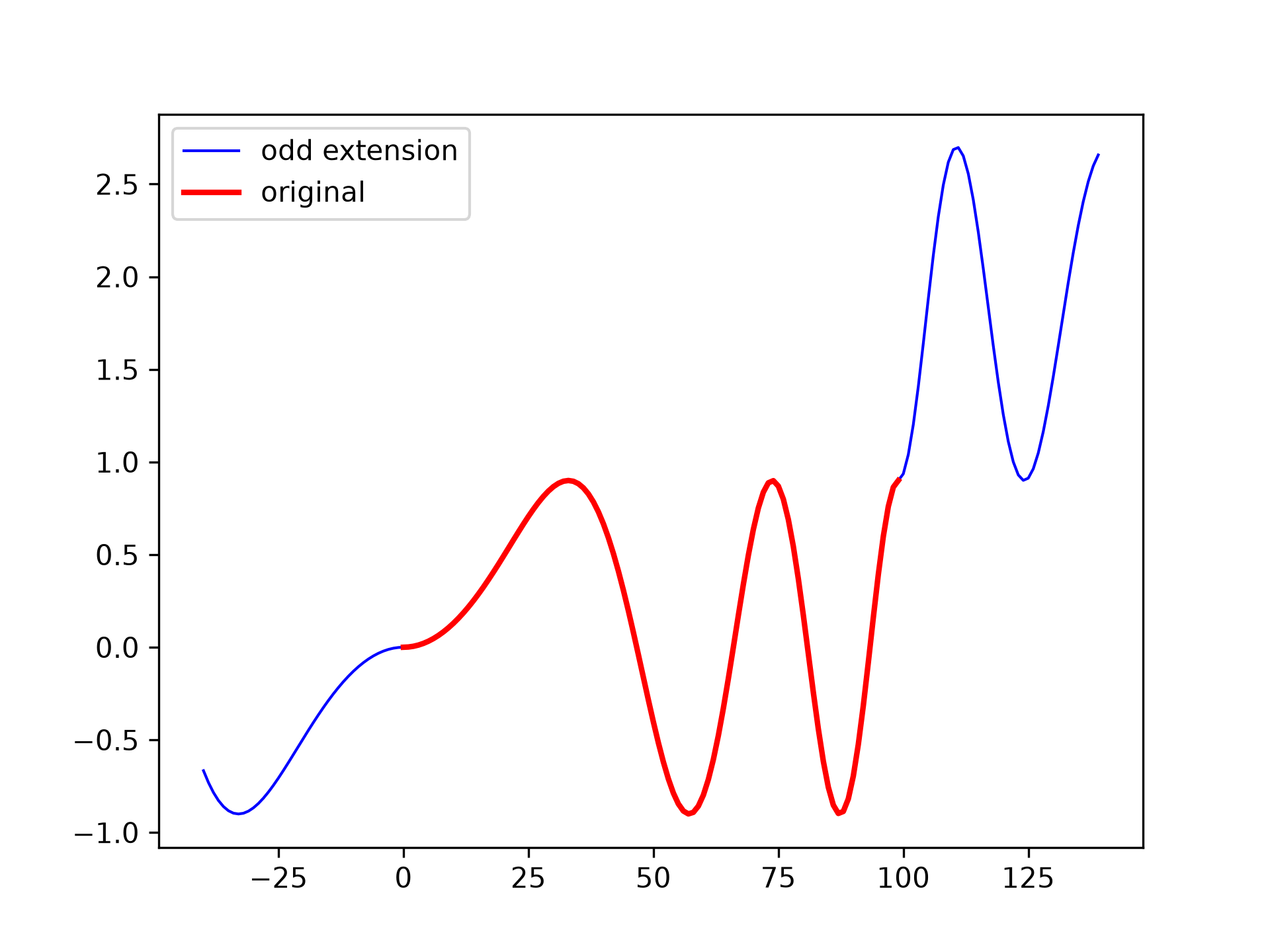
Odd extension is a "180 degree rotation" at the endpoints of the original
array:
t = np.linspace(0, 1.5, 100)
a = 0.9 * np.sin(2 * np.pi * t**2)
b = odd_ext(a, 40)
import matplotlib.pyplot as plt
✓
plt.plot(np.arange(-40, 140), b, 'b', lw=1, label='odd extension')
plt.plot(np.arange(100), a, 'r', lw=2, label='original')
plt.legend(loc='best')
✗
<matplotlib.legend.Legend object at 0x7f3f43920c20>
plt.show()
✓
Aliases
scipy.signal._arraytools.odd_ext