bundles / numpy 2.4.3 / numpy / polyfit
_ArrayFunctionDispatcher
numpy:polyfit
Signature
def polyfit(x, y, deg, rcond = None, full = False, w = None, cov = False)Summary
Least squares polynomial fit.
Extended Summary
Fit a polynomial p[0] * x**deg + ... + p[deg] of degree deg to points (x, y). Returns a vector of coefficients p that minimises the squared error in the order deg, deg-1, ... 0.
The Polynomial.fit <numpy.polynomial.polynomial.Polynomial.fit> class method is recommended for new code as it is more stable numerically. See the documentation of the method for more information.
Parameters
x: array_like, shape (M,)x-coordinates of the M sample points
(x[i], y[i]).y: array_like, shape (M,) or (M, K)y-coordinates of the sample points. Several data sets of sample points sharing the same x-coordinates can be fitted at once by passing in a 2D-array that contains one dataset per column.
deg: intDegree of the fitting polynomial
rcond: float, optionalRelative condition number of the fit. Singular values smaller than this relative to the largest singular value will be ignored. The default value is len(x)*eps, where eps is the relative precision of the float type, about 2e-16 in most cases.
full: bool, optionalSwitch determining nature of return value. When it is False (the default) just the coefficients are returned, when True diagnostic information from the singular value decomposition is also returned.
w: array_like, shape (M,), optionalWeights. If not None, the weight
w[i]applies to the unsquared residualy[i] - y_hat[i]atx[i]. Ideally the weights are chosen so that the errors of the productsw[i]*y[i]all have the same variance. When using inverse-variance weighting, usew[i] = 1/sigma(y[i]). The default value is None.cov: bool or str, optionalIf given and not False, return not just the estimate but also its covariance matrix. By default, the covariance are scaled by chi2/dof, where dof = M - (deg + 1), i.e., the weights are presumed to be unreliable except in a relative sense and everything is scaled such that the reduced chi2 is unity. This scaling is omitted if
cov='unscaled', as is relevant for the case that the weights are w = 1/sigma, with sigma known to be a reliable estimate of the uncertainty.
Returns
p: ndarray, shape (deg + 1,) or (deg + 1, K)Polynomial coefficients, highest power first. If
ywas 2-D, the coefficients fork-th data set are inp[:,k].: residuals, rank, singular_values, rcondThese values are only returned if
full == Trueresiduals -- sum of squared residuals of the least squares fit
rank -- the effective rank of the scaled Vandermonde coefficient matrix
singular_values -- singular values of the scaled Vandermonde coefficient matrix
rcond -- value of
rcond.
For more details, see numpy.linalg.lstsq.
V: ndarray, shape (deg + 1, deg + 1) or (deg + 1, deg + 1, K)Present only if
full == Falseandcov == True. The covariance matrix of the polynomial coefficient estimates. The diagonal of this matrix are the variance estimates for each coefficient. If y is a 2-D array, then the covariance matrix for thek-th data set are inV[:,:,k]
Warns
: RankWarningThe rank of the coefficient matrix in the least-squares fit is deficient. The warning is only raised if
full == False.The warnings can be turned off by
>>> import warnings
>>> warnings.simplefilter('ignore', np.exceptions.RankWarning)
Notes
The solution minimizes the squared error
in the equations
x[0]**n * p[0] + ... + x[0] * p[n-1] + p[n] = y[0]
x[1]**n * p[0] + ... + x[1] * p[n-1] + p[n] = y[1]
...
x[k]**n * p[0] + ... + x[k] * p[n-1] + p[n] = y[k]
The coefficient matrix of the coefficients p is a Vandermonde matrix.
polyfit issues a RankWarning when the least-squares fit is badly conditioned. This implies that the best fit is not well-defined due to numerical error. The results may be improved by lowering the polynomial degree or by replacing x by x - x.mean(). The rcond parameter can also be set to a value smaller than its default, but the resulting fit may be spurious: including contributions from the small singular values can add numerical noise to the result.
Note that fitting polynomial coefficients is inherently badly conditioned when the degree of the polynomial is large or the interval of sample points is badly centered. The quality of the fit should always be checked in these cases. When polynomial fits are not satisfactory, splines may be a good alternative.
Examples
import numpy as np
import warnings
x = np.array([0.0, 1.0, 2.0, 3.0,  4.0,  5.0])
y = np.array([0.0, 0.8, 0.9, 0.1, -0.8, -1.0])
z = np.polyfit(x, y, 3)
✓
z
✗array([ 0.08703704, -0.81349206, 1.69312169, -0.03968254])It is convenient to use `poly1d` objects for dealing with polynomials:
p = np.poly1d(z)
✓p(0.5) p(3.5) p(10)✗
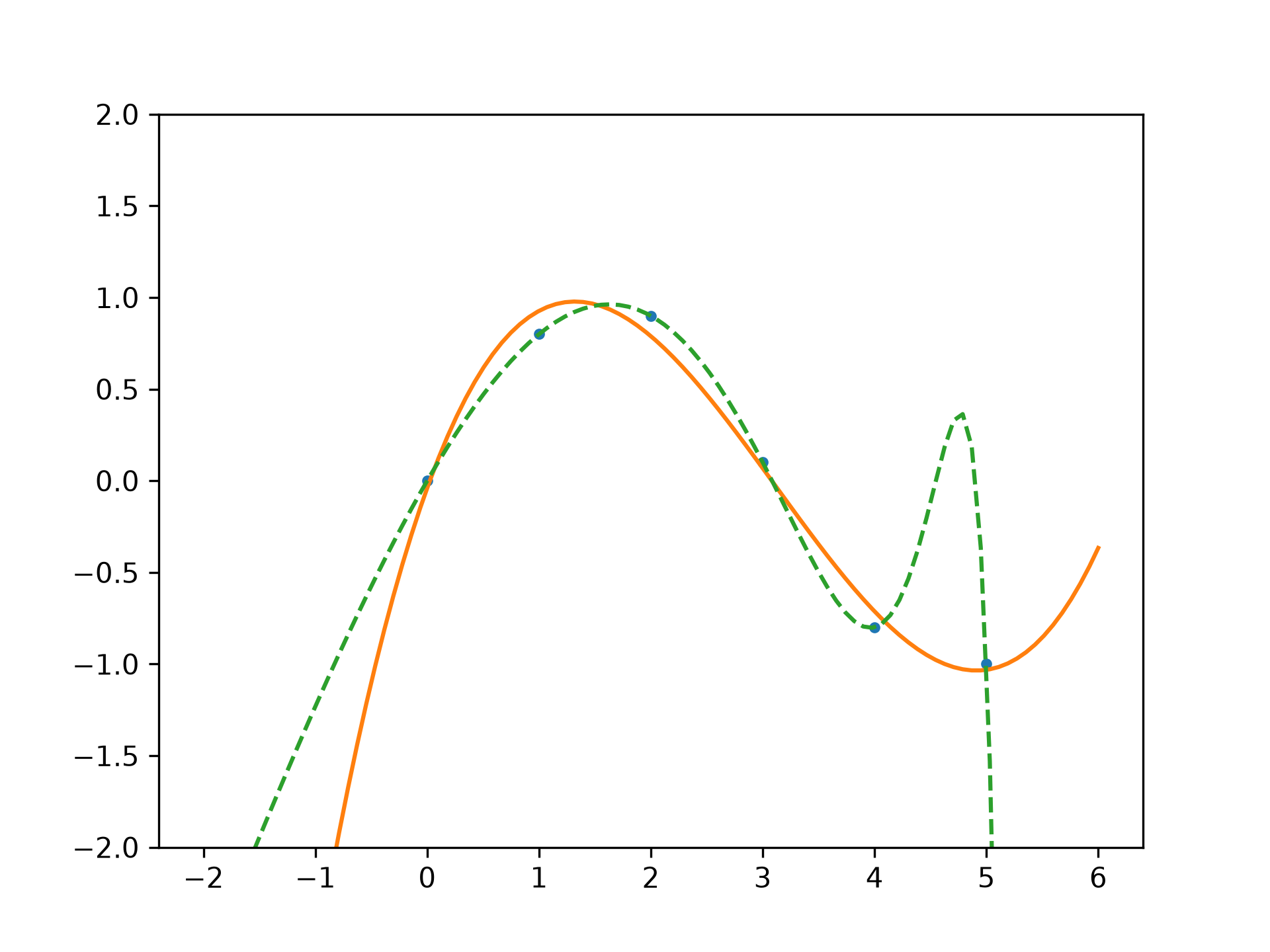
np.float64(22.579365079365008)High-order polynomials may oscillate wildly:
with warnings.catch_warnings():
    warnings.simplefilter('ignore', np.exceptions.RankWarning)
    p30 = np.poly1d(np.polyfit(x, y, 30))
✓
p30(4)
p30(5)
p30(4.5)
✗
np.float64(-0.11804856672741311)Illustration:
import matplotlib.pyplot as plt
xp = np.linspace(-2, 6, 100)
_ = plt.plot(x, y, '.', xp, p(xp), '-', xp, p30(xp), '--')
✓
plt.ylim(-2,2)
✗(-2.0, 2.0)
plt.show()
✓
See also
- linalg.lstsq
Computes a least-squares fit.
- polyval
Compute polynomial values.
- scipy.interpolate.UnivariateSpline
Computes spline fits.
Aliases
numpy.polyfit