bundles / scipy 1.17.1 / scipy / integrate / _odepack_py / odeint
function
scipy.integrate._odepack_py:odeint
Signature
def odeint(func, y0, t, args = (), Dfun = None, col_deriv = 0, full_output = 0, ml = None, mu = None, rtol = None, atol = None, tcrit = None, h0 = 0.0, hmax = 0.0, hmin = 0.0, ixpr = 0, mxstep = 0, mxhnil = 0, mxordn = 12, mxords = 5, printmessg = 0, tfirst = False)Summary
Integrate a system of ordinary differential equations.
Extended Summary
Solve a system of ordinary differential equations using lsoda from the FORTRAN library odepack.
Solves the initial value problem for stiff or non-stiff systems of first order ode-s
dy/dt = func(y, t, ...) [or func(t, y, ...)]where y can be a vector.
Parameters
func: callable(y, t, ...) or callable(t, y, ...)Computes the derivative of y at t. If the signature is
callable(t, y, ...), then the argumenttfirstmust be setTrue.funcmust not modify the data in y, as it is a view of the data used internally by the ODE solver.y0: arrayInitial condition on y (can be a vector).
t: arrayA sequence of time points for which to solve for y. The initial value point should be the first element of this sequence. This sequence must be monotonically increasing or monotonically decreasing; repeated values are allowed.
args: tuple, optionalExtra arguments to pass to function.
Dfun: callable(y, t, ...) or callable(t, y, ...)Gradient (Jacobian) of
func. If the signature iscallable(t, y, ...), then the argumenttfirstmust be setTrue.Dfunmust not modify the data in y, as it is a view of the data used internally by the ODE solver.col_deriv: bool, optionalTrue if
Dfundefines derivatives down columns (faster), otherwiseDfunshould define derivatives across rows.full_output: bool, optionalTrue if to return a dictionary of optional outputs as the second output
printmessg: bool, optionalWhether to print the convergence message
tfirst: bool, optionalIf True, the first two arguments of
func(andDfun, if given) mustt, yinstead of the defaulty, t.
Returns
y: array, shape (len(t), len(y0))Array containing the value of y for each desired time in t, with the initial value
y0in the first row.infodict: dict, only returned if full_output == TrueDictionary containing additional output information
=======  ============================================================
key      meaning
=======  ============================================================
'hu'     vector of step sizes successfully used for each time step
'tcur'   vector with the value of t reached for each time step
         (will always be at least as large as the input times)
'tolsf'  vector of tolerance scale factors, greater than 1.0,
         computed when a request for too much accuracy was detected
'tsw'    value of t at the time of the last method switch
         (given for each time step)
'nst'    cumulative number of time steps
'nfe'    cumulative number of function evaluations for each time step
'nje'    cumulative number of jacobian evaluations for each time step
'nqu'    a vector of method orders for each successful step
'imxer'  index of the component of largest magnitude in the
         weighted local error vector (e / ewt) on an error return, -1
         otherwise
'lenrw'  the length of the double work array required
'leniw'  the length of integer work array required
'mused'  a vector of method indicators for each successful time step:
         1: adams (nonstiff), 2: bdf (stiff)
=======  ============================================================
Other Parameters
ml, mu: int, optionalIf either of these are not None or non-negative, then the Jacobian is assumed to be banded. These give the number of lower and upper non-zero diagonals in this banded matrix. For the banded case,
Dfunshould return a matrix whose rows contain the non-zero bands (starting with the lowest diagonal). Thus, the return matrixjacfromDfunshould have shape(ml + mu + 1, len(y0))whenml >=0ormu >=0. The data injacmust be stored such thatjac[i - j + mu, j]holds the derivative of theith equation with respect to thejth state variable. Ifcol_derivis True, the transpose of thisjacmust be returned.rtol, atol: float, optionalThe input parameters
rtolandatoldetermine the error control performed by the solver. The solver will control the vector, e, of estimated local errors in y, according to an inequality of the formmax-norm of (e / ewt) <= 1, where ewt is a vector of positive error weights computed asewt = rtol * abs(y) + atol. rtol and atol can be either vectors the same length as y or scalars. Defaults to 1.49012e-8.tcrit: ndarray, optionalVector of critical points (e.g., singularities) where integration care should be taken.
h0: float, (0: solver-determined), optionalThe step size to be attempted on the first step.
hmax: float, (0: solver-determined), optionalThe maximum absolute step size allowed.
hmin: float, (0: solver-determined), optionalThe minimum absolute step size allowed.
ixpr: bool, optionalWhether to generate extra printing at method switches.
mxstep: int, (0: solver-determined), optionalMaximum number of (internally defined) steps allowed for each integration point in t.
mxhnil: int, (0: solver-determined), optionalMaximum number of messages printed.
mxordn: int, (0: solver-determined), optionalMaximum order to be allowed for the non-stiff (Adams) method.
mxords: int, (0: solver-determined), optionalMaximum order to be allowed for the stiff (BDF) method.
Notes
Array API Standard Support
odeint is not in-scope for support of Python Array API Standard compatible backends other than NumPy.
See dev-arrayapi for more information.
Examples
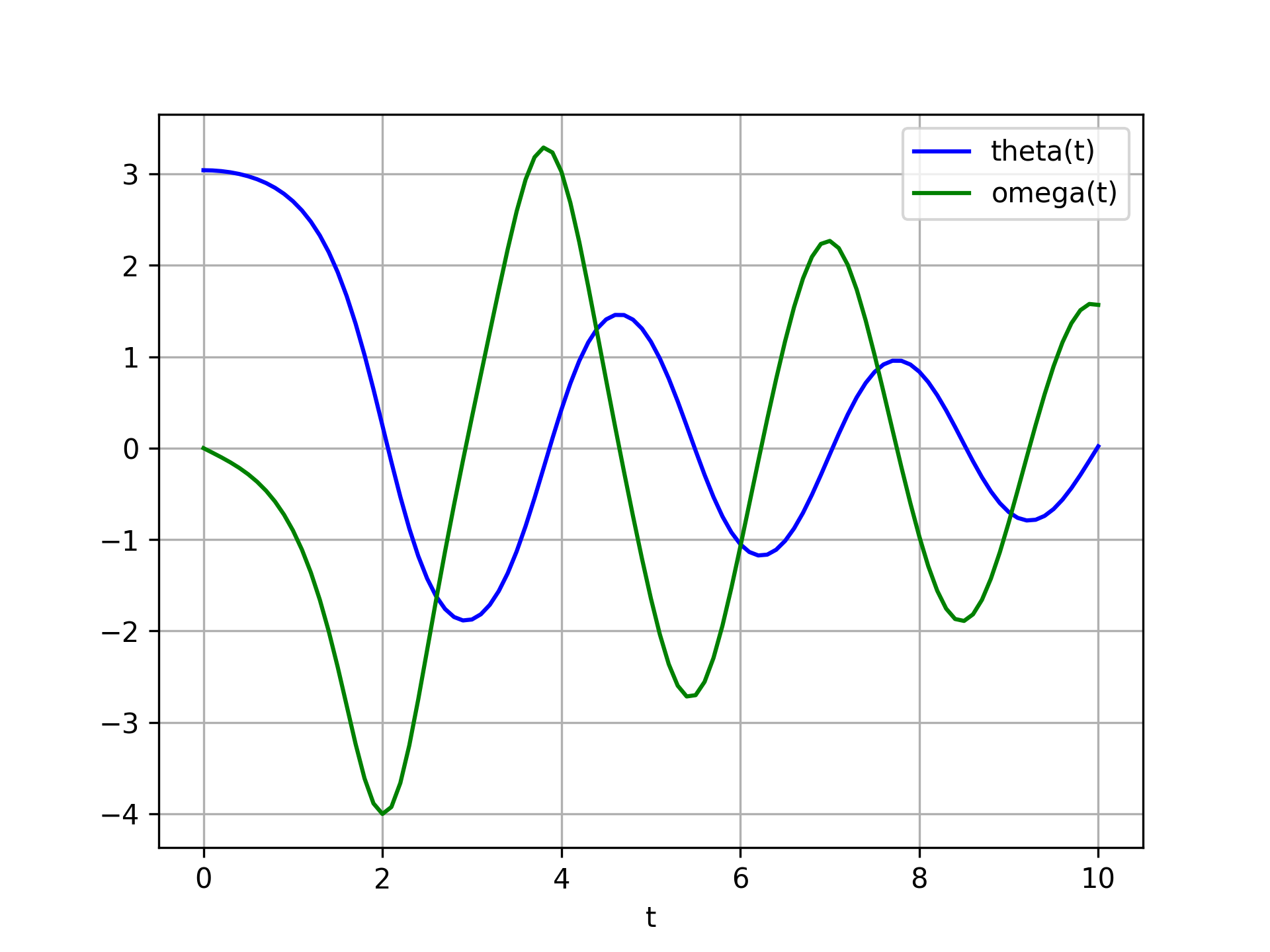
The second order differential equation for the angle `theta` of a pendulum acted on by gravity with friction can be written:: theta''(t) + b*theta'(t) + c*sin(theta(t)) = 0 where `b` and `c` are positive constants, and a prime (') denotes a derivative. To solve this equation with `odeint`, we must first convert it to a system of first order equations. By defining the angular velocity ``omega(t) = theta'(t)``, we obtain the system:: theta'(t) = omega(t) omega'(t) = -b*omega(t) - c*sin(theta(t)) Let `y` be the vector [`theta`, `omega`]. We implement this system in Python as:import numpy as np def pend(y, t, b, c): theta, omega = y dydt = [omega, -b*omega - c*np.sin(theta)] return dydt✓
b = 0.25
c = 5.0
✓
y0 = [np.pi - 0.1, 0.0]
✓t = np.linspace(0, 10, 101)
✓from scipy.integrate import odeint sol = odeint(pend, y0, t, args=(b, c))✓
import matplotlib.pyplot as plt
✓plt.plot(t, sol[:, 0], 'b', label='theta(t)') plt.plot(t, sol[:, 1], 'g', label='omega(t)') plt.legend(loc='best') plt.xlabel('t')✗
plt.grid()
plt.show()
✓
See also
Aliases
scipy.integrate.odeint