bundles / scipy 1.17.1 / scipy / interpolate / _polyint / krogh_interpolate
function
scipy.interpolate._polyint:krogh_interpolate
Signature
def krogh_interpolate(xi, yi, x, der = 0, axis = 0)Summary
Convenience function for Krogh interpolation.
Extended Summary
See KroghInterpolator for more details.
Parameters
xi: array_likeInterpolation points (known x-coordinates).
yi: array_likeKnown y-coordinates, of shape
(xi.size, R). Interpreted as vectors of length R, or scalars if R=1.x: array_likePoint or points at which to evaluate the derivatives.
der: int or list or None, optionalHow many derivatives to evaluate, or None for all potentially nonzero derivatives (that is, a number equal to the number of points), or a list of derivatives to evaluate. This number includes the function value as the '0th' derivative.
axis: int, optionalAxis in the
yiarray corresponding to the x-coordinate values.
Returns
d: ndarrayIf the interpolator's values are R-D then the returned array will be the number of derivatives by N by R. If
xis a scalar, the middle dimension will be dropped; if theyiare scalars then the last dimension will be dropped.
Notes
Construction of the interpolating polynomial is a relatively expensive process. If you want to evaluate it repeatedly consider using the class KroghInterpolator (which is what this function uses).
Examples
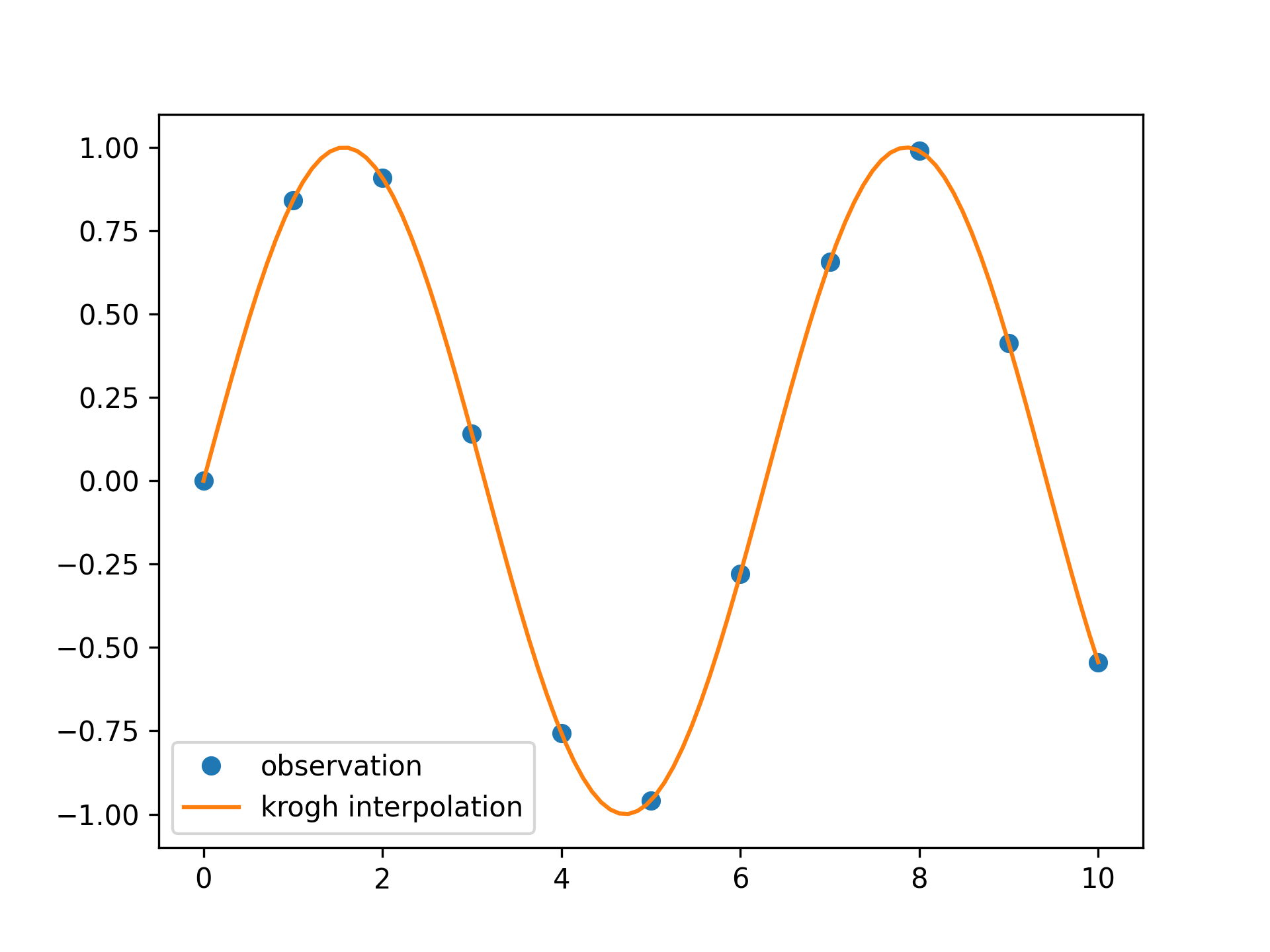
We can interpolate 2D observed data using Krogh interpolation:import numpy as np import matplotlib.pyplot as plt from scipy.interpolate import krogh_interpolate x_observed = np.linspace(0.0, 10.0, 11) y_observed = np.sin(x_observed) x = np.linspace(min(x_observed), max(x_observed), num=100) y = krogh_interpolate(x_observed, y_observed, x)✓
plt.plot(x_observed, y_observed, "o", label="observation")
plt.plot(x, y, label="krogh interpolation")
plt.legend()
✗
plt.show()
✓
See also
- KroghInterpolator
Krogh interpolator
Aliases
scipy.interpolate.krogh_interpolate