bundles / scipy 1.17.1 / scipy / signal / _short_time_fft / closest_STFT_dual_window
function
scipy.signal._short_time_fft:closest_STFT_dual_window
Signature
def closest_STFT_dual_window(win: np.ndarray, hop: int, desired_dual: np.ndarray | None = None, *, scaled: bool = True) → tuple[np.ndarray, float | complex]Summary
Calculate the STFT dual window of a given window closest to a desired dual window.
Extended Summary
For a given short-time Fourier transform window win incremented by hop samples, the dual window is calculated, which minimizes abs(dual_win - desired_dual)**2 when scaled is False. For scaled set to True, abs(alpha*dual_win - desired_dual)**2 is minimized with alpha being the optimal scaling factor. A ValueError is raised if no valid dual window can be determined.
Parameters
win: np.ndarrayThe window must be a real- or complex-valued 1d array.
hop: intThe increment in samples by which the window is shifted in each step.
desired_dual: np.ndarray | NoneThe desired dual window must be a 1d array of the same length as
win. If set toNone(default), thendesired_dualis assumed to be the rectangular window, i.e.,np.ones_like(win).scaled: boolIf set (default), the closest scaled version instead of closest dual window is calculated.
Returns
dual_win: np.ndarrayA dual window of
alpha*win(with hop intervalhop), which is closest todesired_dual. Note that the dual window ofwinisdual_win/alphaand that the dual window of dual_win isalpha*win. dual_win has the same shape aswinanddesired_win.alpha: float | complexScale factor for
win. It is always one ifscaledis set toFalse.
Notes
For a given window and hop interval, all possible dual windows are expressed by the hop linear conditions of Eq. eq_STFT_AllDualWinsCond in the tutorial_stft section of the user_guide. Hence, decreasing hop, increases the number of degrees of freedom of the set of all possible dual windows, improving the ability to better approximate a desired_dual.
This function can also be used to determine windows which fulfill the so-called "Constant OverLap Add" (COLA) condition [1]. It states that summing all touching window values at any given sample position results in the same constant . Eq. eq_STFT_AllDualWinsCond shows that this is equal to having a rectangular dual window, i.e., the dual being alpha*np.ones(m).
Some examples of windows that satisfy COLA (taken from [2]):
Rectangular window at overlap of 0, 1/2, 2/3, 3/4, ...
Bartlett window at overlap of 1/2, 3/4, 5/6, ...
Hann window at 1/2, 2/3, 3/4, ...
Any Blackman family window at 2/3 overlap
Any window with
hop=1
Array API Standard Support
closest_STFT_dual_window has experimental support for Python Array API Standard compatible backends in addition to NumPy. Please consider testing these features by setting an environment variable SCIPY_ARRAY_API=1 and providing CuPy, PyTorch, JAX, or Dask arrays as array arguments. The following combinations of backend and device (or other capability) are supported.
====================  ====================  ====================
Library               CPU                   GPU
====================  ====================  ====================
NumPy                 ✅                     n/a
CuPy                  n/a                   ⛔
PyTorch               ⛔                     ⛔
JAX                   ⛔                     ⛔
Dask                  ⛔                     n/a
====================  ====================  ====================
See
dev-arrayapifor more information.
Examples
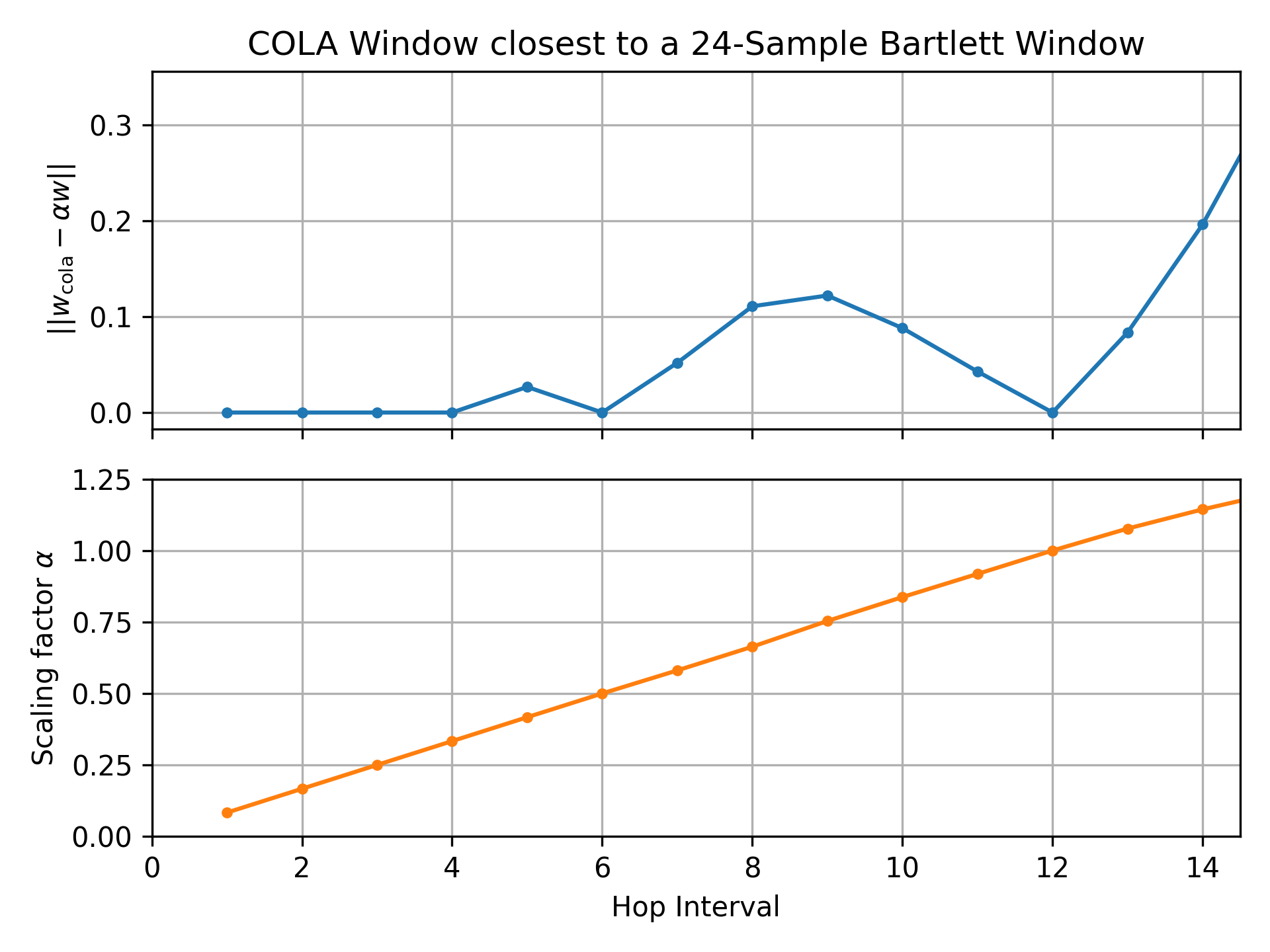
Let's show that a Bartlett window with 75% overlap fulfills the COLA condition:import matplotlib.pyplot as plt import numpy as np from scipy.signal import closest_STFT_dual_window, windows m = 24 win, w_rect = windows.bartlett(m, sym=False), np.ones(m) d_win, alpha = closest_STFT_dual_window(win, m//4, w_rect, scaled=True) print(f"COLA: {np.allclose(d_win, w_rect*alpha)}, {alpha = :g}")✓
hops, deviations, alphas = np.arange(1, 16, dtype=int), [], []
for h_ in hops:
    w_cola, alpha = closest_STFT_dual_window(w_rect, h_, win, scaled=True)
    deviations.append(np.linalg.norm(w_cola - win*alpha))
    alphas.append(alpha)
fg0, (ax0, ax1) = plt.subplots(2, 1, sharex='all', tight_layout=True)
✓
ax0.set_title(f"COLA Window closest to a {m}-Sample Bartlett Window")
ax0.set(ylabel=r"$||w_\text{cola}-\alpha w||$", xlim=(0, hops[-1]-.5))
ax1.set(xlabel="Hop Interval", ylabel=r"Scaling factor $\alpha$",
        ylim=(0, 1.25))
ax0.plot(hops, deviations, 'C0.-')
ax1.plot(hops, alphas, 'C1.-')
✗
for ax_ in (ax0, ax1):
    ax_.grid()
plt.show()
✓
See also
- ShortTimeFFT
Short-time Fourier transform which is able to utilize a dual window for calculating the inverse.
- ShortTimeFFT.from_win_equals_dual
Create instance where the window and its dual are equal.
Aliases
scipy.signal.closest_STFT_dual_window