bundles / scipy 1.17.1 / scipy / stats / _multivariate / vonmises_fisher_gen
class
scipy.stats._multivariate:vonmises_fisher_gen
Signature
class vonmises_fisher_gen(seed = None)Members
Summary
A von Mises-Fisher variable.
Extended Summary
The mu keyword specifies the mean direction vector. The kappa keyword specifies the concentration parameter.
Parameters
mu: array_likeMean direction of the distribution. Must be a one-dimensional unit vector of norm 1.
kappa: floatConcentration parameter. Must be positive.
seed: {None, int, np.random.RandomState, np.random.Generator}, optionalUsed for drawing random variates. If
seedisNone, the~np.random.RandomStatesingleton is used. Ifseedis an int, a newRandomStateinstance is used, seeded with seed. Ifseedis already aRandomStateorGeneratorinstance, then that object is used. Default isNone.
Methods
pdf(x, mu=None, kappa=1)Probability density function.
logpdf(x, mu=None, kappa=1)Log of the probability density function.
rvs(mu=None, kappa=1, size=1, random_state=None)Draw random samples from a von Mises-Fisher distribution.
entropy(mu=None, kappa=1)Compute the differential entropy of the von Mises-Fisher distribution.
fit(data)Fit a von Mises-Fisher distribution to data.
Notes
The von Mises-Fisher distribution is a directional distribution on the surface of the unit hypersphere. The probability density function of a unit vector is
where is the mean direction, the concentration parameter, the dimension and the modified Bessel function of the first kind. As represents a direction, it must be a unit vector or in other words, a point on the hypersphere: . is a concentration parameter, which means that it must be positive () and that the distribution becomes more narrow with increasing . In that sense, the reciprocal value resembles the variance parameter of the normal distribution.
The von Mises-Fisher distribution often serves as an analogue of the normal distribution on the sphere. Intuitively, for unit vectors, a useful distance measure is given by the angle between them. This is exactly what the scalar product in the von Mises-Fisher probability density function describes: the angle between the mean direction and the vector . The larger the angle between them, the smaller the probability to observe for this particular mean direction .
In dimensions 2 and 3, specialized algorithms are used for fast sampling [2], [3]. For dimensions of 4 or higher the rejection sampling algorithm described in [4] is utilized. This implementation is partially based on the geomstats package [5], [6].
Examples
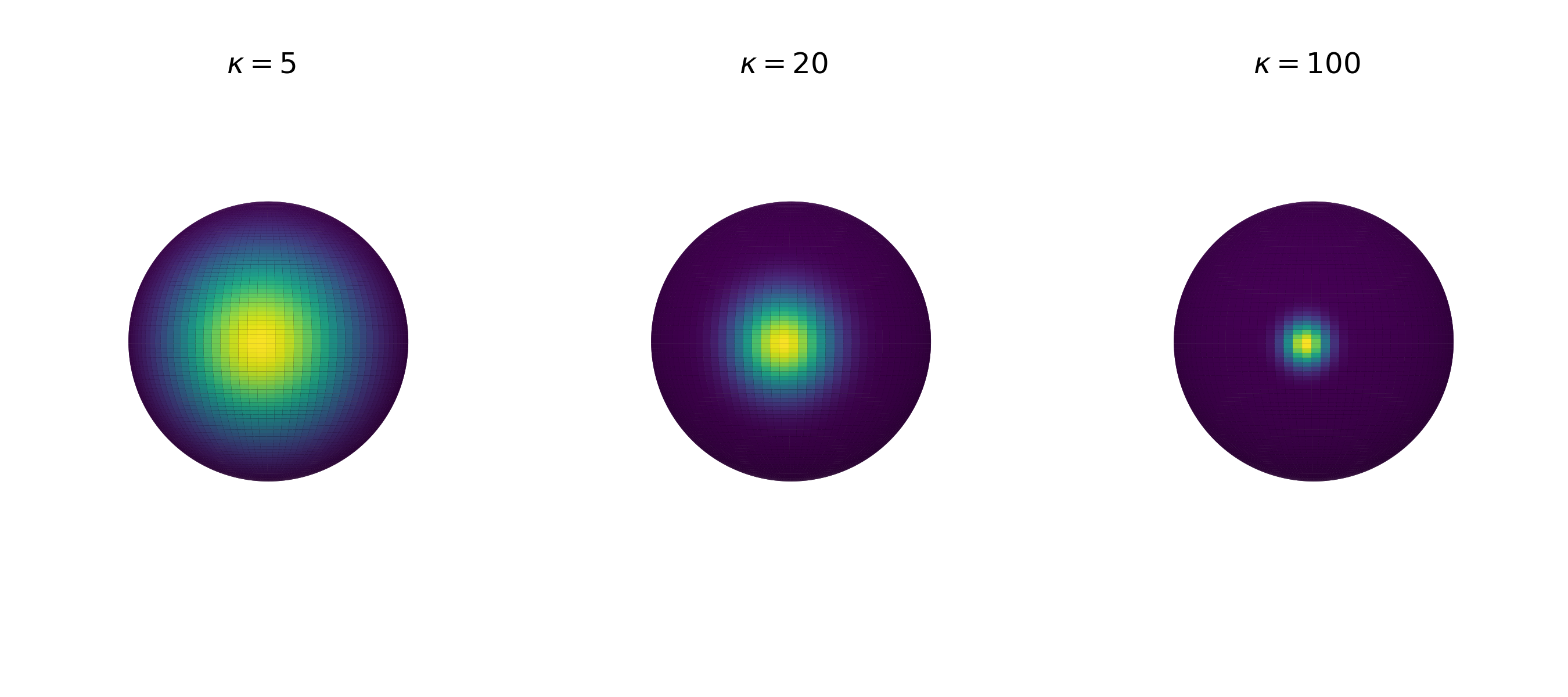
**Visualization of the probability density** Plot the probability density in three dimensions for increasing concentration parameter. The density is calculated by the ``pdf`` method.import numpy as np import matplotlib.pyplot as plt from scipy.stats import vonmises_fisher from matplotlib.colors import Normalize n_grid = 100 u = np.linspace(0, np.pi, n_grid) v = np.linspace(0, 2 * np.pi, n_grid) u_grid, v_grid = np.meshgrid(u, v) vertices = np.stack([np.cos(v_grid) * np.sin(u_grid), np.sin(v_grid) * np.sin(u_grid), np.cos(u_grid)], axis=2) x = np.outer(np.cos(v), np.sin(u)) y = np.outer(np.sin(v), np.sin(u)) z = np.outer(np.ones_like(u), np.cos(u)) def plot_vmf_density(ax, x, y, z, vertices, mu, kappa): vmf = vonmises_fisher(mu, kappa) pdf_values = vmf.pdf(vertices) pdfnorm = Normalize(vmin=pdf_values.min(), vmax=pdf_values.max()) ax.plot_surface(x, y, z, rstride=1, cstride=1, facecolors=plt.cm.viridis(pdfnorm(pdf_values)), linewidth=0) ax.set_aspect('equal') ax.view_init(azim=-130, elev=0) ax.axis('off') ax.set_title(rf"$\kappa={kappa}$") fig, axes = plt.subplots(nrows=1, ncols=3, figsize=(9, 4), subplot_kw={"projection": "3d"}) left, middle, right = axes mu = np.array([-np.sqrt(0.5), -np.sqrt(0.5), 0]) plot_vmf_density(left, x, y, z, vertices, mu, 5) plot_vmf_density(middle, x, y, z, vertices, mu, 20) plot_vmf_density(right, x, y, z, vertices, mu, 100) plt.subplots_adjust(top=1, bottom=0.0, left=0.0, right=1.0, wspace=0.) plt.show()✓
rng = np.random.default_rng()
mu = np.array([0, 0, 1])
samples = vonmises_fisher(mu, 20).rvs(5, random_state=rng)
✓
samples
✗np.linalg.norm(samples, axis=1)
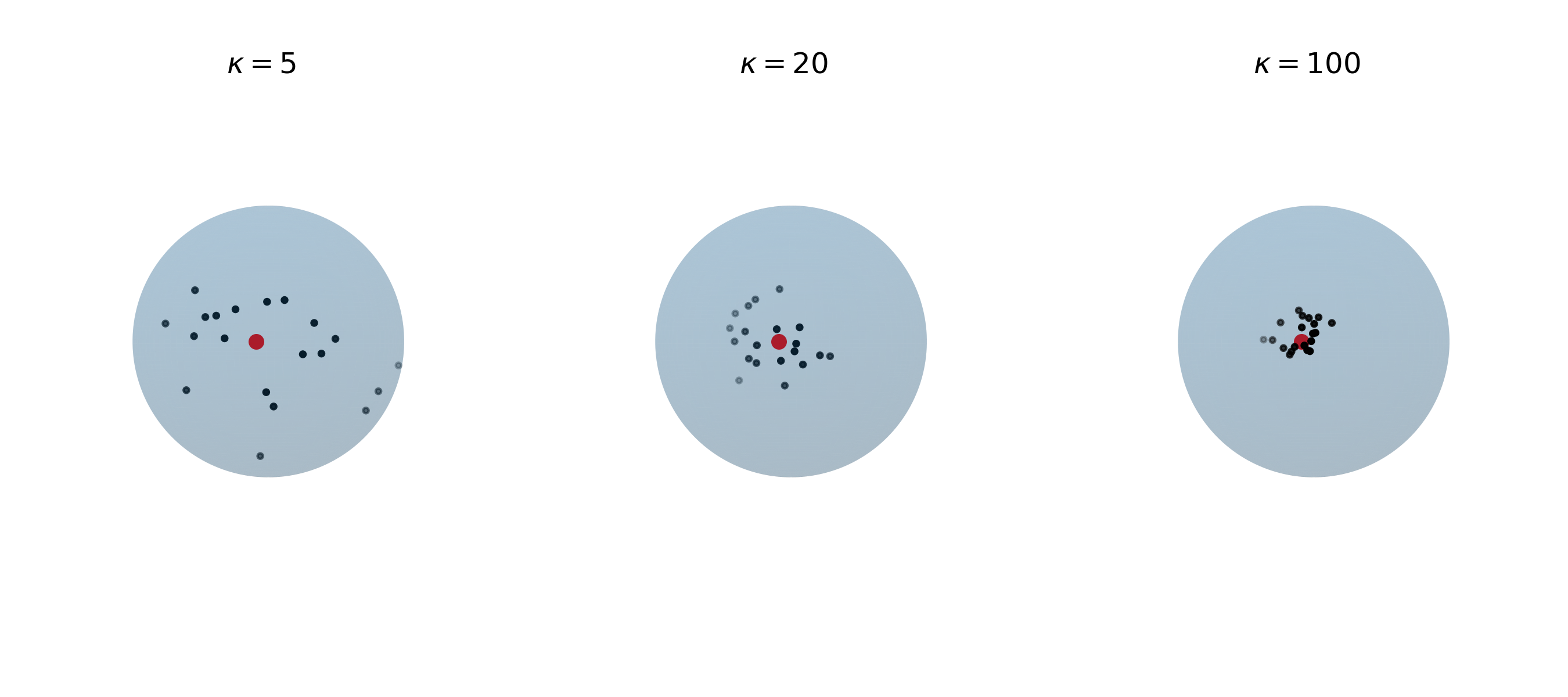
✓def plot_vmf_samples(ax, x, y, z, mu, kappa): vmf = vonmises_fisher(mu, kappa) samples = vmf.rvs(20) ax.plot_surface(x, y, z, rstride=1, cstride=1, linewidth=0, alpha=0.2) ax.scatter(samples[:, 0], samples[:, 1], samples[:, 2], c='k', s=5) ax.scatter(mu[0], mu[1], mu[2], c='r', s=30) ax.set_aspect('equal') ax.view_init(azim=-130, elev=0) ax.axis('off') ax.set_title(rf"$\kappa={kappa}$") mu = np.array([-np.sqrt(0.5), -np.sqrt(0.5), 0]) fig, axes = plt.subplots(nrows=1, ncols=3, subplot_kw={"projection": "3d"}, figsize=(9, 4)) left, middle, right = axes plot_vmf_samples(left, x, y, z, mu, 5) plot_vmf_samples(middle, x, y, z, mu, 20) plot_vmf_samples(right, x, y, z, mu, 100) plt.subplots_adjust(top=1, bottom=0.0, left=0.0, right=1.0, wspace=0.) plt.show()✓
mu, kappa = np.array([0, 0, 1]), 20
samples = vonmises_fisher(mu, kappa).rvs(1000, random_state=rng)
mu_fit, kappa_fit = vonmises_fisher.fit(samples)
✓
mu_fit, kappa_fit
✗See also
- scipy.stats.vonmises
Von-Mises Fisher distribution in 2D on a circle
- uniform_direction
uniform distribution on the surface of a hypersphere
Aliases
scipy.stats._multivariate.vonmises_fisher_gen