bundles / scipy 1.17.1 / scipy / stats / _qmc / MultivariateNormalQMC
class
scipy.stats._qmc:MultivariateNormalQMC
source: /scipy/stats/_qmc.py:2312
Signature
class MultivariateNormalQMC(mean: npt.ArrayLike, cov: npt.ArrayLike | None = None, *, cov_root: npt.ArrayLike | None = None, inv_transform: bool = True, engine: scipy.stats._qmc.QMCEngine | None = None, rng: int | numpy.integer | numpy.random._generator.Generator | numpy.random.mtrand.RandomState | None = None, seed = None) → NoneMembers
Summary
QMC sampling from a multivariate Normal .
Parameters
mean: array_like (d,)The mean vector. Where
dis the dimension.cov: array_like (d, d), optionalThe covariance matrix. If omitted, use
cov_rootinstead. If bothcovandcov_rootare omitted, use the identity matrix.cov_root: array_like (d, d'), optionalA root decomposition of the covariance matrix, where
d'may be less thandif the covariance is not full rank. If omitted, usecov.inv_transform: bool, optionalIf True, use inverse transform instead of Box-Muller. Default is True.
engine: QMCEngine, optionalQuasi-Monte Carlo engine sampler. If None, Sobol is used.
rng: `numpy.random.Generator`, optionalPseudorandom number generator state. When
rngis None, a new numpy.random.Generator is created using entropy from the operating system. Types other than numpy.random.Generator are passed to numpy.random.default_rng to instantiate aGenerator.
Examples
import matplotlib.pyplot as plt
from scipy.stats import qmc
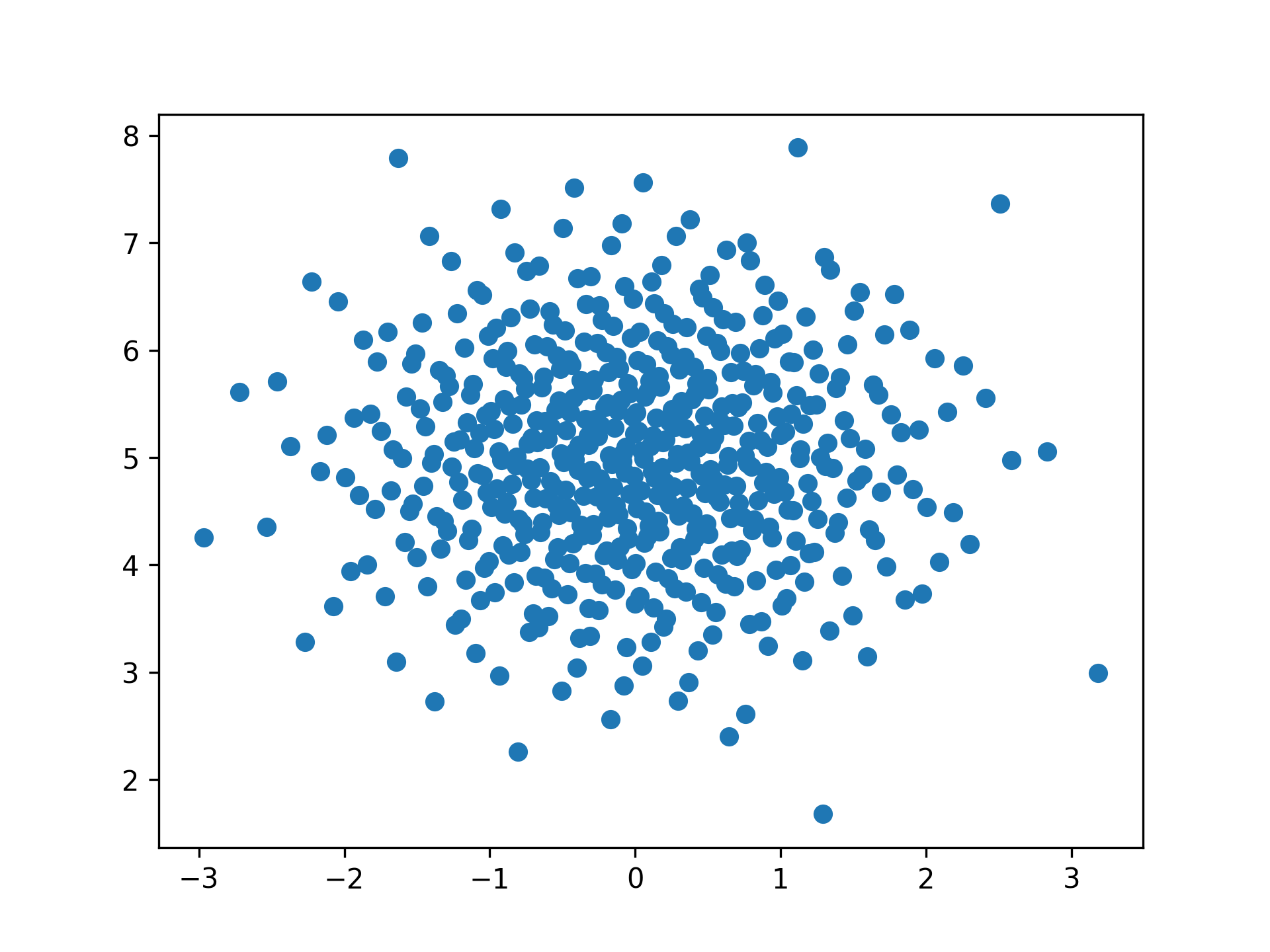
dist = qmc.MultivariateNormalQMC(mean=[0, 5], cov=[[1, 0], [0, 1]])
sample = dist.random(512)
_ = plt.scatter(sample[:, 0], sample[:, 1])
plt.show()
✓
Aliases
scipy.stats._qmc.MultivariateNormalQMC