bundles / scipy 2.0.0.dev0+git20260907.41eeb59 / scipy / fft / _realtransforms / idst
_Function
scipy.fft._realtransforms:idst
source: build-install/usr/lib/python3.14/site-packages/scipy/fft/_realtransforms.py:656
Signature
def idst(x, type = 2, n = None, axis = -1, norm = None, overwrite_x = False, workers = None, orthogonalize = None)Summary
Return the Inverse Discrete Sine Transform of an arbitrary type sequence.
Parameters
x: array_likeThe input array.
type: {1, 2, 3, 4}, optionalType of the DST (see Notes). Default type is 2.
n: int, optionalLength of the transform. If
n < x.shape[axis],xis truncated. Ifn > x.shape[axis],xis zero-padded. The default results inn = x.shape[axis].axis: int, optionalAxis along which the idst is computed; the default is over the last axis (i.e.,
axis=-1).norm: {"backward", "ortho", "forward"}, optionalNormalization mode (see Notes). Default is "backward".
overwrite_x: bool, optionalIf True, the contents of
xcan be destroyed; the default is False.workers: int, optionalMaximum number of workers to use for parallel computation. If negative, the value wraps around from
os.cpu_count(). See fft for more details.orthogonalize: bool, optionalWhether to use the orthogonalized IDST variant (see Notes). Defaults to
Truewhennorm="ortho"andFalseotherwise.
Returns
idst: ndarray of realThe transformed input array.
Notes
For norm="ortho" both the dst and idst are scaled by the same overall factor in both directions. By default, the transform is also orthogonalized which for types 2 and 3 means the transform definition is modified to give orthogonality of the DST matrix (see dst for the full definitions).
'The' IDST is the IDST-II, which is the same as the normalized DST-III.
The IDST is equivalent to a normal DST except for the normalization and type. DST type 1 and 4 are their own inverse and DSTs 2 and 3 are each other's inverses. For an example that demonstrates the relation between the DST and ISDT, consult the DST and IDST section of the user_guide.
Examples
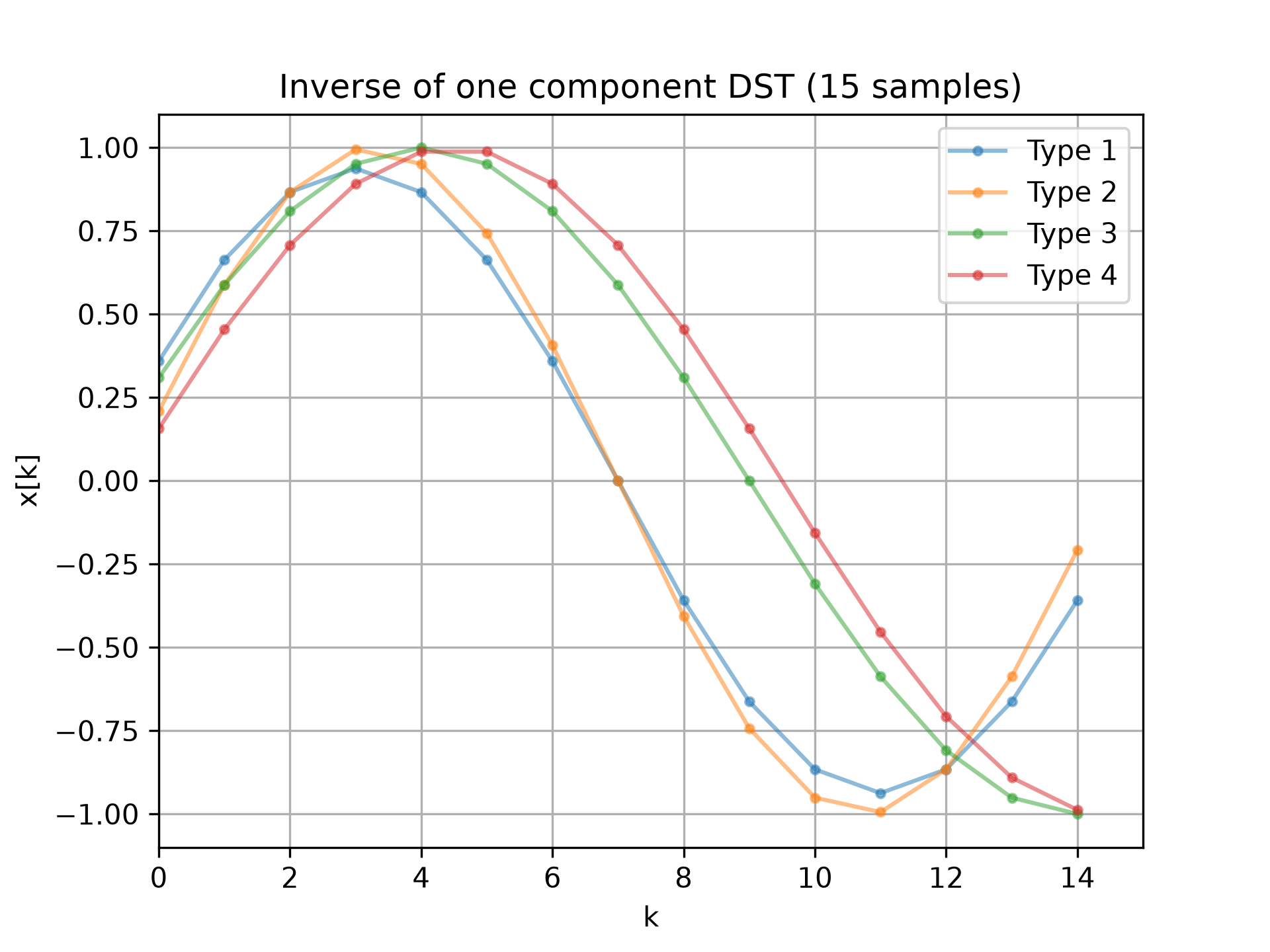
The following example calculates the signal from a spectrum `X` where only the first bin has a non-zero value. The signal for all four DST types is plotted:import numpy as np import matplotlib.pyplot as plt from scipy.fft import idst N = 15 X = np.array([0, N]) # the last `N-2` bin zero-valued bins are not needed _, ax = plt.subplots()✓
ax.set(title=f"Inverse of one component DST ({N} samples)",
       xlim=(0, N), xlabel="k", ylabel="x[k]")
for t_ in range(1, 5):
    x = idst(X, type=t_, n=N)  # parameter `n` pads `X` to length `N`.
    ax.plot(x, '.-', alpha=0.5, label=f"Type {t_}")
✗
[<matplotlib.lines.Line2D object at 0x7f3f60d6b770>]
[<matplotlib.lines.Line2D object at 0x7f3f60d6b8c0>]
[<matplotlib.lines.Line2D object at 0x7f3f60d6ba10>]
[<matplotlib.lines.Line2D object at 0x7f3f60d6bb60>]
ax.grid(True)
✓ax.legend()
✗<matplotlib.legend.Legend object at 0x7f3f60d6b4d0>
plt.show()
✓
See also
- dst
Forward DST
- irfft
Inverse FFT for real input
Aliases
scipy.fft.idst