bundles / scipy latest / scipy / cluster / hierarchy / linkage
function
scipy.cluster.hierarchy:linkage
source: /scipy/cluster/hierarchy.py :813
Signature
def linkage ( y , method = single , metric = euclidean , optimal_ordering = False ) Summary
Perform hierarchical/agglomerative clustering.
Extended Summary
The input y may be either a 1-D condensed distance matrix or a 2-D array of observation vectors.
If y is a 1-D condensed distance matrix, then y must be a sized vector, where n is the number of original observations paired in the distance matrix. The behavior of this function is very similar to the MATLAB linkage function.
A by 4 matrix Z is returned. At the -th iteration, clusters with indices Z[i, 0] and Z[i, 1] are combined to form cluster . A cluster with an index less than corresponds to one of the original observations. The distance between clusters Z[i, 0] and Z[i, 1] is given by Z[i, 2]. The fourth value Z[i, 3] represents the number of original observations in the newly formed cluster.
The following linkage methods are used to compute the distance between two clusters and . The algorithm begins with a forest of clusters that have yet to be used in the hierarchy being formed. When two clusters and from this forest are combined into a single cluster , and are removed from the forest, and is added to the forest. When only one cluster remains in the forest, the algorithm stops, and this cluster becomes the root.
A distance matrix is maintained at each iteration. The d[i,j] entry corresponds to the distance between cluster and in the original forest.
At each iteration, the algorithm must update the distance matrix to reflect the distance of the newly formed cluster u with the remaining clusters in the forest.
Suppose there are original observations in cluster and original objects in cluster . Recall, and are combined to form cluster . Let be any remaining cluster in the forest that is not .
The following are methods for calculating the distance between the newly formed cluster and each .
method='single' assigns
for all points in cluster and in cluster . This is also known as the Nearest Point Algorithm.
method='complete' assigns
for all points in cluster u and in cluster . This is also known by the Farthest Point Algorithm or Voor Hees Algorithm.
method='average' assigns
for all points and where and are the cardinalities of clusters and , respectively. This is also called the UPGMA algorithm.
method='weighted' assigns
where cluster u was formed with cluster s and t and v is a remaining cluster in the forest (also called WPGMA).
method='centroid' assigns
where and are the centroids of clusters and , respectively. When two clusters and are combined into a new cluster , the new centroid is computed over all the original objects in clusters and . The distance then becomes the Euclidean distance between the centroid of and the centroid of a remaining cluster in the forest. This is also known as the UPGMC algorithm.
method='median' assigns like the
centroidmethod. When two clusters and are combined into a new cluster , the average of centroids s and t give the new centroid . This is also known as the WPGMC algorithm.method='ward' uses the Ward variance minimization algorithm. The new entry is computed as follows,
where is the newly joined cluster consisting of clusters and , is an unused cluster in the forest, , and is the cardinality of its argument. This is also known as the incremental algorithm.
Warning: When the minimum distance pair in the forest is chosen, there may be two or more pairs with the same minimum distance. This implementation may choose a different minimum than the MATLAB version.
Parameters
y: ndarrayA condensed distance matrix. A condensed distance matrix is a flat array containing the upper triangular of the distance matrix. This is the form that
pdistreturns. Alternatively, a collection of observation vectors in dimensions may be passed as an by array. All elements of the condensed distance matrix must be finite, i.e., no NaNs or infs.method: str, optionalThe linkage algorithm to use. See the
Linkage Methodssection below for full descriptions.metric: str or function, optionalThe distance metric to use in the case that y is a collection of observation vectors; ignored otherwise. See the
pdistfunction for a list of valid distance metrics. A custom distance function can also be used.optimal_ordering: bool, optionalIf True, the linkage matrix will be reordered so that the distance between successive leaves is minimal. This results in a more intuitive tree structure when the data are visualized. defaults to False, because this algorithm can be slow, particularly on large datasets [2]. See also the
optimal_leaf_orderingfunction.
Returns
Z: ndarrayThe hierarchical clustering encoded as a linkage matrix.
Notes
For method 'single', an optimized algorithm based on minimum spanning tree is implemented. It has time complexity . For methods 'complete', 'average', 'weighted' and 'ward', an algorithm called nearest-neighbors chain is implemented. It also has time complexity . For other methods, a naive algorithm is implemented with time complexity. All algorithms use memory. Refer to [1] for details about the algorithms.
Methods 'centroid', 'median', and 'ward' are correctly defined only if Euclidean pairwise metric is used. If
yis passed as precomputed pairwise distances, then it is the user's responsibility to assure that these distances are in fact Euclidean, otherwise the produced result will be incorrect.
Array API Standard Support
linkage has experimental support for Python Array API Standard compatible backends in addition to NumPy. Please consider testing these features by setting an environment variable SCIPY_ARRAY_API=1 and providing CuPy, PyTorch, JAX, or Dask arrays as array arguments. The following combinations of backend and device (or other capability) are supported.
====================  ====================  ====================
Library               CPU                   GPU
====================  ====================  ====================
NumPy                 ✅                     n/a
CuPy                  n/a                   ⛔
PyTorch               ✅                     ⛔
JAX                   ✅                     ⛔
Dask                  ⚠️ merges chunks      n/a
====================  ====================  ====================
See
dev-arrayapifor more information.
Examples
from scipy.cluster.hierarchy import dendrogram, linkage
from matplotlib import pyplot as plt
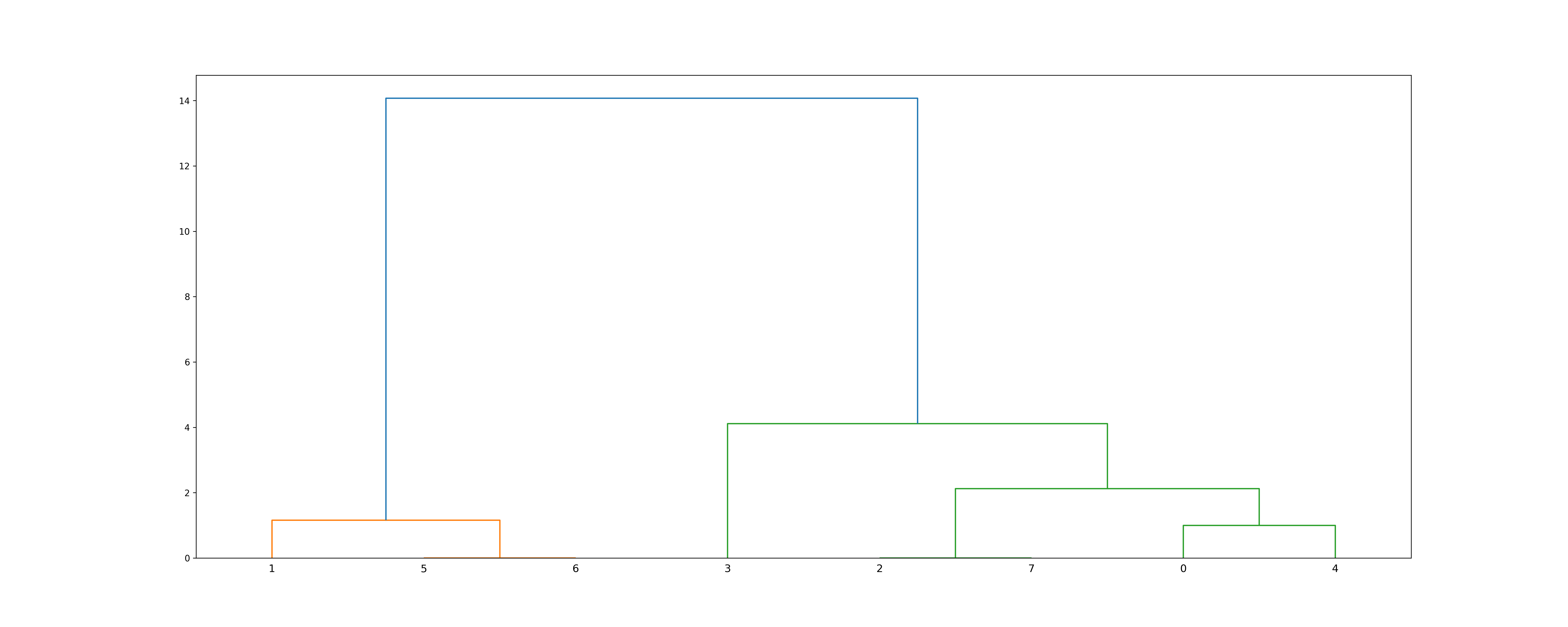
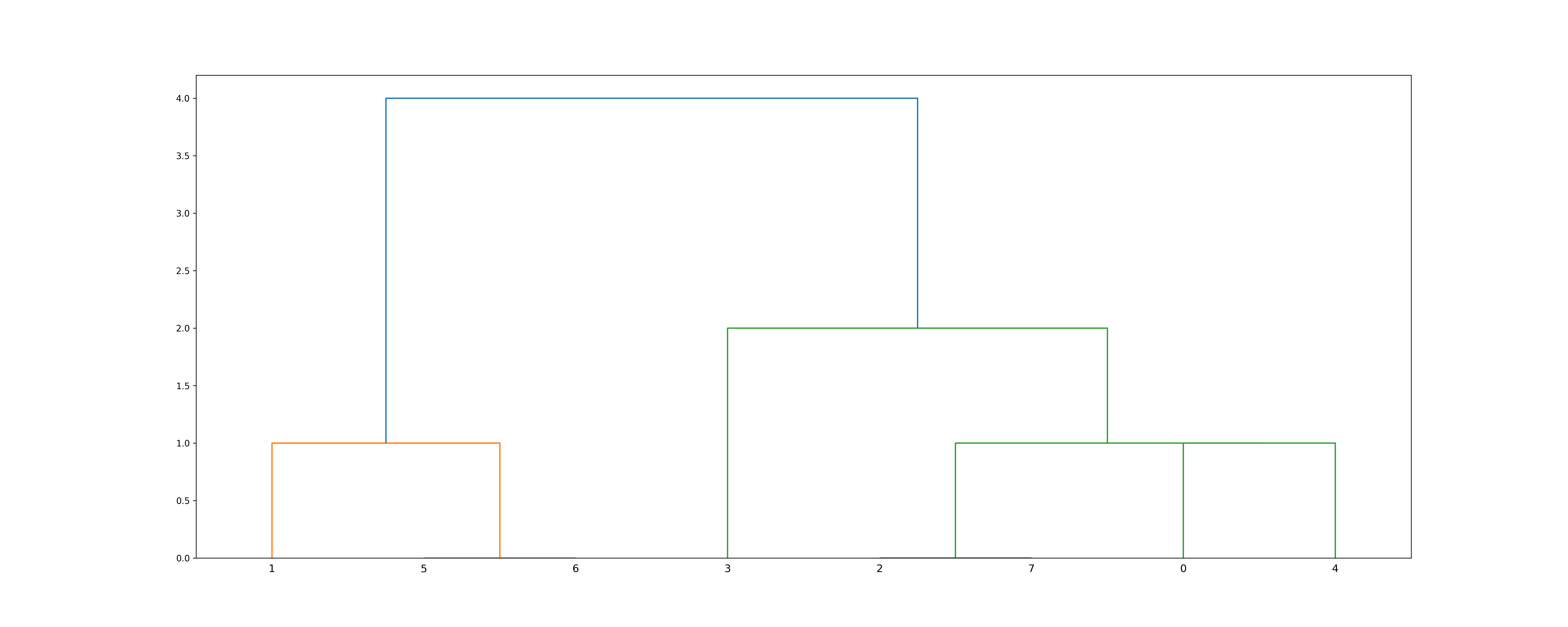
X = [[i] for i in [2, 8, 0, 4, 1, 9, 9, 0]]
✓
Z = linkage(X, 'ward')
fig = plt.figure(figsize=(25, 10))
dn = dendrogram(Z)
✓
Z = linkage(X, 'single')
fig = plt.figure(figsize=(25, 10))
dn = dendrogram(Z)
plt.show()
✓
See also
- scipy.spatial.distance.pdist
pairwise distance metrics
Aliases
-
scipy.cluster.hierarchy.linkage