bundles / scipy latest / scipy / integrate / _bvp / solve_bvp
function
scipy.integrate._bvp:solve_bvp
source: build-install/usr/lib/python3.14/site-packages/scipy/integrate/_bvp.py:711
Signature
def solve_bvp(fun, bc, x, y, p = None, S = None, fun_jac = None, bc_jac = None, tol = 0.001, max_nodes = 1000, verbose = 0, bc_tol = None)Summary
Solve a boundary value problem for a system of ODEs.
Extended Summary
This function numerically solves a first order system of ODEs subject to two-point boundary conditions
dy / dx = f(x, y, p) + S * y / (x - a), a <= x <= b
bc(y(a), y(b), p) = 0
Here x is a 1-D independent variable, y(x) is an n-D vector-valued function and p is a k-D vector of unknown parameters which is to be found along with y(x). For the problem to be determined, there must be n + k boundary conditions, i.e., bc must be an (n + k)-D function.
The last singular term on the right-hand side of the system is optional. It is defined by an n-by-n matrix S, such that the solution must satisfy S y(a) = 0. This condition will be forced during iterations, so it must not contradict boundary conditions. See [2] for the explanation how this term is handled when solving BVPs numerically.
Problems in a complex domain can be solved as well. In this case, y and p are considered to be complex, and f and bc are assumed to be complex-valued functions, but x stays real. Note that f and bc must be complex differentiable (satisfy Cauchy-Riemann equations [4]), otherwise you should rewrite your problem for real and imaginary parts separately. To solve a problem in a complex domain, pass an initial guess for y with a complex data type (see below).
Parameters
fun: callableRight-hand side of the system. The calling signature is
fun(x, y), orfun(x, y, p)if parameters are present. All arguments are ndarray:xwith shape (m,),ywith shape (n, m), meaning thaty[:, i]corresponds tox[i], andpwith shape (k,). The return value must be an array with shape (n, m) and with the same layout asy.bc: callableFunction evaluating residuals of the boundary conditions. The calling signature is
bc(ya, yb), orbc(ya, yb, p)if parameters are present. All arguments are ndarray:yaandybwith shape (n,), andpwith shape (k,). The return value must be an array with shape (n + k,). The order of the returned residuals does not matter, as solve_bvp attempts to drive all residuals to zero.x: array_like, shape (m,)Initial mesh. Must be a strictly increasing sequence of real numbers with
x[0]=aandx[-1]=b.y: array_like, shape (n, m)Initial guess for the function values at the mesh nodes, ith column corresponds to
x[i]. For problems in a complex domain passywith a complex data type (even if the initial guess is purely real).p: array_like with shape (k,) or None, optionalInitial guess for the unknown parameters. If None (default), it is assumed that the problem doesn't depend on any parameters.
S: array_like with shape (n, n) or NoneMatrix defining the singular term. If None (default), the problem is solved without the singular term.
fun_jac: callable or None, optionalFunction computing derivatives of f with respect to y and p. The calling signature is
fun_jac(x, y), orfun_jac(x, y, p)if parameters are present. The return must contain 1 or 2 elements in the following order:df_dyarray_like with shape
(n, n, m), where an element(i, j, q)equals tod f_i(x_q, y_q, p) / d (y_q)_j.df_dparray_like with shape
(n, k, m), where an element(i, j, q)equals tod f_i(x_q, y_q, p) / d p_j.
Here q numbers nodes at which x and y are defined, whereas i and j number vector components. If the problem is solved without unknown parameters, df_dp should not be returned.
If
fun_jacis None (default), the derivatives will be estimated by the forward finite differences.bc_jac: callable or None, optionalFunction computing derivatives of bc with respect to ya, yb, and p. The calling signature is
bc_jac(ya, yb), orbc_jac(ya, yb, p)if parameters are present. The return must contain 2 or 3 elements in the following order:dbc_dyaarray_like with shape(n, n), where an element(i, j)equals tod bc_i(ya, yb, p) / d ya_j.dbc_dybarray_like with shape(n, n), where an element(i, j)equals tod bc_i(ya, yb, p) / d yb_j.dbc_dparray_like with shape(n, k), where an element(i, j)equals tod bc_i(ya, yb, p) / d p_j.
If the problem is solved without unknown parameters, dbc_dp should not be returned.
If
bc_jacis None (default), the derivatives will be estimated by the forward finite differences.tol: float, optionalDesired tolerance of the solution. If we define
r = y' - f(x, y), where y is the found solution, then the solver tries to achieve on each mesh intervalnorm(r / (1 + abs(f)) < tol, wherenormis estimated in a root mean squared sense (using a numerical quadrature formula). Default is 1e-3.max_nodes: int, optionalMaximum allowed number of the mesh nodes. If exceeded, the algorithm terminates. Default is 1000.
verbose: {0, 1, 2}, optionalLevel of algorithm's verbosity:
0 (default)work silently.
1display a termination report.
2display progress during iterations.
bc_tol: float, optionalDesired absolute tolerance for the boundary condition residuals:
bcvalue should satisfyabs(bc) < bc_tolcomponent-wise. Equals totolby default. Up to 10 iterations are allowed to achieve this tolerance.
Returns
result: BVPResultBunch object with the following fields defined:
sol
Found solution for y as scipy.interpolate.PPoly instance, a C1 continuous cubic spline.
p
Found parameters. None, if the parameters were not present in the problem.
x
Nodes of the final mesh.
y
Solution values at the mesh nodes.
yp
Solution derivatives at the mesh nodes.
rms_residuals
RMS values of the relative residuals over each mesh interval (see the description of
tolparameter).niter
Number of completed iterations.
status
Reason for algorithm termination:
0: The algorithm converged to the desired accuracy.
1: The maximum number of mesh nodes is exceeded.
2: A singular Jacobian encountered when solving the collocation system.
message
Verbal description of the termination reason.
success
True if the algorithm converged to the desired accuracy (
status=0).
Notes
This function implements a 4th order collocation algorithm with the control of residuals similar to [1]. A collocation system is solved by a damped Newton method with an affine-invariant criterion function as described in [3].
Note that in [1] integral residuals are defined without normalization by interval lengths. So, their definition is different by a multiplier of h**0.5 (h is an interval length) from the definition used here.
Examples
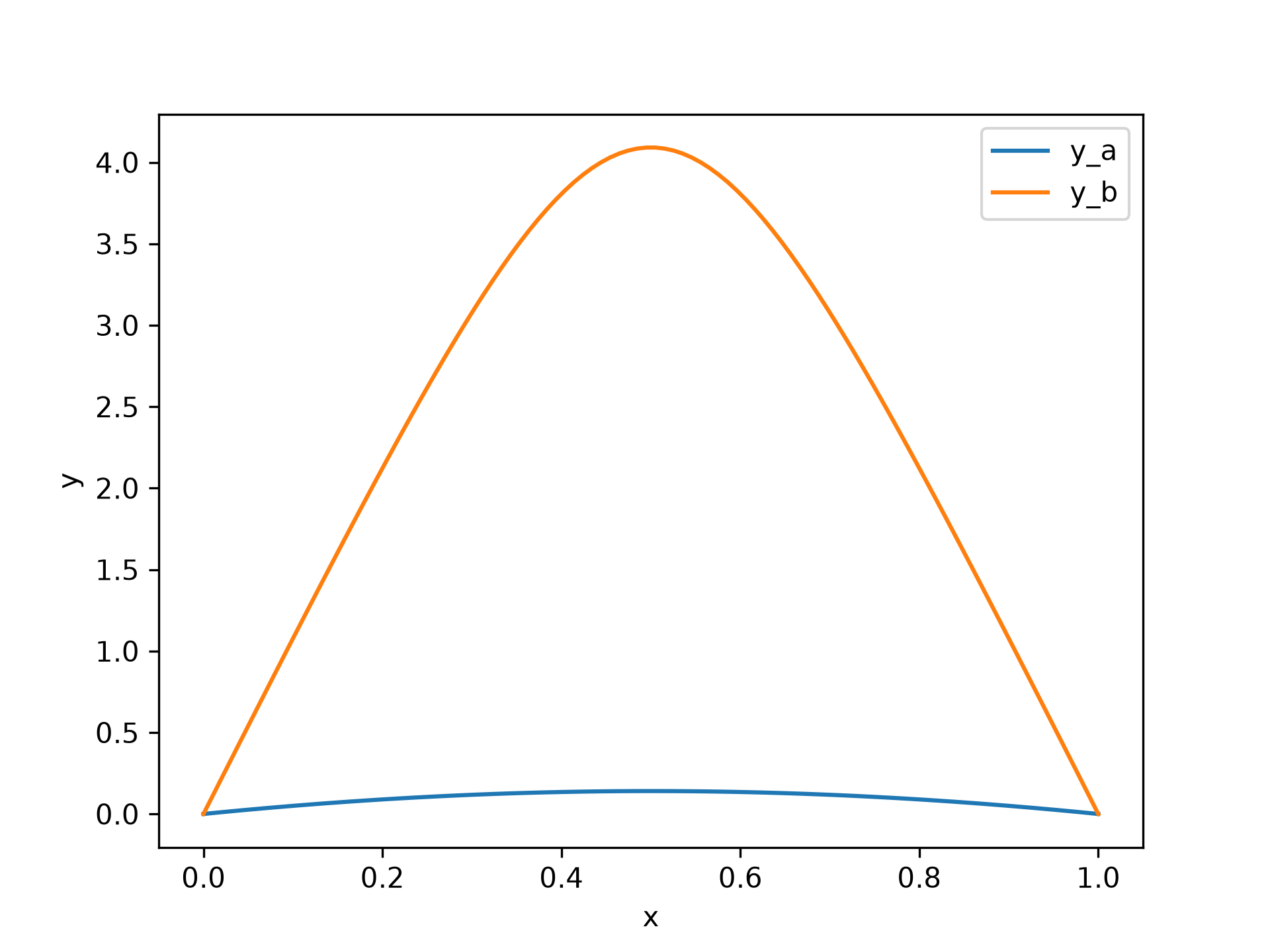
In the first example, we solve Bratu's problem:: y'' + k * exp(y) = 0 y(0) = y(1) = 0 for k = 1. We rewrite the equation as a first-order system and implement its right-hand side evaluation:: y1' = y2 y2' = -exp(y1)import numpy as np def fun(x, y): return np.vstack((y[1], -np.exp(y[0])))✓
def bc(ya, yb):
    return np.array([ya[0], yb[0]])
✓
x = np.linspace(0, 1, 5)
✓y_a = np.zeros((2, x.size)) y_b = np.zeros((2, x.size)) y_b[0] = 3✓
from scipy.integrate import solve_bvp
res_a = solve_bvp(fun, bc, x, y_a)
res_b = solve_bvp(fun, bc, x, y_b)
✓
x_plot = np.linspace(0, 1, 100)
y_plot_a = res_a.sol(x_plot)[0]
y_plot_b = res_b.sol(x_plot)[0]
import matplotlib.pyplot as plt
✓
plt.plot(x_plot, y_plot_a, label='y_a')
plt.plot(x_plot, y_plot_b, label='y_b')
plt.legend()
plt.xlabel("x")
plt.ylabel("y")
✗
Text(0, 0.5, 'y')
plt.show()
✓
def fun(x, y, p):
    k = p[0]
    return np.vstack((y[1], -k**2 * y[0]))
✓
def bc(ya, yb, p):
    k = p[0]
    return np.array([ya[0], yb[0], ya[1] - k])
✓
x = np.linspace(0, 1, 5)
y = np.zeros((2, x.size))
y[0, 1] = 1
y[0, 3] = -1
✓
sol = solve_bvp(fun, bc, x, y, p=[6])
✓sol.p[0]
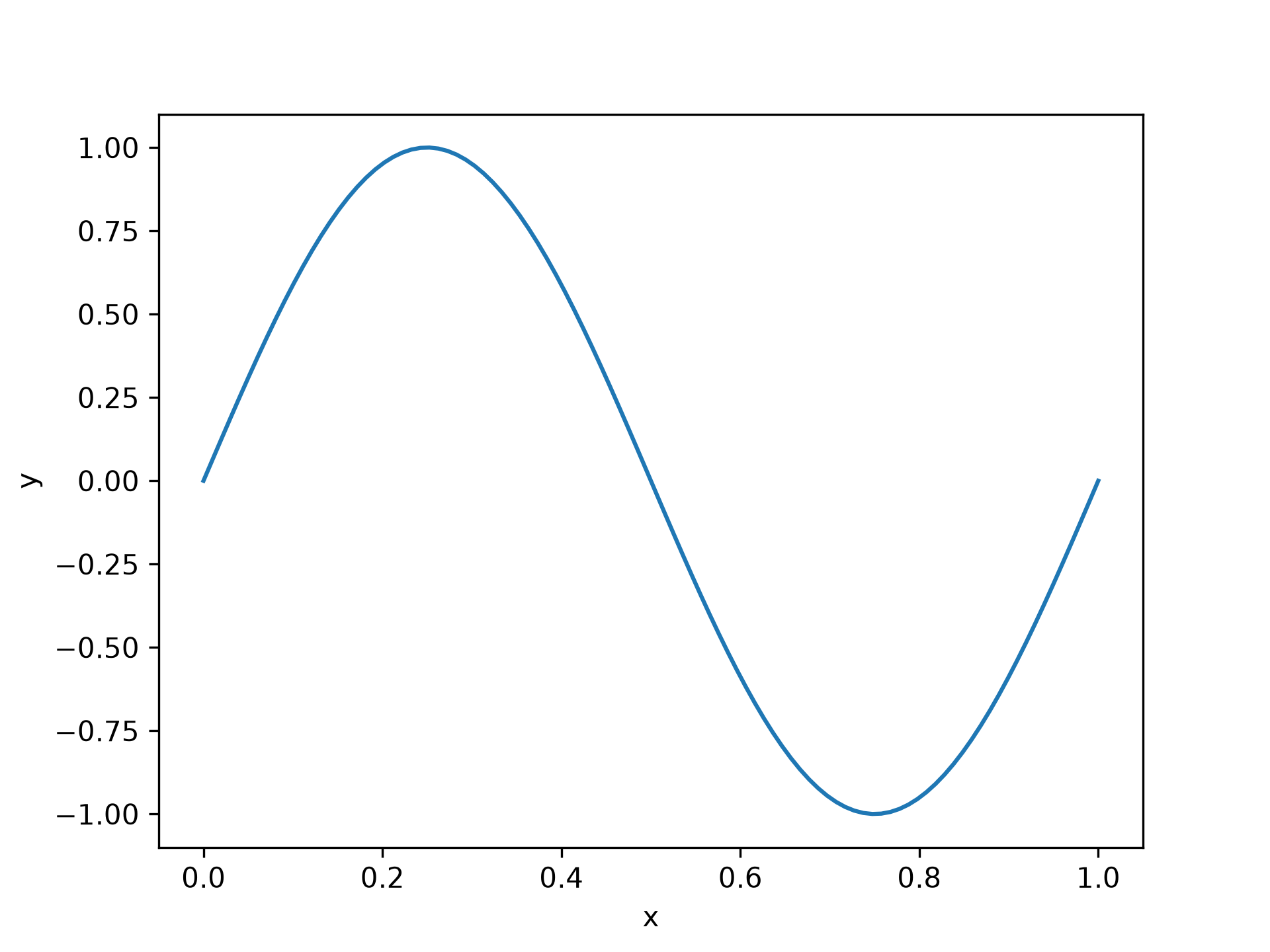
✗np.float64(6.283294600464793)And, finally, plot the solution to see the anticipated sinusoid:
x_plot = np.linspace(0, 1, 100)
y_plot = sol.sol(x_plot)[0]
✓
plt.plot(x_plot, y_plot)
plt.xlabel("x")
plt.ylabel("y")
✗
Text(0, 0.5, 'y')
plt.show()
✓
Aliases
scipy.integrate.solve_bvp