bundles / scipy latest / scipy / integrate / _quad_vec / quad_vec
function
scipy.integrate._quad_vec:quad_vec
source: build-install/usr/lib/python3.14/site-packages/scipy/integrate/_quad_vec.py:97
Signature
def quad_vec(f, a, b, epsabs = 1e-200, epsrel = 1e-08, norm = 2, cache_size = 100000000.0, limit = 10000, workers = 1, points = None, quadrature = None, full_output = False, *, args = ())Summary
Adaptive integration of a vector-valued function.
Parameters
f: callableVector-valued function f(x) to integrate.
a: floatInitial point.
b: floatFinal point.
epsabs: float, optionalAbsolute tolerance.
epsrel: float, optionalRelative tolerance.
norm: {'max', '2'}, optionalVector norm to use for error estimation.
cache_size: int, optionalNumber of bytes to use for memoization.
limit: float or int, optionalAn upper bound on the number of subintervals used in the adaptive algorithm.
workers: int or map-like callable, optionalIf
workersis an integer, part of the computation is done in parallel subdivided to this many tasks (usingpython:multiprocessing.pool.Pool). Supply-1to use all cores available to the Process. Alternatively, supply a map-like callable, such aspython:multiprocessing.pool.Pool.mapfor evaluating the population in parallel. This evaluation is carried out asworkers(func, iterable).points: list, optionalList of additional breakpoints.
quadrature: {'gk21', 'gk15', 'trapezoid'}, optionalQuadrature rule to use on subintervals. Options: 'gk21' (Gauss-Kronrod 21-point rule), 'gk15' (Gauss-Kronrod 15-point rule), 'trapezoid' (composite trapezoid rule). Default: 'gk21' for finite intervals and 'gk15' for (semi-)infinite.
full_output: bool, optionalReturn an additional
infoobject.args: tuple, optionalExtra arguments to pass to function, if any.
Returns
res: {float, array-like}Estimate for the result
err: floatError estimate for the result in the given norm
info: objectReturned only when
full_output=True. Result object with the attributes:success
Whether integration reached target precision.
status
Indicator for convergence, success (0), failure (1), and failure due to rounding error (2).
neval
Number of function evaluations.
intervals
Start and end points of subdivision intervals.
integrals
Integral for each interval. Note that at most
cache_sizevalues are recorded, and the array may contains nan for missing items.errors
Estimated integration error for each interval.
Notes
The algorithm mainly follows the implementation of QUADPACK's DQAG* algorithms, implementing global error control and adaptive subdivision.
The algorithm here has some differences to the QUADPACK approach:
Instead of subdividing one interval at a time, the algorithm subdivides N intervals with largest errors at once. This enables (partial) parallelization of the integration.
The logic of subdividing "next largest" intervals first is then not implemented, and we rely on the above extension to avoid concentrating on "small" intervals only.
The Wynn epsilon table extrapolation is not used (QUADPACK uses it for infinite intervals). This is because the algorithm here is supposed to work on vector-valued functions, in an user-specified norm, and the extension of the epsilon algorithm to this case does not appear to be widely agreed. For max-norm, using elementwise Wynn epsilon could be possible, but we do not do this here with the hope that the epsilon extrapolation is mainly useful in special cases.
Examples
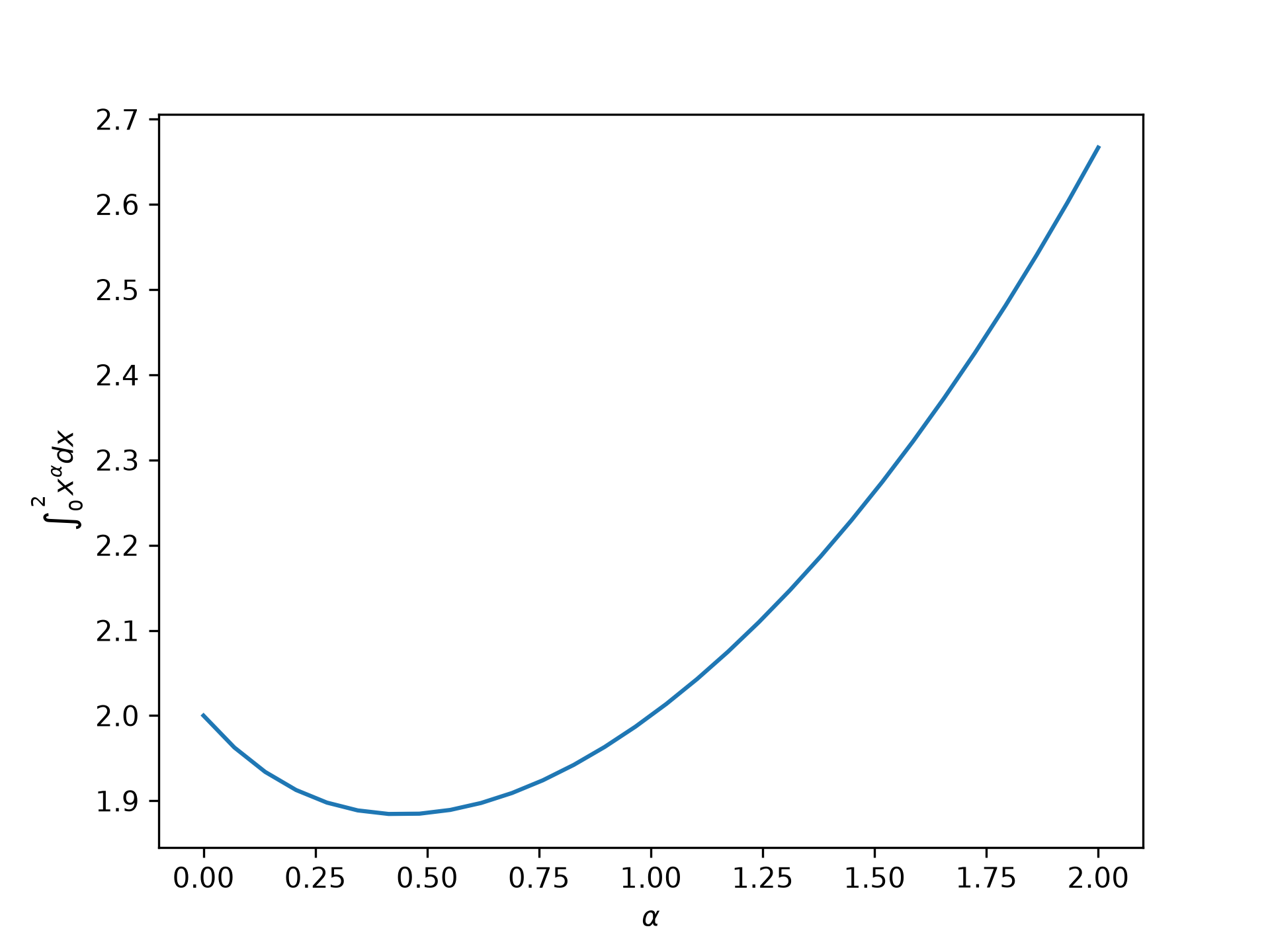
We can compute integrations of a vector-valued function:from scipy.integrate import quad_vec import numpy as np import matplotlib.pyplot as plt alpha = np.linspace(0.0, 2.0, num=30) f = lambda x: x**alpha x0, x1 = 0, 2 y, err = quad_vec(f, x0, x1)✓
plt.plot(alpha, y)
plt.xlabel(r"$\alpha$")
plt.ylabel(r"$\int_{0}^{2} x^\alpha dx$")
✗
Text(0, 0.5, '$\\int_{0}^{2} x^\\alpha dx$')
plt.show()
✓
Aliases
scipy.integrate.quad_vec