bundles / scipy latest / scipy / ndimage / _fourier / fourier_uniform
function
scipy.ndimage._fourier:fourier_uniform
source: build-install/usr/lib/python3.14/site-packages/scipy/ndimage/_fourier.py:129
Signature
def fourier_uniform(input, size, n = -1, axis = -1, output = None)Summary
Multidimensional uniform fourier filter.
Extended Summary
The array is multiplied with the Fourier transform of a box of given size.
Parameters
input: array_likeThe input array.
size: float or sequenceThe size of the box used for filtering. If a float,
sizeis the same for all axes. If a sequence,sizehas to contain one value for each axis.n: int, optionalIf
nis negative (default), then the input is assumed to be the result of a complex fft. Ifnis larger than or equal to zero, the input is assumed to be the result of a real fft, andngives the length of the array before transformation along the real transform direction.axis: int, optionalThe axis of the real transform.
output: ndarray, optionalIf given, the result of filtering the input is placed in this array.
Returns
fourier_uniform: ndarrayThe filtered input.
Examples
from scipy import ndimage, datasets
import numpy.fft
import matplotlib.pyplot as plt
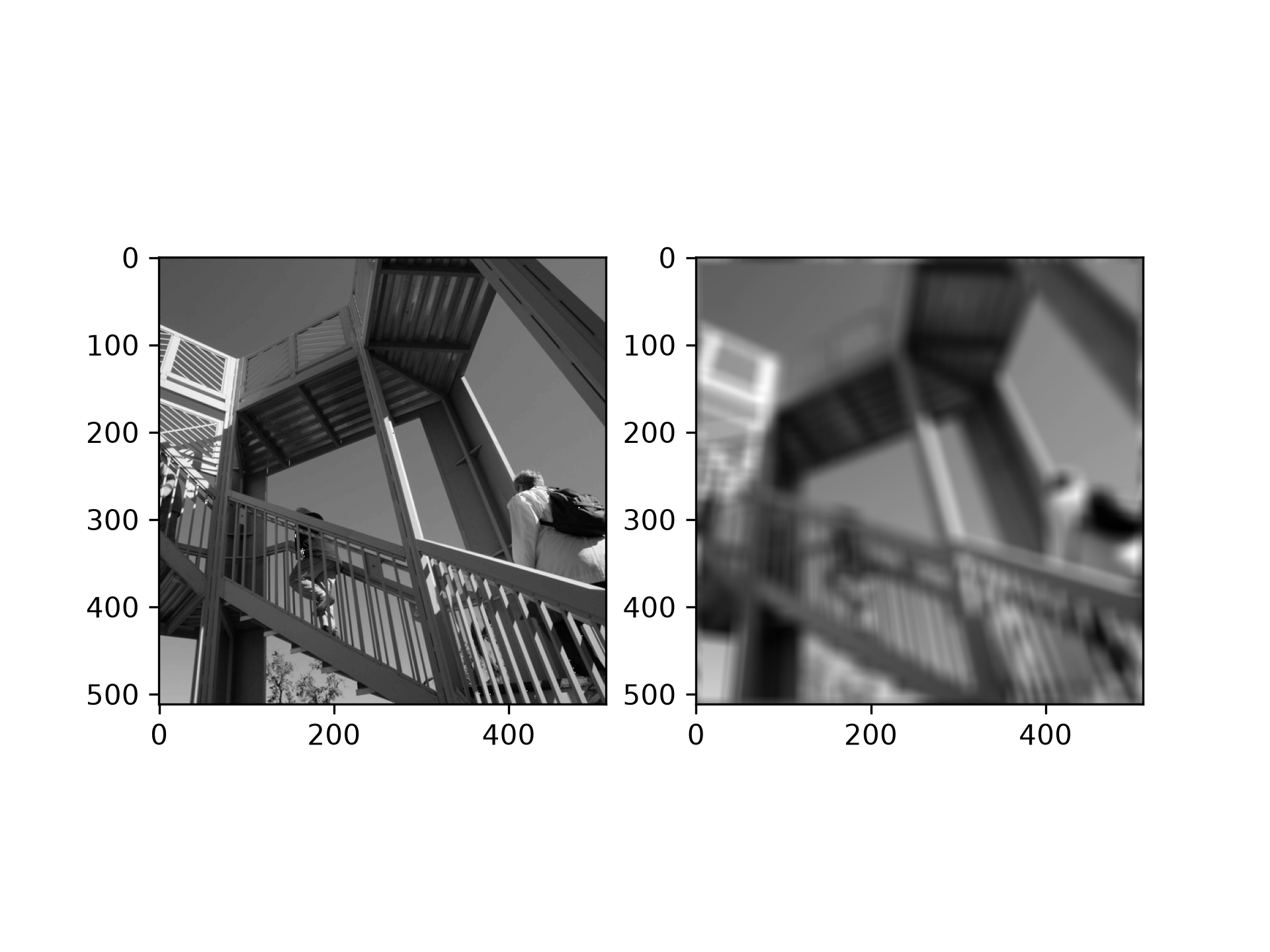
fig, (ax1, ax2) = plt.subplots(1, 2)
plt.gray()  # show the filtered result in grayscale
ascent = datasets.ascent()
input_ = numpy.fft.fft2(ascent)
result = ndimage.fourier_uniform(input_, size=20)
result = numpy.fft.ifft2(result)
✓
ax1.imshow(ascent)
ax2.imshow(result.real)  # the imaginary part is an artifact
✗
<matplotlib.image.AxesImage object at 0x7f3f59d66210>
plt.show()
✓
Aliases
scipy.ndimage.fourier_uniform