bundles / scipy latest / scipy / ndimage / _morphology / distance_transform_cdt
function
scipy.ndimage._morphology:distance_transform_cdt
source: build-install/usr/lib/python3.14/site-packages/scipy/ndimage/_morphology.py:2223
Signature
def distance_transform_cdt(input, metric = chessboard, return_distances = True, return_indices = False, distances = None, indices = None)Summary
Distance transform for chamfer type of transforms.
Extended Summary
This function calculates the distance transform of the input, by replacing each foreground (non-zero) element, with its shortest distance to the background (any zero-valued element).
In addition to the distance transform, the feature transform can be calculated. In this case the index of the closest background element to each foreground element is returned in a separate array.
Parameters
input: array_likeInput. Values of 0 are treated as background.
metric: {'chessboard', 'taxicab'} or array_like, optionalThe
metricdetermines the type of chamfering that is done. If themetricis equal to 'taxicab' a structure is generated using generate_binary_structure with a squared distance equal to 1. If themetricis equal to 'chessboard', ametricis generated using generate_binary_structure with a squared distance equal to the dimensionality of the array. These choices correspond to the common interpretations of the 'taxicab' and the 'chessboard' distance metrics in two dimensions. A custom metric may be provided, in the form of a matrix where each dimension has a length of three. 'cityblock' and 'manhattan' are also valid, and map to 'taxicab'. The default is 'chessboard'.return_distances: bool, optionalWhether to calculate the distance transform. Default is True.
return_indices: bool, optionalWhether to calculate the feature transform. Default is False.
distances: int32 ndarray, optionalAn output array to store the calculated distance transform, instead of returning it.
return_distancesmust be True. It must be the same shape asinput.indices: int32 ndarray, optionalAn output array to store the calculated feature transform, instead of returning it.
return_indicesmust be True. Its shape must be(input.ndim,) + input.shape.
Returns
distances: int32 ndarray, optionalThe calculated distance transform. Returned only when
return_distancesis True, anddistancesis not supplied. It will have the same shape as the input array.indices: int32 ndarray, optionalThe calculated feature transform. It has an input-shaped array for each dimension of the input. See distance_transform_edt documentation for an example. Returned only when
return_indicesis True, andindicesis not supplied.
Examples
Import the necessary modules.import numpy as np from scipy.ndimage import distance_transform_cdt import matplotlib.pyplot as plt from mpl_toolkits.axes_grid1 import ImageGrid✓
def add_circle(center_x, center_y, radius, image, fillvalue=1):
    # fill circular area with 1
    xx, yy = np.mgrid[:image.shape[0], :image.shape[1]]
    circle = (xx - center_x) ** 2 + (yy - center_y) ** 2
    circle_shape = np.sqrt(circle) < radius
    image[circle_shape] = fillvalue
    return image
image = np.zeros((100, 100), dtype=np.uint8)
image[35:65, 20:80] = 1
image = add_circle(28, 65, 10, image)
image = add_circle(37, 30, 10, image)
image = add_circle(70, 45, 20, image)
image = add_circle(45, 80, 10, image)
✓
fig = plt.figure(figsize=(5, 15))
grid = ImageGrid(fig, 111, nrows_ncols=(3, 1), axes_pad=(0.5, 0.3),
                 label_mode="1", share_all=True,
                 cbar_location="right", cbar_mode="each",
                 cbar_size="7%", cbar_pad="2%")
✓
for ax in grid:
    ax.axis('off')
✗
(np.float64(0.0), np.float64(1.0), np.float64(0.0), np.float64(1.0))
(np.float64(0.0), np.float64(1.0), np.float64(0.0), np.float64(1.0))
(np.float64(0.0), np.float64(1.0), np.float64(0.0), np.float64(1.0))
top, middle, bottom = grid
colorbar_ticks = [0, 10, 20]
✓
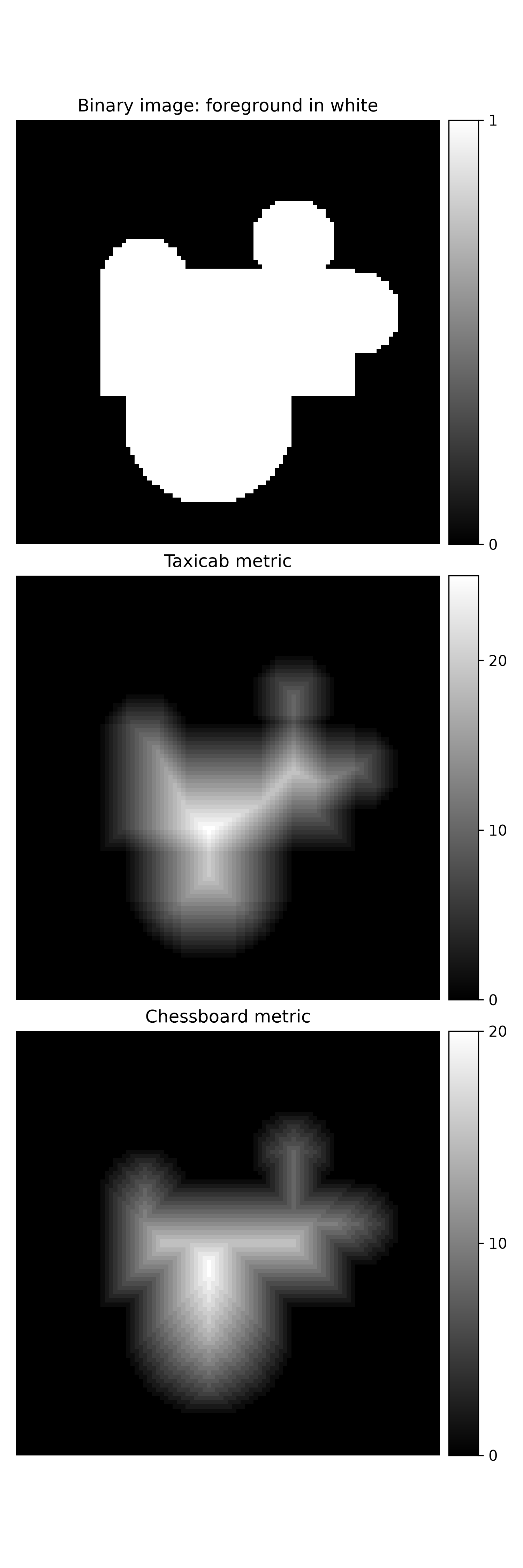
binary_image = top.imshow(image, cmap='gray')
cbar_binary_image = top.cax.colorbar(binary_image)
cbar_binary_image.set_ticks([0, 1])
✓
top.set_title("Binary image: foreground in white")
✗Text(0.5, 1.0, 'Binary image: foreground in white')The middle image contains the distance transform using the ``taxicab`` metric.
distance_taxicab = distance_transform_cdt(image, metric="taxicab")
taxicab_transform = middle.imshow(distance_taxicab, cmap='gray')
cbar_taxicab = middle.cax.colorbar(taxicab_transform)
cbar_taxicab.set_ticks(colorbar_ticks)
✓
middle.set_title("Taxicab metric")
✗Text(0.5, 1.0, 'Taxicab metric')The bottom image contains the distance transform using the ``chessboard`` metric.
distance_chessboard = distance_transform_cdt(image,
                                             metric="chessboard")
chessboard_transform = bottom.imshow(distance_chessboard, cmap='gray')
cbar_chessboard = bottom.cax.colorbar(chessboard_transform)
cbar_chessboard.set_ticks(colorbar_ticks)
✓
bottom.set_title("Chessboard metric")
✗Text(0.5, 1.0, 'Chessboard metric')
plt.tight_layout()
plt.show()
✓
See also
- distance_transform_bf
Distance transform for different metrics using a slower brute force algorithm
- distance_transform_edt
Fast distance transform for euclidean metric
Aliases
scipy.ndimage.distance_transform_cdt