bundles / scipy latest / scipy / optimize / _root / root
function
scipy.optimize._root:root
source: build-install/usr/lib/python3.14/site-packages/scipy/optimize/_root.py:25
Signature
def root(fun, x0, args = (), method = hybr, jac = None, tol = None, callback = None, options = None)Summary
Find a root of a vector function.
Parameters
fun: callableA vector function to find a root of.
Suppose the callable has signature
f0(x, *my_args, **my_kwargs), wheremy_argsandmy_kwargsare required positional and keyword arguments. Rather than passingf0as the callable, wrap it to accept onlyx; e.g., passfun=lambda x: f0(x, *my_args, **my_kwargs)as the callable, wheremy_args(tuple) andmy_kwargs(dict) have been gathered before invoking this function.x0: ndarrayInitial guess.
args: tuple, optionalExtra arguments passed to the objective function and its Jacobian.
method: str, optionalType of solver. Should be one of
'hybr' (see here)
'lm' (see here)
'broyden1' (see here)
'broyden2' (see here)
'anderson' (see here)
'linearmixing' (see here)
'diagbroyden' (see here)
'excitingmixing' (see here)
'krylov' (see here)
'df-sane' (see here)
jac: bool or callable, optionalIf
jacis a Boolean and is True,funis assumed to return the value of Jacobian along with the objective function. If False, the Jacobian will be estimated numerically.jaccan also be a callable returning the Jacobian offun. In this case, it must accept the same arguments asfun.tol: float, optionalTolerance for termination. For detailed control, use solver-specific options.
callback: function, optionalOptional callback function. It is called on every iteration as
callback(x, f)wherexis the current solution andfthe corresponding residual. For all methods but 'hybr' and 'lm'.options: dict, optionalA dictionary of solver options. E.g.,
xtolormaxiter, see show_options() for details.
Returns
sol: OptimizeResultThe solution represented as a
OptimizeResultobject. Important attributes are:xthe solution array,successa Boolean flag indicating if the algorithm exited successfully andmessagewhich describes the cause of the termination. See OptimizeResult for a description of other attributes.
Notes
This section describes the available solvers that can be selected by the 'method' parameter. The default method is hybr.
Method hybr uses a modification of the Powell hybrid method as implemented in MINPACK [1].
Method lm solves the system of nonlinear equations in a least squares sense using a modification of the Levenberg-Marquardt algorithm as implemented in MINPACK [1].
Method df-sane is a derivative-free spectral method. [3]
Methods broyden1, broyden2, anderson, linearmixing, diagbroyden, excitingmixing, krylov are inexact Newton methods, with backtracking or full line searches [2]. Each method corresponds to a particular Jacobian approximations.
Method broyden1 uses Broyden's first Jacobian approximation, it is known as Broyden's good method.
Method broyden2 uses Broyden's second Jacobian approximation, it is known as Broyden's bad method.
Method anderson uses (extended) Anderson mixing.
Method Krylov uses Krylov approximation for inverse Jacobian. It is suitable for large-scale problem.
Method diagbroyden uses diagonal Broyden Jacobian approximation.
Method linearmixing uses a scalar Jacobian approximation.
Method excitingmixing uses a tuned diagonal Jacobian approximation.
Examples
The following functions define a system of nonlinear equations and its jacobian.import numpy as np def fun(x): return [x[0] + 0.5 * (x[0] - x[1])**3 - 1.0, 0.5 * (x[1] - x[0])**3 + x[1]]✓
def jac(x):
    return np.array([[1 + 1.5 * (x[0] - x[1])**2,
                      -1.5 * (x[0] - x[1])**2],
                     [-1.5 * (x[1] - x[0])**2,
                      1 + 1.5 * (x[1] - x[0])**2]])
✓
from scipy import optimize
sol = optimize.root(fun, [0, 0], jac=jac, method='hybr')
✓
sol.x
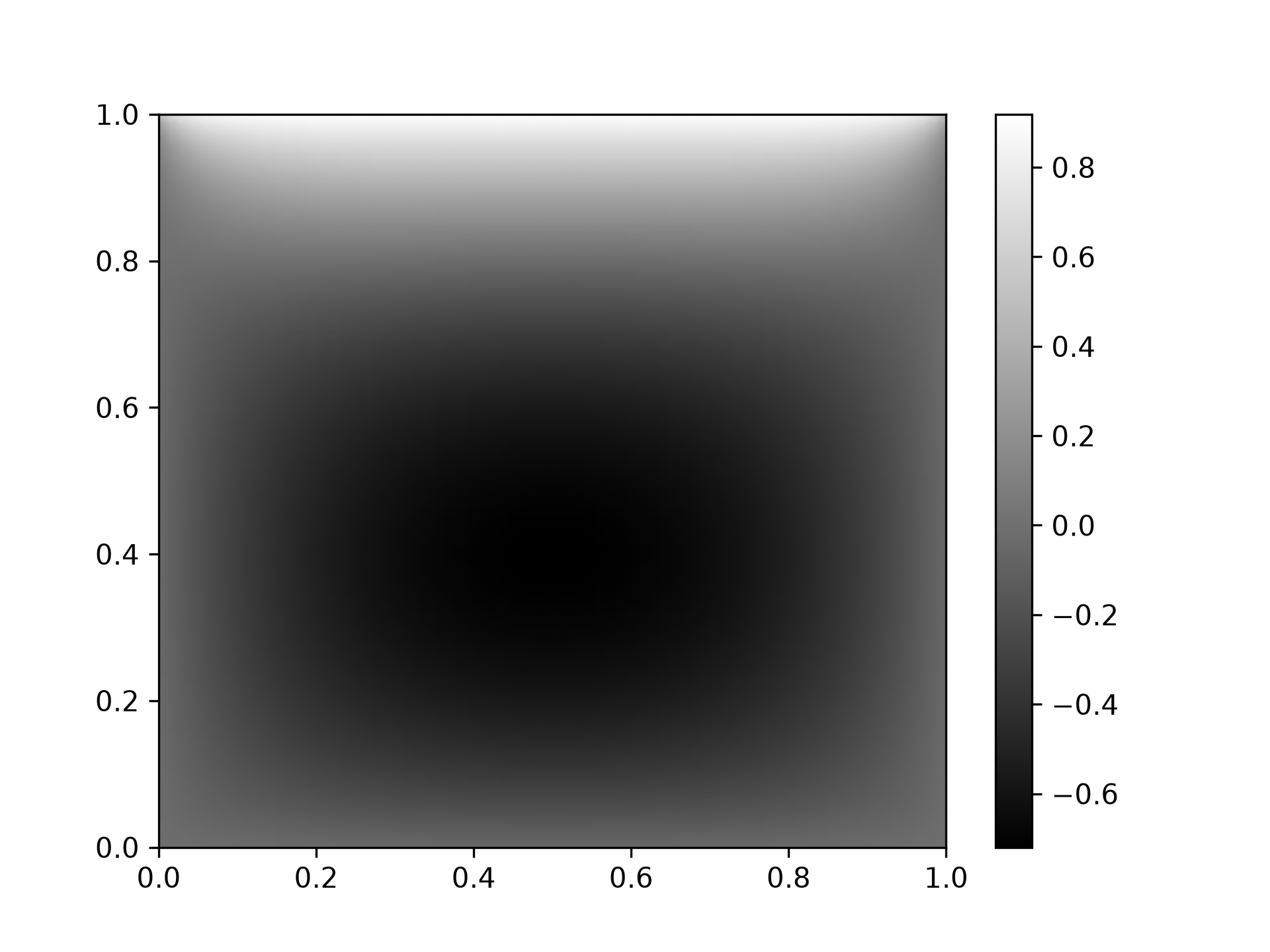
✗array([0.841, 0.159])**Large problem** Suppose that we needed to solve the following integrodifferential equation on the square :math:`[0,1]\times[0,1]`: .. math:: \nabla^2 P = 10 \left(\int_0^1\int_0^1\cosh(P)\,dx\,dy\right)^2 with :math:`P(x,1) = 1` and :math:`P=0` elsewhere on the boundary of the square. The solution can be found using the ``method='krylov'`` solver:
from scipy import optimize
nx, ny = 75, 75
hx, hy = 1./(nx-1), 1./(ny-1)
✓
P_left, P_right = 0, 0
P_top, P_bottom = 1, 0
✓
def residual(P):
   d2x = np.zeros_like(P)
   d2y = np.zeros_like(P)

   d2x[1:-1] = (P[2:]   - 2*P[1:-1] + P[:-2]) / hx/hx
   d2x[0]    = (P[1]    - 2*P[0]    + P_left)/hx/hx
   d2x[-1]   = (P_right - 2*P[-1]   + P[-2])/hx/hx

   d2y[:,1:-1] = (P[:,2:] - 2*P[:,1:-1] + P[:,:-2])/hy/hy
   d2y[:,0]    = (P[:,1]  - 2*P[:,0]    + P_bottom)/hy/hy
   d2y[:,-1]   = (P_top   - 2*P[:,-1]   + P[:,-2])/hy/hy

   return d2x + d2y - 10*np.cosh(P).mean()**2
✓
guess = np.zeros((nx, ny), float)
sol = optimize.root(residual, guess, method='krylov')
✓
print('Residual: %g' % abs(residual(sol.x)).max())
✗Residual: 5.7863e-06
import matplotlib.pyplot as plt
x, y = np.mgrid[0:1:(nx*1j), 0:1:(ny*1j)]
✓
plt.pcolormesh(x, y, sol.x, shading='gouraud')
plt.colorbar()
✗
<matplotlib.colorbar.Colorbar object at 0x7f3f687dae40>
plt.show()
✓
See also
- show_options
Additional options accepted by the solvers
Aliases
scipy.optimize.root