bundles / scipy latest / scipy / spatial / _qhull / HalfspaceIntersection
class
scipy.spatial._qhull:HalfspaceIntersection
source: build-install/usr/lib/python3.14/site-packages/scipy/spatial/_qhull.cpython-314-x86_64-linux-gnu.so
Signature
class HalfspaceIntersection(halfspaces, interior_point, incremental = False, qhull_options = None)Members
Summary
Halfspace intersections in N dimensions.
Extended Summary
Parameters
halfspaces: ndarray of floats, shape (nineq, ndim+1)Stacked Inequalities of the form Ax + b <= 0 in format [A; b]
interior_point: ndarray of floats, shape (ndim,)Point clearly inside the region defined by halfspaces. Also called a feasible point, it can be obtained by linear programming.
incremental: bool, optionalAllow adding new halfspaces incrementally. This takes up some additional resources.
qhull_options: str, optionalAdditional options to pass to Qhull. See Qhull manual for details. (Default: "Qx" for ndim > 4 and "" otherwise) Option "H" is always enabled.
Attributes
halfspaces: ndarray of double, shape (nineq, ndim+1)Input halfspaces.
interior_point :ndarray of floats, shape (ndim,)Input interior point.
intersections: ndarray of double, shape (ninter, ndim)Intersections of all halfspaces.
dual_points: ndarray of double, shape (nineq, ndim)Dual points of the input halfspaces.
dual_facets: list of lists of intsIndices of points forming the (non necessarily simplicial) facets of the dual convex hull.
dual_vertices: ndarray of ints, shape (nvertices,)Indices of halfspaces forming the vertices of the dual convex hull. For 2-D convex hulls, the vertices are in counterclockwise order. For other dimensions, they are in input order.
dual_equations: ndarray of double, shape (nfacet, ndim+1)[normal, offset] forming the hyperplane equation of the dual facet (see Qhull documentation for more).
dual_area: floatArea of the dual convex hull
dual_volume: floatVolume of the dual convex hull
Raises
: QhullErrorRaised when Qhull encounters an error condition, such as geometrical degeneracy when options to resolve are not enabled.
: ValueErrorRaised if an incompatible array is given as input.
Notes
The intersections are computed using the Qhull library. This reproduces the "qhalf" functionality of Qhull.
Examples
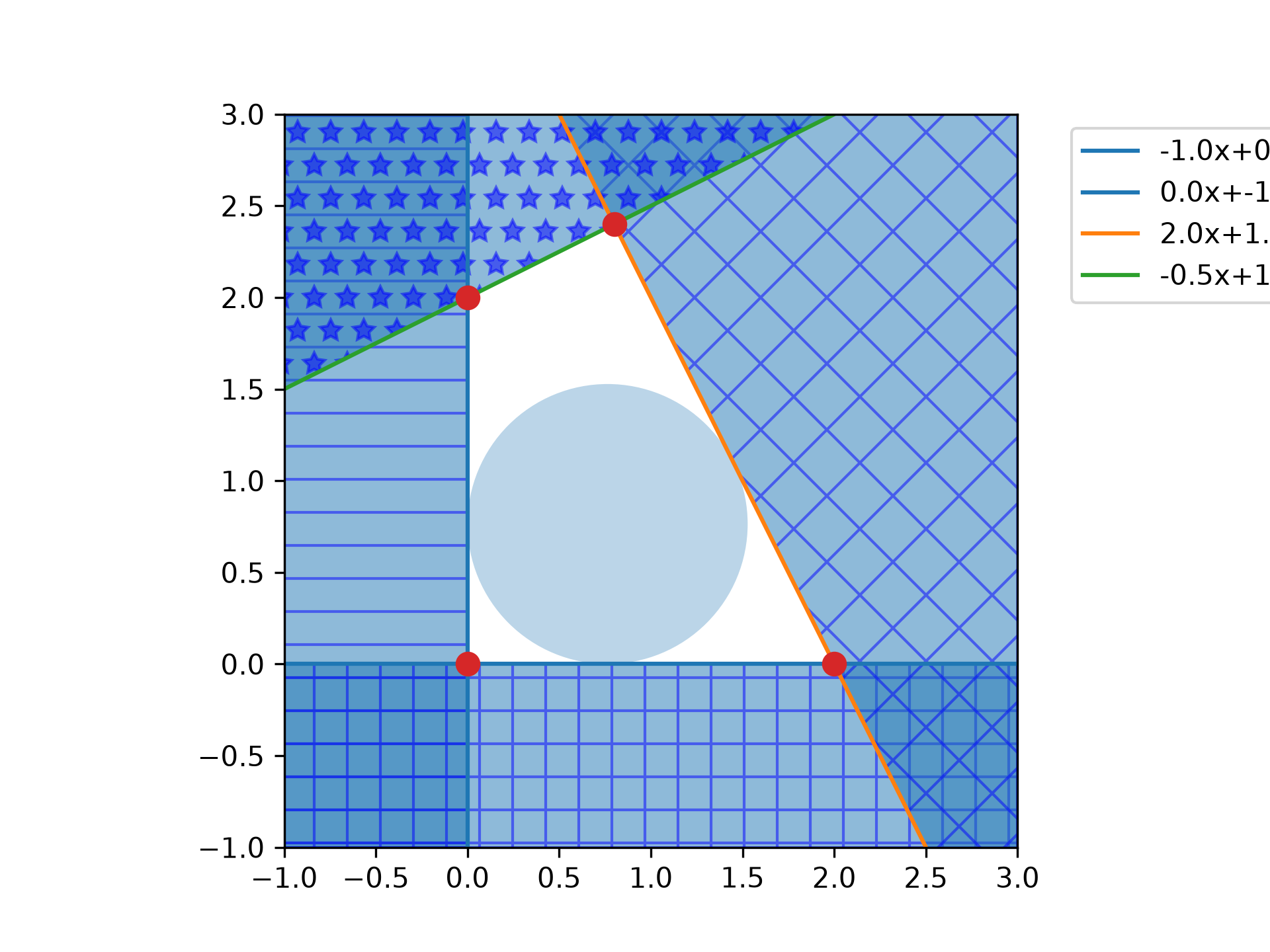
Halfspace intersection of planes forming some polygonfrom scipy.spatial import HalfspaceIntersection import numpy as np halfspaces = np.array([[-1, 0., 0.], [0., -1., 0.], [2., 1., -4.], [-0.5, 1., -2.]]) feasible_point = np.array([0.5, 0.5]) hs = HalfspaceIntersection(halfspaces, feasible_point)✓
import matplotlib.pyplot as plt
fig = plt.figure()
ax = fig.add_subplot(1, 1, 1, aspect='equal')
xlim, ylim = (-1, 3), (-1, 3)
✓
ax.set_xlim(xlim)
ax.set_ylim(ylim)
✗
(-1.0, 3.0)
x = np.linspace(-1, 3, 100)
symbols = ['-', '+', 'x', '*']
signs = [0, 0, -1, -1]
fmt = {"color": None, "edgecolor": "b", "alpha": 0.5}
✓
for h, sym, sign in zip(halfspaces, symbols, signs):
    hlist = h.tolist()
    fmt["hatch"] = sym
    if h[1]== 0:
        ax.axvline(-h[2]/h[0], label='{}x+{}y+{}=0'.format(*hlist))
        xi = np.linspace(xlim[sign], -h[2]/h[0], 100)
        ax.fill_between(xi, ylim[0], ylim[1], **fmt)
    else:
        ax.plot(x, (-h[2]-h[0]*x)/h[1], label='{}x+{}y+{}=0'.format(*hlist))
        ax.fill_between(x, (-h[2]-h[0]*x)/h[1], ylim[sign], **fmt)
✗
<matplotlib.lines.Line2D object at 0x7f3f686d0590>
<matplotlib.collections.FillBetweenPolyCollection object at 0x7f3f686d0440>
[<matplotlib.lines.Line2D object at 0x7f3f686d0830>]
<matplotlib.collections.FillBetweenPolyCollection object at 0x7f3f60956d50>
[<matplotlib.lines.Line2D object at 0x7f3f686d16a0>]
<matplotlib.collections.FillBetweenPolyCollection object at 0x7f3f60956e90>
[<matplotlib.lines.Line2D object at 0x7f3f686d1160>]
<matplotlib.collections.FillBetweenPolyCollection object at 0x7f3f60956c10>
x, y = zip(*hs.intersections)
✓ax.plot(x, y, 'o', markersize=8)
✗[<matplotlib.lines.Line2D object at 0x7f3f686d0c20>]By default, qhull does not provide with a way to compute an interior point. This can easily be computed using linear programming. Considering halfspaces of the form :math:`Ax + b \leq 0`, solving the linear program: .. math:: max \: y s.t. Ax + y ||A_i|| \leq -b With :math:`A_i` being the rows of A, i.e. the normals to each plane. Will yield a point x that is furthest inside the convex polyhedron. To be precise, it is the center of the largest hypersphere of radius y inscribed in the polyhedron. This point is called the Chebyshev center of the polyhedron (see [1]_ 4.3.1, pp148-149). The equations outputted by Qhull are always normalized.
from scipy.optimize import linprog
from matplotlib.patches import Circle
norm_vector = np.reshape(np.linalg.norm(halfspaces[:, :-1], axis=1),
    (halfspaces.shape[0], 1))
c = np.zeros((halfspaces.shape[1],))
c[-1] = -1
A = np.hstack((halfspaces[:, :-1], norm_vector))
b = - halfspaces[:, -1:]
res = linprog(c, A_ub=A, b_ub=b, bounds=(None, None))
x = res.x[:-1]
y = res.x[-1]
circle = Circle(x, radius=y, alpha=0.3)
✓
ax.add_patch(circle)
plt.legend(bbox_to_anchor=(1.6, 1.0))
✗
<matplotlib.legend.Legend object at 0x7f3f686d3380>
plt.show()
✓
Aliases
scipy.spatial.HalfspaceIntersection