bundles / scipy 1.17.1 / scipy / stats / _continuous_distns / kstwo_gen
class
scipy.stats._continuous_distns:kstwo_gen
Signature
class kstwo_gen(momtype = 1, a = None, b = None, xtol = 1e-14, badvalue = None, name = None, longname = None, shapes = None, seed = None)Members
Summary
Kolmogorov-Smirnov two-sided test statistic distribution.
Extended Summary
This is the distribution of the two-sided Kolmogorov-Smirnov (KS) statistic for a finite sample size n >= 1 (the shape parameter).
%(before_notes)s
Notes
is given by
where is a (continuous) CDF and is an empirical CDF. kstwo describes the distribution under the null hypothesis of the KS test that the empirical CDF corresponds to i.i.d. random variates with CDF .
%(after_notes)s
Examples
import numpy as np
from scipy.stats import kstwo
import matplotlib.pyplot as plt
fig, ax = plt.subplots(1, 1)
✓
n = 10
x = np.linspace(kstwo.ppf(0.01, n),
                kstwo.ppf(0.99, n), 100)
✓
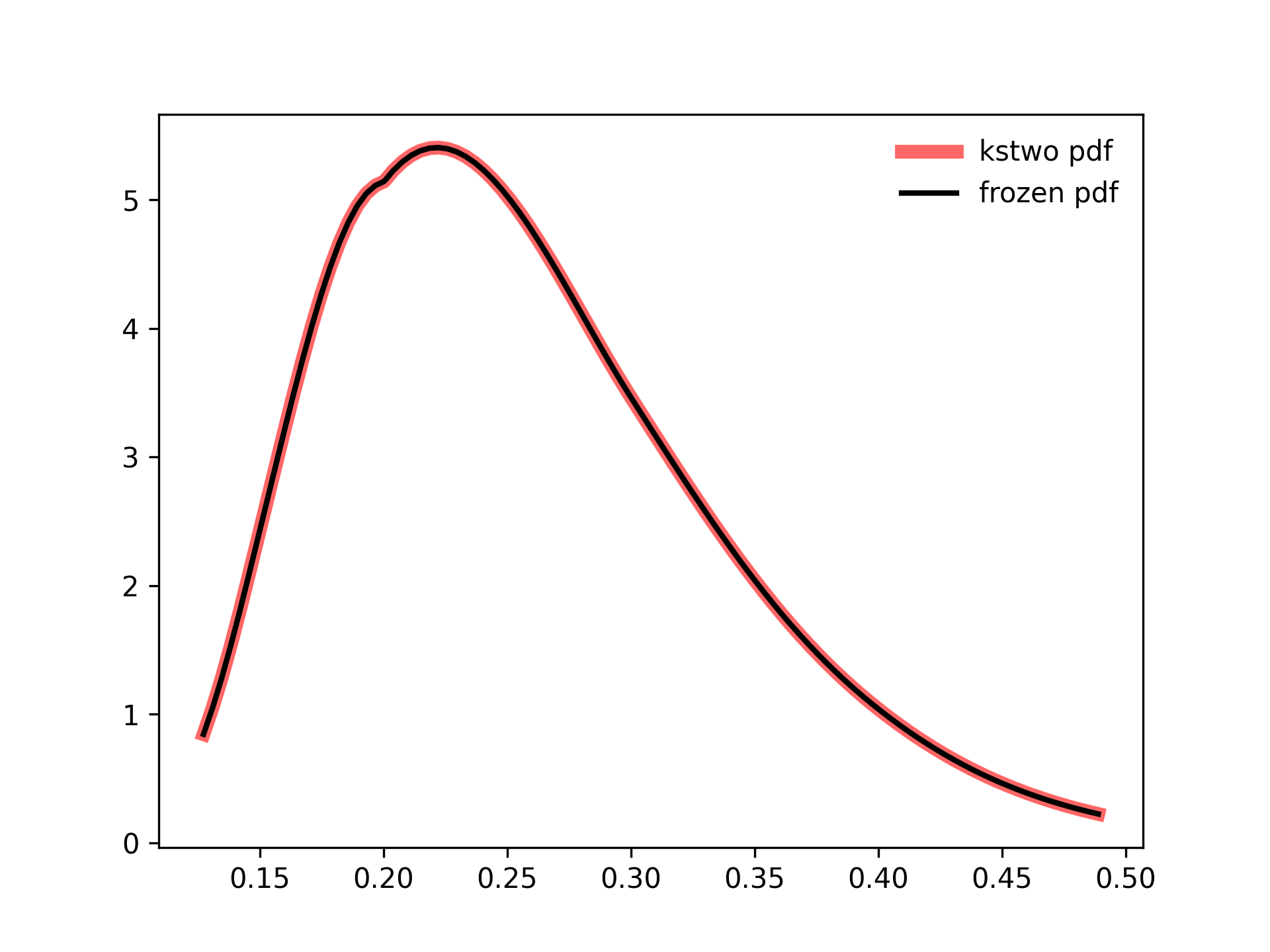
ax.plot(x, kstwo.pdf(x, n),
        'r-', lw=5, alpha=0.6, label='kstwo pdf')
✗
rv = kstwo(n)
✓ax.plot(x, rv.pdf(x), 'k-', lw=2, label='frozen pdf') ax.legend(loc='best', frameon=False)✗
plt.show()
✓
vals = kstwo.ppf([0.001, 0.5, 0.999], n)
np.allclose([0.001, 0.5, 0.999], kstwo.cdf(vals, n))
✓
See also
- ksone
- kstest
- kstwobign
Aliases
scipy.stats._continuous_distns.kstwo_gen