bundles / scipy 1.17.1 / scipy / stats / _continuous_distns / studentized_range_gen
class
scipy.stats._continuous_distns:studentized_range_gen
Signature
class studentized_range_gen(momtype = 1, a = None, b = None, xtol = 1e-14, badvalue = None, name = None, longname = None, shapes = None, seed = None)Members
Summary
A studentized range continuous random variable.
Extended Summary
%(before_notes)s
Notes
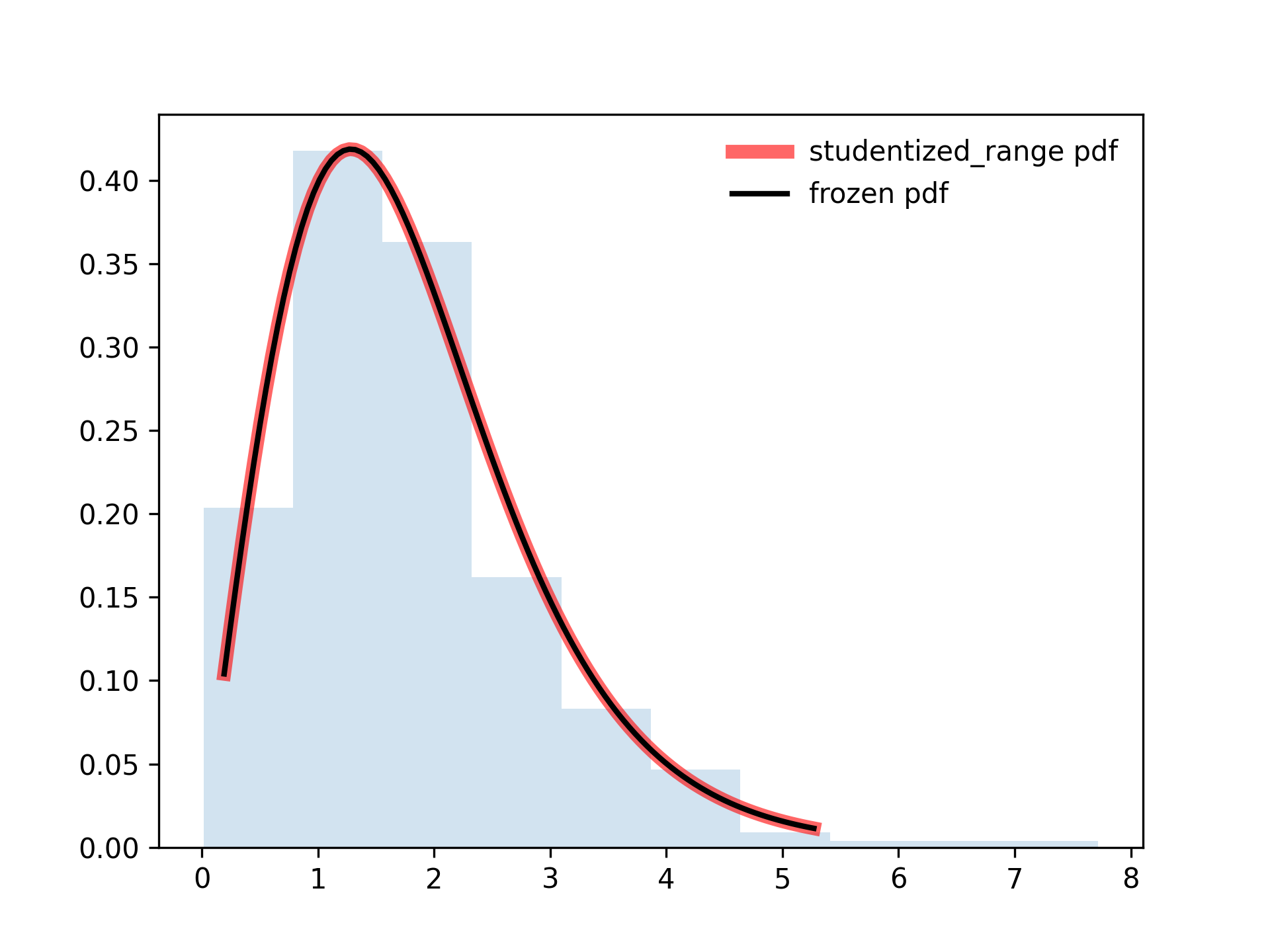
The probability density function for studentized_range is:
for , , and .
studentized_range takes k for and df for as shape parameters.
When exceeds 100,000, an asymptotic approximation (infinite degrees of freedom) is used to compute the cumulative distribution function [4] and probability distribution function.
%(after_notes)s
Examples
import numpy as np
from scipy.stats import studentized_range
import matplotlib.pyplot as plt
fig, ax = plt.subplots(1, 1)
✓
k, df = 3, 10
x = np.linspace(studentized_range.ppf(0.01, k, df),
                studentized_range.ppf(0.99, k, df), 100)
✓
ax.plot(x, studentized_range.pdf(x, k, df),
        'r-', lw=5, alpha=0.6, label='studentized_range pdf')
✗
rv = studentized_range(k, df)
✓ax.plot(x, rv.pdf(x), 'k-', lw=2, label='frozen pdf')
✗vals = studentized_range.ppf([0.001, 0.5, 0.999], k, df) np.allclose([0.001, 0.5, 0.999], studentized_range.cdf(vals, k, df))✓
a, b = studentized_range.ppf([0, .999], k, df)
✓a, b
✗from scipy.interpolate import interp1d rng = np.random.default_rng() xs = np.linspace(a, b, 50)✓
cdf = studentized_range.cdf(xs, k, df)
ppf = interp1d(cdf, xs, fill_value='extrapolate')
✗
r = ppf(rng.uniform(size=1000))
✓ax.hist(r, density=True, histtype='stepfilled', alpha=0.2) ax.legend(loc='best', frameon=False)✗
plt.show()
✓
See also
- t
Student's t distribution
Aliases
scipy.stats._continuous_distns.studentized_range_gen