bundles / scipy latest / scipy / interpolate / _bsplines / BSpline
class
scipy.interpolate._bsplines:BSpline
source: build-install/usr/lib/python3.14/site-packages/scipy/interpolate/_bsplines.py:685
Signature
class BSpline(t, c, k, extrapolate = True, axis = 0)Members
Summary
Univariate spline in the B-spline basis.
Extended Summary
where are B-spline basis functions of degree k and knots t.
Parameters
t: ndarray, shape (n+k+1,)knots
c: ndarray, shape (>=n, ...)spline coefficients
k: intB-spline degree
extrapolate: bool or 'periodic', optionalwhether to extrapolate beyond the base interval,
t[k] .. t[n], or to return nans. If True, extrapolates the first and last polynomial pieces of b-spline functions active on the base interval. If 'periodic', periodic extrapolation is used. Default is True.axis: int, optionalInterpolation axis. Default is zero.
Attributes
t: ndarrayknot vector
c: ndarrayspline coefficients
k: intspline degree
extrapolate: boolIf True, extrapolates the first and last polynomial pieces of b-spline functions active on the base interval.
axis: intInterpolation axis.
tck: tupleA read-only equivalent of
(self.t, self.c, self.k)
Methods
__call__basis_elementderivativeantiderivativeintegrateinsert_knotconstruct_fastdesign_matrixfrom_power_basis
Notes
B-spline basis elements are defined via
Implementation details
At least
k+1coefficients are required for a spline of degreek, so thatn >= k+1. Additional coefficients,c[j]withj > n, are ignored.B-spline basis elements of degree
kform a partition of unity on the base interval,t[k] <= x <= t[n].
Examples
Translating the recursive definition of B-splines into Python code, we have:def B(x, k, i, t): if k == 0: return 1.0 if t[i] <= x < t[i+1] else 0.0 if t[i+k] == t[i]: c1 = 0.0 else: c1 = (x - t[i])/(t[i+k] - t[i]) * B(x, k-1, i, t) if t[i+k+1] == t[i+1]: c2 = 0.0 else: c2 = (t[i+k+1] - x)/(t[i+k+1] - t[i+1]) * B(x, k-1, i+1, t) return c1 + c2✓
def bspline(x, t, c, k):
   n = len(t) - k - 1
   assert (n >= k+1) and (len(c) >= n)
   return sum(c[i] * B(x, k, i, t) for i in range(n))
✓
from scipy.interpolate import BSpline
k = 2
t = [0, 1, 2, 3, 4, 5, 6]
c = [-1, 2, 0, -1]
spl = BSpline(t, c, k)
✓
spl(2.5)
✗array(1.38)
bspline(2.5, t, c, k)
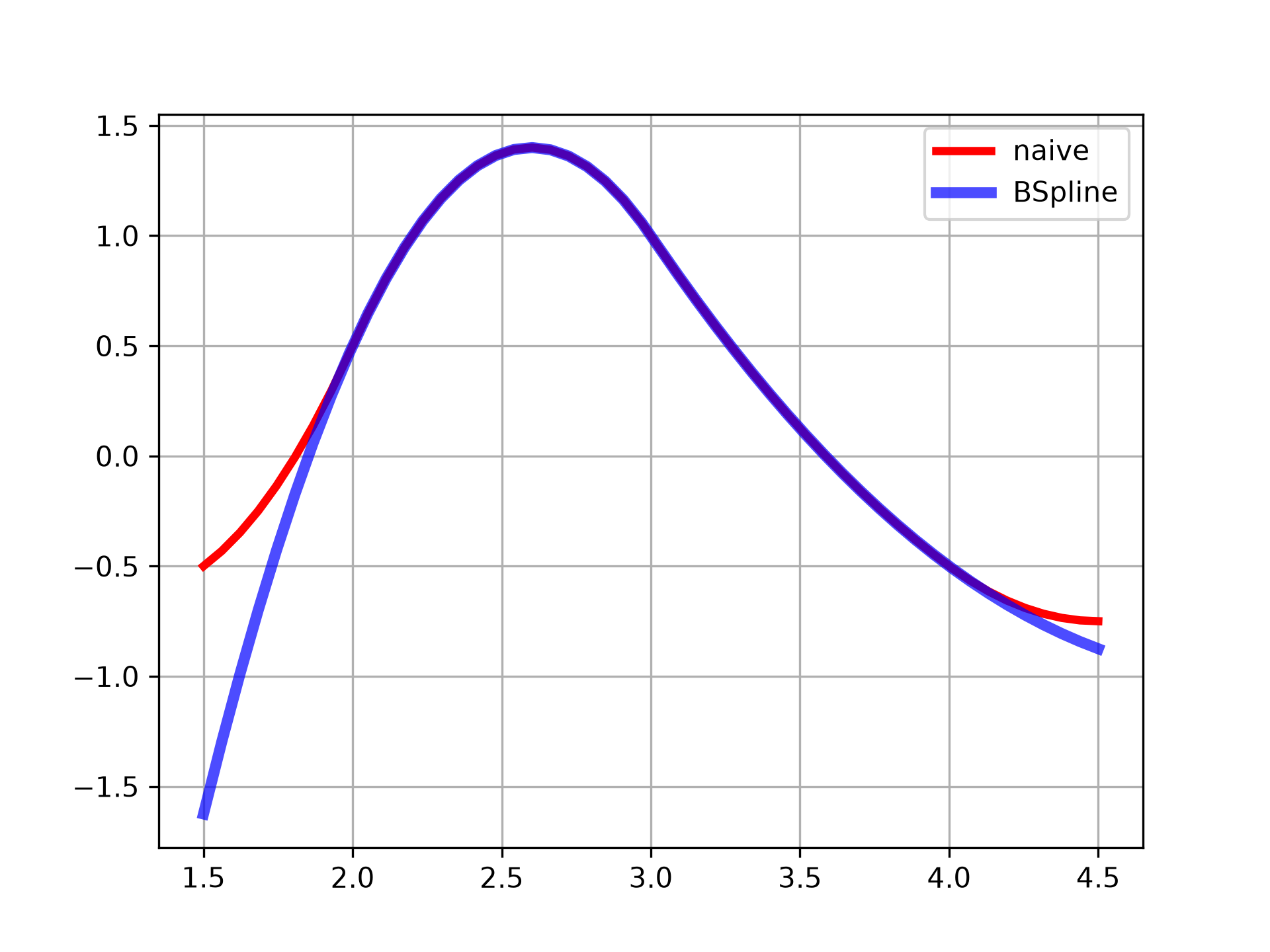
✓1.375Note that outside of the base interval results differ. This is because `BSpline` extrapolates the first and last polynomial pieces of B-spline functions active on the base interval.
import matplotlib.pyplot as plt
import numpy as np
fig, ax = plt.subplots()
xx = np.linspace(1.5, 4.5, 50)
✓
ax.plot(xx, [bspline(x, t, c ,k) for x in xx], 'r-', lw=3, label='naive')
ax.plot(xx, spl(xx), 'b-', lw=4, alpha=0.7, label='BSpline')
✗
[<matplotlib.lines.Line2D object at 0x7f3f6854aba0>]
ax.grid(True)
✓ax.legend(loc='best')
✗<matplotlib.legend.Legend object at 0x7f3f68548ec0>
plt.show()
✓
Aliases
scipy.interpolate.BSpline