bundles / scipy latest / scipy / interpolate / _bsplines / make_smoothing_spline
function
scipy.interpolate._bsplines:make_smoothing_spline
source: build-install/usr/lib/python3.14/site-packages/scipy/interpolate/_bsplines.py:2854
Signature
def make_smoothing_spline(x, y, w = None, lam = None, *, axis = 0)Summary
Create a smoothing B-spline satisfying the Generalized Cross Validation (GCV) criterion.
Extended Summary
Compute the (coefficients of) smoothing cubic spline function using lam to control the tradeoff between the amount of smoothness of the curve and its proximity to the data. In case lam is None, using the GCV criteria [1] to find it.
A smoothing spline is found as a solution to the regularized weighted linear regression problem:
where is a spline function, is a vector of weights and is a regularization parameter.
If lam is None, we use the GCV criteria to find an optimal regularization parameter, otherwise we solve the regularized weighted linear regression problem with given parameter. The parameter controls the tradeoff in the following way: the larger the parameter becomes, the smoother the function gets.
Parameters
x: array_like, shape (n,)Abscissas.
nmust be at least 5.y: array_like, shape (n, ...)Ordinates.
nmust be at least 5.w: array_like, shape (n,), optionalVector of weights. Default is
np.ones_like(x).lam: float, (:math:`\lambda \geq 0`), optionalRegularization parameter. If
lamis None, then it is found from the GCV criteria. Default is None.axis: int, optionalThe data axis. Default is zero. The assumption is that
y.shape[axis] == n, and all other axes ofyare batching axes.
Returns
func: `BSpline` objectAn object representing a spline in the B-spline basis as a solution of the problem of smoothing splines using the GCV criteria [1] in case
lamis None, otherwise using the given parameterlam.
Notes
This algorithm is a clean room reimplementation of the algorithm introduced by Woltring in FORTRAN [2]. The original version cannot be used in SciPy source code because of the license issues. The details of the reimplementation are discussed here (available only in Russian) [4].
If the vector of weights w is None, we assume that all the points are equal in terms of weights, and vector of weights is vector of ones.
Note that in weighted residual sum of squares, weights are not squared: while in splrep the sum is built from the squared weights.
In cases when the initial problem is ill-posed (for example, the product where is a design matrix is not a positive defined matrix) a ValueError is raised.
Examples
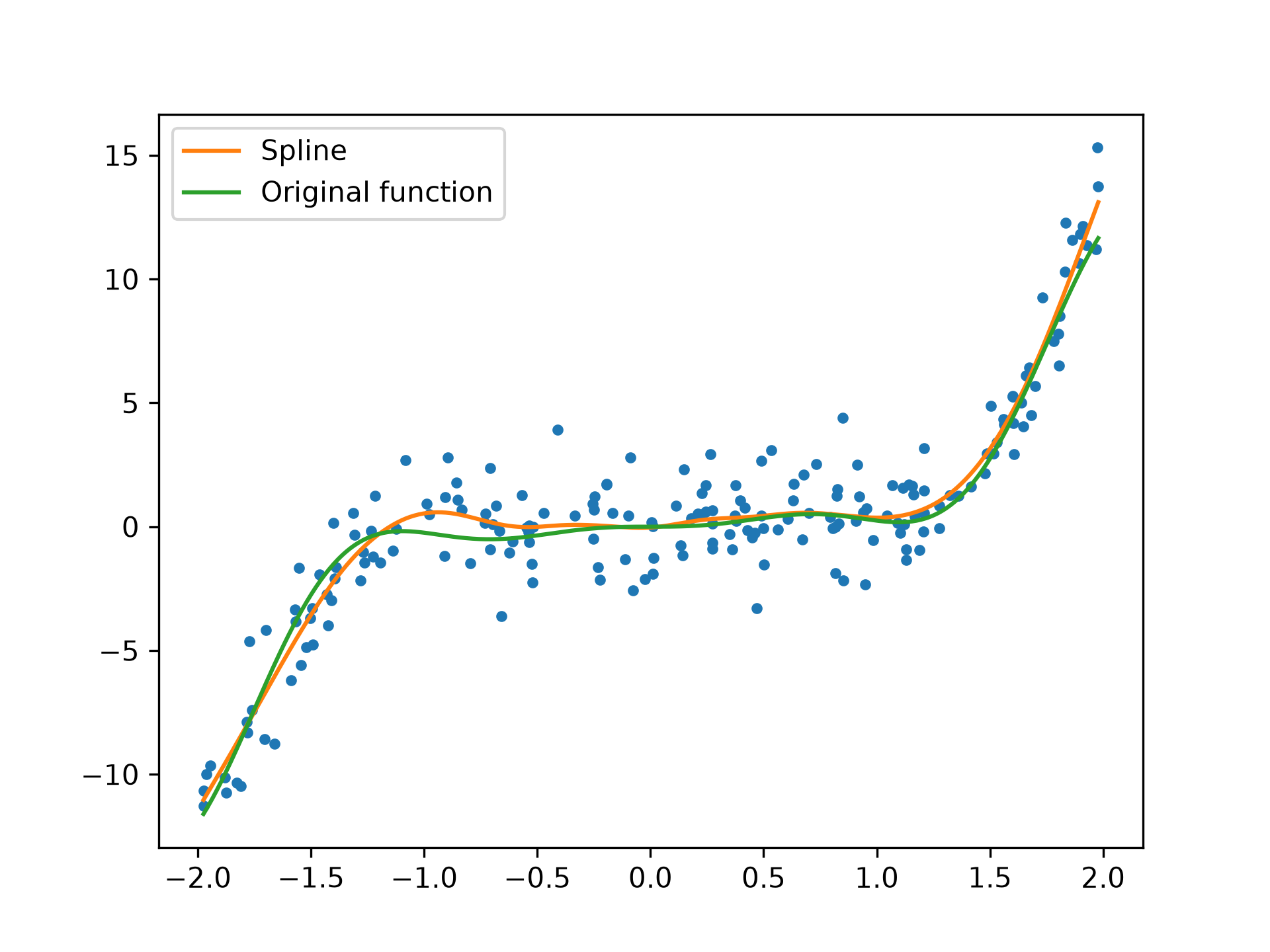
Generate some noisy dataimport numpy as np np.random.seed(1234) n = 200 def func(x): return x**3 + x**2 * np.sin(4 * x) x = np.sort(np.random.random_sample(n) * 4 - 2) y = func(x) + np.random.normal(scale=1.5, size=n)✓
from scipy.interpolate import make_smoothing_spline
spl = make_smoothing_spline(x, y)
✓
import matplotlib.pyplot as plt
grid = np.linspace(x[0], x[-1], 400)
✓
plt.plot(x, y, '.')
plt.plot(grid, spl(grid), label='Spline')
plt.plot(grid, func(grid), label='Original function')
plt.legend(loc='best')
✗
<matplotlib.legend.Legend object at 0x7f3f60e60d70>
plt.show()
✓
Aliases
scipy.interpolate.make_smoothing_spline