bundles / scipy latest / scipy / interpolate / _interpolate / lagrange
function
scipy.interpolate._interpolate:lagrange
source: build-install/usr/lib/python3.14/site-packages/scipy/interpolate/_interpolate.py:27
Signature
def lagrange(x, w)Summary
Return a Lagrange interpolating polynomial.
Extended Summary
Given two 1-D arrays x and w, returns the Lagrange interpolating polynomial through the points (x, w).
Warning: This implementation is numerically unstable. Do not expect to be able to use more than about 20 points even if they are chosen optimally.
Parameters
x: array_likexrepresents the x-coordinates of a set of datapoints.w: array_likewrepresents the y-coordinates of a set of datapoints, i.e., f(x).
Returns
lagrange: `numpy.poly1d` instanceThe Lagrange interpolating polynomial.
Notes
The name of this function refers to the fact that the returned object represents a Lagrange polynomial, the unique polynomial of lowest degree that interpolates a given set of data [1]. It computes the polynomial using Newton's divided differences formula [2]; that is, it works with Newton basis polynomials rather than Lagrange basis polynomials. For numerical calculations, the barycentric form of Lagrange interpolation (scipy.interpolate.BarycentricInterpolator) is typically more appropriate.
Array API Standard Support
lagrange is not in-scope for support of Python Array API Standard compatible backends other than NumPy.
See dev-arrayapi for more information.
Examples
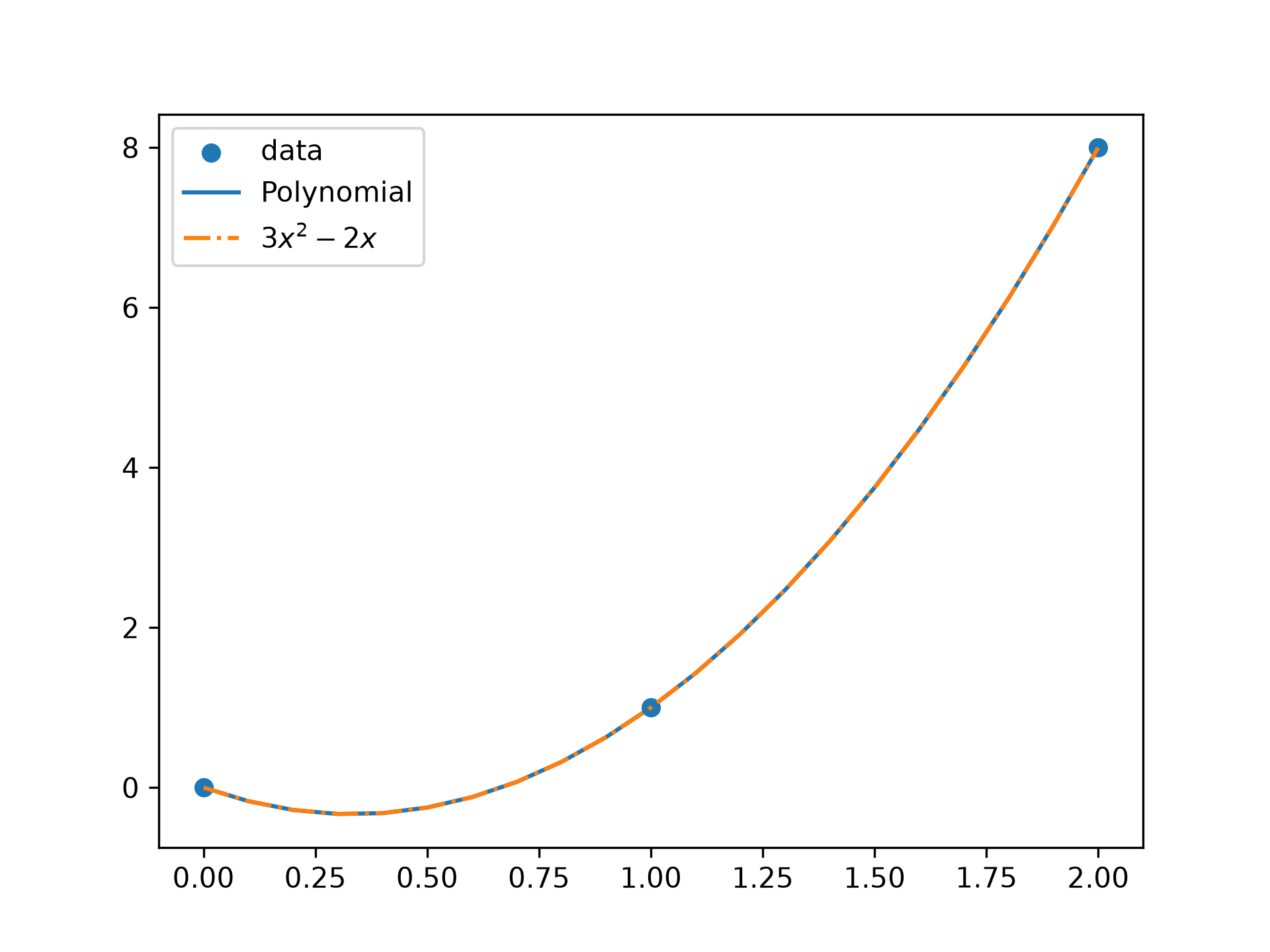
Interpolate :math:`f(x) = x^3` by 3 points.import numpy as np from scipy.interpolate import lagrange x = np.array([0, 1, 2]) y = x**3 poly = lagrange(x, y)✓
from numpy.polynomial.polynomial import Polynomial
Polynomial(poly.coef[::-1]).coef
✓
array([ 0., -2., 3.])
import matplotlib.pyplot as plt
x_new = np.arange(0, 2.1, 0.1)
✓
plt.scatter(x, y, label='data')
plt.plot(x_new, Polynomial(poly.coef[::-1])(x_new), label='Polynomial')
plt.plot(x_new, 3*x_new**2 - 2*x_new + 0*x_new,
         label=r"$3 x^2 - 2 x$", linestyle='-.')
plt.legend()
✗
<matplotlib.legend.Legend object at 0x7f3f60f05550>
plt.show()
✓
Aliases
scipy.interpolate.lagrange