bundles / scipy latest / scipy / interpolate / _interpolate / interp1d
class
scipy.interpolate._interpolate:interp1d
source: build-install/usr/lib/python3.14/site-packages/scipy/interpolate/_interpolate.py:189
Signature
class interp1d(x, y, kind = linear, axis = -1, copy = True, bounds_error = None, fill_value = nan, assume_sorted = False)Members
Summary
Interpolate a 1-D function (legacy).
Extended Summary
x and y are arrays of values used to approximate some function f: y = f(x). This class returns a function whose call method uses interpolation to find the value of new points.
Parameters
x: (npoints, ) array_likeA 1-D array of real values.
y: (..., npoints, ...) array_likeAn N-D array of real values. The length of
yalong the interpolation axis must be equal to the length ofx. Use theaxisparameter to select correct axis. Unlike other interpolators, the default interpolation axis is the last axis ofy.kind: str or int, optionalSpecifies the kind of interpolation as a string or as an integer specifying the order of the spline interpolator to use. The string has to be one of 'linear', 'nearest', 'nearest-up', 'zero', 'slinear', 'quadratic', 'cubic', 'previous', or 'next'. 'zero', 'slinear', 'quadratic' and 'cubic' refer to a spline interpolation of zeroth, first, second or third order; 'previous' and 'next' simply return the previous or next value of the point; 'nearest-up' and 'nearest' differ when interpolating half-integers (e.g. 0.5, 1.5) in that 'nearest-up' rounds up and 'nearest' rounds down. Default is 'linear'.
axis: int, optionalAxis in the
yarray corresponding to the x-coordinate values. Unlike other interpolators, defaults toaxis=-1.copy: bool, optionalIf
True, the class makes internal copies of x and y. IfFalse, references toxandyare used if possible. The default is to copy.bounds_error: bool, optionalIf True, a ValueError is raised any time interpolation is attempted on a value outside of the range of x (where extrapolation is necessary). If False, out of bounds values are assigned
fill_value. By default, an error is raised unlessfill_value="extrapolate".fill_value: array-like or (array-like, array_like) or "extrapolate", optionalif an ndarray (or float), this value will be used to fill in for requested points outside of the data range. If not provided, then the default is NaN. The array-like must broadcast properly to the dimensions of the non-interpolation axes.
If a two-element tuple, then the first element is used as a fill value for
x_new < x[0]and the second element is used forx_new > x[-1]. Anything that is not a 2-element tuple (e.g., list or ndarray, regardless of shape) is taken to be a single array-like argument meant to be used for both bounds asbelow, above = fill_value, fill_value. Using a two-element tuple or ndarray requiresbounds_error=False.If "extrapolate", then points outside the data range will be extrapolated.
assume_sorted: bool, optionalIf False, values of
xcan be in any order and they are sorted first. If True,xhas to be an array of monotonically increasing values.
Attributes
fill_value
Methods
__call__
Notes
Calling interp1d with NaNs present in input values results in undefined behaviour.
Input values x and y must be convertible to float values like int or float.
If the values in x are not unique, the resulting behavior is undefined and specific to the choice of kind, i.e., changing kind will change the behavior for duplicates.
Array API Standard Support
interp1d is not in-scope for support of Python Array API Standard compatible backends other than NumPy.
See dev-arrayapi for more information.
Examples
import numpy as np
import matplotlib.pyplot as plt
from scipy import interpolate
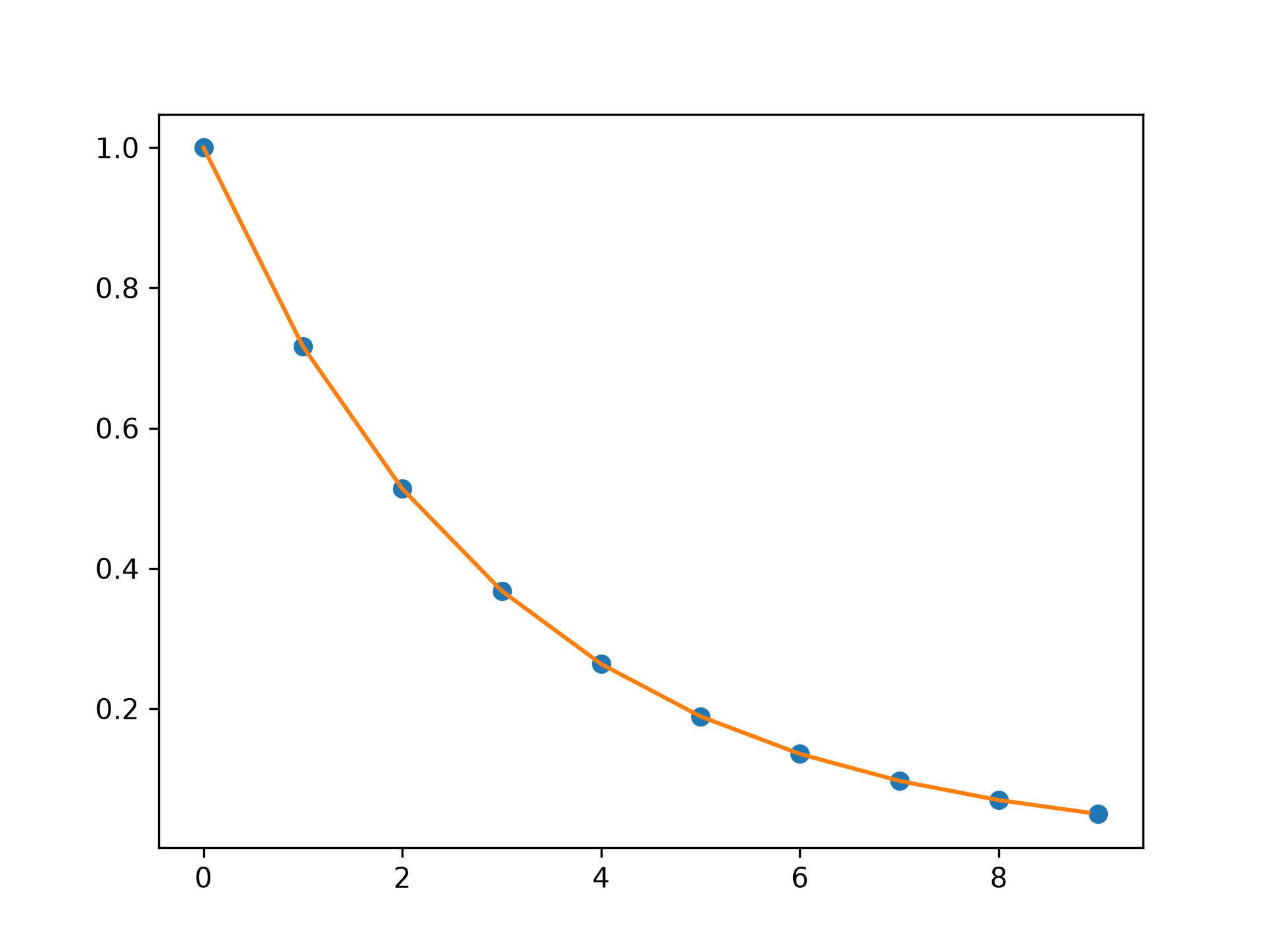
x = np.arange(0, 10)
y = np.exp(-x/3.0)
f = interpolate.interp1d(x, y)
✓
xnew = np.arange(0, 9, 0.1)
ynew = f(xnew)   # use interpolation function returned by `interp1d`
✓
plt.plot(x, y, 'o', xnew, ynew, '-')
✗[<matplotlib.lines.Line2D object at 0x7f3f60b417f0>, <matplotlib.lines.Line2D object at 0x7f3f60b41940>]
plt.show()
✓
See also
- UnivariateSpline
An object-oriented wrapper of the FITPACK routines.
- interp2d
2-D interpolation
- splev
Spline interpolation/smoothing based on FITPACK.
- splrep
Spline interpolation/smoothing based on FITPACK.
Aliases
scipy.interpolate.interp1d