bundles / scipy latest / scipy / optimize / _lsq / least_squares / least_squares
function
scipy.optimize._lsq.least_squares:least_squares
source: build-install/usr/lib/python3.14/site-packages/scipy/optimize/_lsq/least_squares.py:266
Signature
def least_squares(fun, x0, jac = 2-point, bounds = (-inf, inf), method = trf, ftol = 1e-08, xtol = 1e-08, gtol = 1e-08, x_scale = None, loss = linear, f_scale = 1.0, diff_step = None, tr_solver = None, tr_options = None, jac_sparsity = None, max_nfev = None, verbose = 0, args = (), kwargs = None, callback = None, workers = None)Summary
Solve a nonlinear least-squares problem with bounds on the variables.
Extended Summary
Given the residuals f(x) (an m-D real function of n real variables) and the loss function rho(s) (a scalar function), least_squares finds a local minimum of the cost function F(x)
minimize F(x) = 0.5 * sum(rho(f_i(x)**2), i = 0, ..., m - 1)
subject to lb <= x <= ub
The purpose of the loss function rho(s) is to reduce the influence of outliers on the solution.
Parameters
fun: callableFunction which computes the vector of residuals, with the signature
fun(x, *args, **kwargs), i.e., the minimization proceeds with respect to its first argument. The argumentxpassed to this function is an ndarray of shape (n,) (never a scalar, even for n=1). It must allocate and return a 1-D array_like of shape (m,) or a scalar. If the argumentxis complex or the functionfunreturns complex residuals, it must be wrapped in a real function of real arguments, as shown at the end of the Examples section.x0: array_like with shape (n,) or floatInitial guess on independent variables. If float, it will be treated as a 1-D array with one element. When
methodis 'trf', the initial guess might be slightly adjusted to lie sufficiently within the givenbounds.jac: {'2-point', '3-point', 'cs', callable}, optionalMethod of computing the Jacobian matrix (an m-by-n matrix, where element (i, j) is the partial derivative of f[i] with respect to x[j]). The keywords select a finite difference scheme for numerical estimation. The scheme '3-point' is more accurate, but requires twice as many operations as '2-point' (default). The scheme 'cs' uses complex steps, and while potentially the most accurate, it is applicable only when
funcorrectly handles complex inputs and can be analytically continued to the complex plane. If callable, it is used asjac(x, *args, **kwargs)and should return a good approximation (or the exact value) for the Jacobian as an array_like (np.atleast_2d is applied), a sparse array (csr_array preferred for performance) or a scipy.sparse.linalg.LinearOperator.bounds: 2-tuple of array_like or `Bounds`, optionalThere are two ways to specify bounds:
Instance of Bounds class
Lower and upper bounds on independent variables. Defaults to no bounds. Each array must match the size of
x0or be a scalar, in the latter case a bound will be the same for all variables. Usenp.infwith an appropriate sign to disable bounds on all or some variables.
method: {'trf', 'dogbox', 'lm'}, optionalAlgorithm to perform minimization.
'trf'Trust Region Reflective algorithm, particularly suitable for large sparse problems with bounds. Generally robust method.
'dogbox'dogleg algorithm with rectangular trust regions, typical use case is small problems with bounds. Not recommended for problems with rank-deficient Jacobian.
'lm'Levenberg-Marquardt algorithm as implemented in MINPACK. Doesn't handle bounds and sparse Jacobians. Usually the most efficient method for small unconstrained problems.
Default is 'trf'. See Notes for more information.
ftol: float or None, optionalTolerance for termination by the change of the cost function. Default is 1e-8. The optimization process is stopped when
dF < ftol * F, and there was an adequate agreement between a local quadratic model and the true model in the last step.If None and 'method' is not 'lm', the termination by this condition is disabled. If 'method' is 'lm', this tolerance must be higher than machine epsilon.
xtol: float or None, optionalTolerance for termination by the change of the independent variables. Default is 1e-8. The exact condition depends on the
methodused:For 'trf' and 'dogbox'
norm(dx) < xtol * (xtol + norm(x)).For 'lm'
Delta < xtol * norm(xs), whereDeltais a trust-region radius andxsis the value ofxscaled according tox_scaleparameter (see below).
If None and 'method' is not 'lm', the termination by this condition is disabled. If 'method' is 'lm', this tolerance must be higher than machine epsilon.
gtol: float or None, optionalTolerance for termination by the norm of the gradient. Default is 1e-8. The exact condition depends on a
methodused:For 'trf'
norm(g_scaled, ord=np.inf) < gtol, whereg_scaledis the value of the gradient scaled to account for the presence of the bounds [STIR].For 'dogbox'
norm(g_free, ord=np.inf) < gtol, whereg_freeis the gradient with respect to the variables which are not in the optimal state on the boundary.For 'lm'the maximum absolute value of the cosine of angles between columns of the Jacobian and the residual vector is less than
gtol, or the residual vector is zero.
If None and 'method' is not 'lm', the termination by this condition is disabled. If 'method' is 'lm', this tolerance must be higher than machine epsilon.
x_scale: {None, array_like, 'jac'}, optionalCharacteristic scale of each variable. Setting
x_scaleis equivalent to reformulating the problem in scaled variablesxs = x / x_scale. An alternative view is that the size of a trust region along jth dimension is proportional tox_scale[j]. Improved convergence may be achieved by settingx_scalesuch that a step of a given size along any of the scaled variables has a similar effect on the cost function. If set to 'jac', the scale is iteratively updated using the inverse norms of the columns of the Jacobian matrix (as described in [JJMore]). The default scaling for each method (i.e. ifx_scale is None) is as follows:For 'trf'
x_scale == 1For 'dogbox'
x_scale == 1For 'lm'
x_scale == 'jac'
loss: str or callable, optionalDetermines the loss function. The following keyword values are allowed:
'linear' (default)
rho(z) = z. Gives a standard least-squares problem.'soft_l1'
rho(z) = 2 * ((1 + z)**0.5 - 1). The smooth approximation of l1 (absolute value) loss. Usually a good choice for robust least squares.'huber'
rho(z) = z if z <= 1 else 2*z**0.5 - 1. Works similarly to 'soft_l1'.'cauchy'
rho(z) = ln(1 + z). Severely weakens outliers influence, but may cause difficulties in optimization process.'arctan'
rho(z) = arctan(z). Limits a maximum loss on a single residual, has properties similar to 'cauchy'.
If callable, it must take a 1-D ndarray
z=f**2and return an array_like with shape (3, m) where row 0 contains function values, row 1 contains first derivatives and row 2 contains second derivatives. Method 'lm' supports only 'linear' loss.f_scale: float, optionalValue of soft margin between inlier and outlier residuals, default is 1.0. The loss function is evaluated as follows
rho_(f**2) = C**2 * rho(f**2 / C**2), whereCisf_scale, andrhois determined bylossparameter. This parameter has no effect withloss='linear', but for otherlossvalues it is of crucial importance.diff_step: None or array_like, optionalDetermines the relative step size for the finite difference approximation of the Jacobian. The actual step is computed as
x * diff_step. If None (default), thendiff_stepis taken to be a conventional "optimal" power of machine epsilon for the finite difference scheme used [NR].tr_solver: {None, 'exact', 'lsmr'}, optionalMethod for solving trust-region subproblems, relevant only for 'trf' and 'dogbox' methods.
'exact' is suitable for not very large problems with dense Jacobian matrices. The computational complexity per iteration is comparable to a singular value decomposition of the Jacobian matrix.
'lsmr' is suitable for problems with sparse and large Jacobian matrices. It uses the iterative procedure scipy.sparse.linalg.lsmr for finding a solution of a linear least-squares problem and only requires matrix-vector product evaluations.
If None (default), the solver is chosen based on the type of Jacobian returned on the first iteration.
tr_options: dict, optionalKeyword options passed to trust-region solver.
tr_solver='exact':tr_optionsare ignored.tr_solver='lsmr': options for scipy.sparse.linalg.lsmr. Additionally,method='trf'supports 'regularize' option (bool, default is True), which adds a regularization term to the normal equation, which improves convergence if the Jacobian is rank-deficient [Byrd] (eq. 3.4).
jac_sparsity: {None, array_like, sparse array}, optionalDefines the sparsity structure of the Jacobian matrix for finite difference estimation, its shape must be (m, n). If the Jacobian has only few non-zero elements in each row, providing the sparsity structure will greatly speed up the computations [Curtis]. A zero entry means that a corresponding element in the Jacobian is identically zero. If provided, forces the use of 'lsmr' trust-region solver. If None (default), then dense differencing will be used. Has no effect for 'lm' method.
max_nfev: None or int, optionalFor all methods this parameter controls the maximum number of function evaluations used by each method, separate to those used in numerical approximation of the jacobian. If None (default), the value is chosen automatically as 100 * n.
verbose: {0, 1, 2}, optionalLevel of algorithm's verbosity:
0 (default)work silently.
1display a termination report.
2display progress during iterations (not supported by 'lm' method).
args, kwargs: tuple and dict, optionalAdditional arguments passed to
funandjac. Both empty by default. The calling signature isfun(x, *args, **kwargs)and the same forjac.callback: None or callable, optionalCallback function that is called by the algorithm on each iteration. This can be used to print or plot the optimization results at each step, and to stop the optimization algorithm based on some user-defined condition. Only implemented for the trf and dogbox methods.
The signature is
callback(intermediate_result: OptimizeResult)intermediate_resultis a scipy.optimize.OptimizeResult which contains the intermediate results of the optimization at the current iteration.The callback also supports a signature like:
callback(x)Introspection is used to determine which of the signatures is invoked.
If the
callbackfunction raises StopIteration the optimization algorithm will stop and return with status code -2.workers: map-like callable, optionalA map-like callable, such as
multiprocessing.Pool.mapfor evaluating any numerical differentiation in parallel. This evaluation is carried out asworkers(fun, iterable).
Returns
result: OptimizeResultOptimizeResult with the following fields defined:
x
Solution found.
cost
Value of the cost function at the solution.
fun
Vector of residuals at the solution.
jac
Modified Jacobian matrix at the solution, in the sense that J^T J is a Gauss-Newton approximation of the Hessian of the cost function. The type is the same as the one used by the algorithm.
grad
Gradient of the cost function at the solution.
optimality
First-order optimality measure. In unconstrained problems, it is always the uniform norm of the gradient. In constrained problems, it is the quantity which was compared with
gtolduring iterations.active_mask
Each component shows whether a corresponding constraint is active (that is, whether a variable is at the bound):
0a constraint is not active.
-1a lower bound is active.
1an upper bound is active.
Might be somewhat arbitrary for 'trf' method as it generates a sequence of strictly feasible iterates and
active_maskis determined within a tolerance threshold.nfev
Number of function evaluations done. This number does not include the function calls used for numerical Jacobian approximation.
njev
Number of Jacobian evaluations done. If numerical Jacobian approximation is used in 'lm' method, it is set to None.
status
The reason for algorithm termination:
-2terminated because callback raised StopIteration.
-1improper input parameters status returned from MINPACK.
0the maximum number of function evaluations is exceeded.
1
gtoltermination condition is satisfied.2
ftoltermination condition is satisfied.3
xtoltermination condition is satisfied.4Both
ftolandxtoltermination conditions are satisfied.
message
Verbal description of the termination reason.
success
True if one of the convergence criteria is satisfied (
status> 0).
Notes
Method 'lm' (Levenberg-Marquardt) calls a wrapper over a least-squares algorithm implemented in MINPACK (lmder). It runs the Levenberg-Marquardt algorithm formulated as a trust-region type algorithm. The implementation is based on paper [JJMore], it is very robust and efficient with a lot of smart tricks. It should be your first choice for unconstrained problems. Note that it doesn't support bounds. Also, it doesn't work when m < n.
Method 'trf' (Trust Region Reflective) is motivated by the process of solving a system of equations, which constitute the first-order optimality condition for a bound-constrained minimization problem as formulated in [STIR]. The algorithm iteratively solves trust-region subproblems augmented by a special diagonal quadratic term and with trust-region shape determined by the distance from the bounds and the direction of the gradient. This enhancements help to avoid making steps directly into bounds and efficiently explore the whole space of variables. To further improve convergence, the algorithm considers search directions reflected from the bounds. To obey theoretical requirements, the algorithm keeps iterates strictly feasible. With dense Jacobians trust-region subproblems are solved by an exact method very similar to the one described in [JJMore] (and implemented in MINPACK). The difference from the MINPACK implementation is that a singular value decomposition of a Jacobian matrix is done once per iteration, instead of a QR decomposition and series of Givens rotation eliminations. For large sparse Jacobians a 2-D subspace approach of solving trust-region subproblems is used [STIR], [Byrd]. The subspace is spanned by a scaled gradient and an approximate Gauss-Newton solution delivered by scipy.sparse.linalg.lsmr. When no constraints are imposed the algorithm is very similar to MINPACK and has generally comparable performance. The algorithm works quite robust in unbounded and bounded problems, thus it is chosen as a default algorithm.
Method 'dogbox' operates in a trust-region framework, but considers rectangular trust regions as opposed to conventional ellipsoids [Voglis]. The intersection of a current trust region and initial bounds is again rectangular, so on each iteration a quadratic minimization problem subject to bound constraints is solved approximately by Powell's dogleg method [NumOpt]. The required Gauss-Newton step can be computed exactly for dense Jacobians or approximately by scipy.sparse.linalg.lsmr for large sparse Jacobians. The algorithm is likely to exhibit slow convergence when the rank of Jacobian is less than the number of variables. The algorithm often outperforms 'trf' in bounded problems with a small number of variables.
Robust loss functions are implemented as described in [BA]. The idea is to modify a residual vector and a Jacobian matrix on each iteration such that computed gradient and Gauss-Newton Hessian approximation match the true gradient and Hessian approximation of the cost function. Then the algorithm proceeds in a normal way, i.e., robust loss functions are implemented as a simple wrapper over standard least-squares algorithms.
Examples
In this example we find a minimum of the Rosenbrock function without bounds on independent variables.import numpy as np def fun_rosenbrock(x): return np.array([10 * (x[1] - x[0]**2), (1 - x[0])])✓
from scipy.optimize import least_squares
x0_rosenbrock = np.array([2, 2])
res_1 = least_squares(fun_rosenbrock, x0_rosenbrock)
✓
res_1.x
res_1.cost
res_1.optimality
✗
np.float64(8.892886493421953e-14)We now constrain the variables, in such a way that the previous solution becomes infeasible. Specifically, we require that ``x[1] >= 1.5``, and ``x[0]`` left unconstrained. To this end, we specify the `bounds` parameter to `least_squares` in the form ``bounds=([-np.inf, 1.5], np.inf)``. We also provide the analytic Jacobian:
def jac_rosenbrock(x):
    return np.array([
        [-20 * x[0], 10],
        [-1, 0]])
✓
res_2 = least_squares(fun_rosenbrock, x0_rosenbrock, jac_rosenbrock,
                      bounds=([-np.inf, 1.5], np.inf))
✓
res_2.x
res_2.cost
res_2.optimality
✗
np.float64(1.5885401433157753e-07)Now we solve a system of equations (i.e., the cost function should be zero at a minimum) for a Broyden tridiagonal vector-valued function of 100000 variables:
def fun_broyden(x):
    f = (3 - x) * x + 1
    f[1:] -= x[:-1]
    f[:-1] -= 2 * x[1:]
    return f
✓
from scipy.sparse import lil_array
def sparsity_broyden(n):
    sparsity = lil_array((n, n), dtype=int)
    i = np.arange(n)
    sparsity[i, i] = 1
    i = np.arange(1, n)
    sparsity[i, i - 1] = 1
    i = np.arange(n - 1)
    sparsity[i, i + 1] = 1
    return sparsity
n = 100000
x0_broyden = -np.ones(n)
res_3 = least_squares(fun_broyden, x0_broyden,
                      jac_sparsity=sparsity_broyden(n))
✓
res_3.cost
res_3.optimality
✗
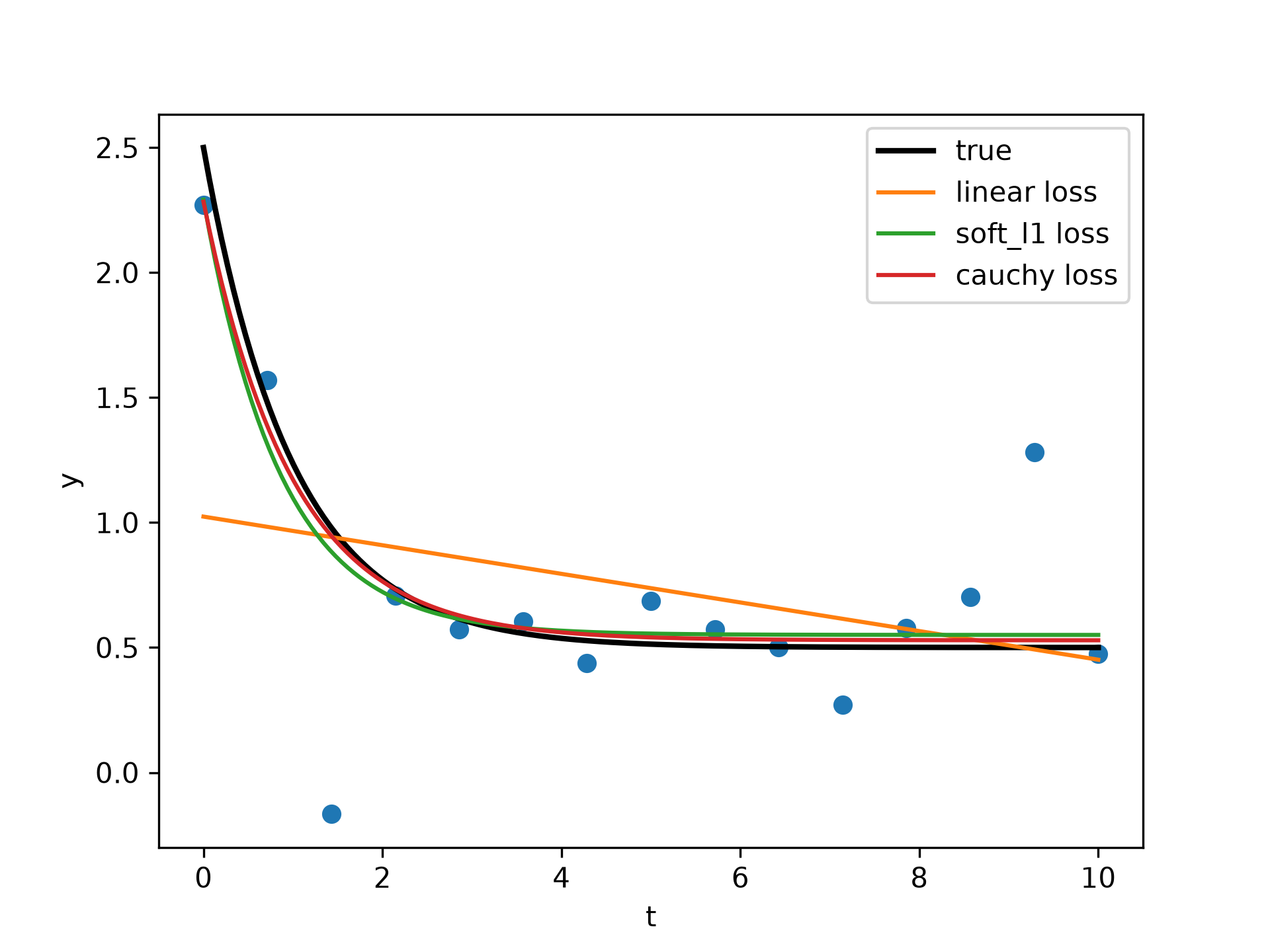
np.float64(1.1650454296851518e-11)Let's also solve a curve fitting problem using robust loss function to take care of outliers in the data. Define the model function as ``y = a + b * exp(c * t)``, where t is a predictor variable, y is an observation and a, b, c are parameters to estimate. First, define the function which generates the data with noise and outliers, define the model parameters, and generate data:
from numpy.random import default_rng
rng = default_rng()
def gen_data(t, a, b, c, noise=0., n_outliers=0, seed=None):
    rng = default_rng(seed)

    y = a + b * np.exp(t * c)

    error = noise * rng.standard_normal(t.size)
    outliers = rng.integers(0, t.size, n_outliers)
    error[outliers] *= 10

    return y + error
a = 0.5
b = 2.0
c = -1
t_min = 0
t_max = 10
n_points = 15
t_train = np.linspace(t_min, t_max, n_points)
y_train = gen_data(t_train, a, b, c, noise=0.1, n_outliers=3)
✓
def fun(x, t, y):
    return x[0] + x[1] * np.exp(x[2] * t) - y
x0 = np.array([1.0, 1.0, 0.0])
✓
res_lsq = least_squares(fun, x0, args=(t_train, y_train))
✓res_soft_l1 = least_squares(fun, x0, loss='soft_l1', f_scale=0.1, args=(t_train, y_train)) res_log = least_squares(fun, x0, loss='cauchy', f_scale=0.1, args=(t_train, y_train))✓
t_test = np.linspace(t_min, t_max, n_points * 10)
y_true = gen_data(t_test, a, b, c)
y_lsq = gen_data(t_test, *res_lsq.x)
y_soft_l1 = gen_data(t_test, *res_soft_l1.x)
y_log = gen_data(t_test, *res_log.x)
import matplotlib.pyplot as plt
✓
plt.plot(t_train, y_train, 'o')
plt.plot(t_test, y_true, 'k', linewidth=2, label='true')
plt.plot(t_test, y_lsq, label='linear loss')
plt.plot(t_test, y_soft_l1, label='soft_l1 loss')
plt.plot(t_test, y_log, label='cauchy loss')
plt.xlabel("t")
plt.ylabel("y")
plt.legend()
✗
<matplotlib.legend.Legend object at 0x7f3f6820b620>
plt.show()
✓
def f(z):
    return z - (0.5 + 0.5j)
✓
def f_wrap(x):
    fx = f(x[0] + 1j*x[1])
    return np.array([fx.real, fx.imag])
✓
from scipy.optimize import least_squares
res_wrapped = least_squares(f_wrap, (0.1, 0.1), bounds=([0, 0], [1, 1]))
z = res_wrapped.x[0] + res_wrapped.x[1]*1j
✓
z
✗np.complex128(0.4999999999992589+0.4999999999992589j)
See also
Aliases
scipy.optimize.least_squares