bundles / scipy latest / scipy / signal / _spline_filters / cspline1d
function
scipy.signal._spline_filters:cspline1d
source: build-install/usr/lib/python3.14/site-packages/scipy/signal/_spline_filters.py:306
Signature
def cspline1d(signal, lamb = 0.0)Summary
Compute cubic spline coefficients for rank-1 array.
Extended Summary
Find the cubic spline coefficients for a 1-D signal assuming mirror-symmetric boundary conditions. To obtain the signal back from the spline representation mirror-symmetric-convolve these coefficients with a length 3 FIR window [1.0, 4.0, 1.0]/ 6.0 .
Parameters
signal: ndarrayA rank-1 array representing samples of a signal.
lamb: float, optionalSmoothing coefficient, default is 0.0.
Returns
c: ndarrayCubic spline coefficients.
Examples
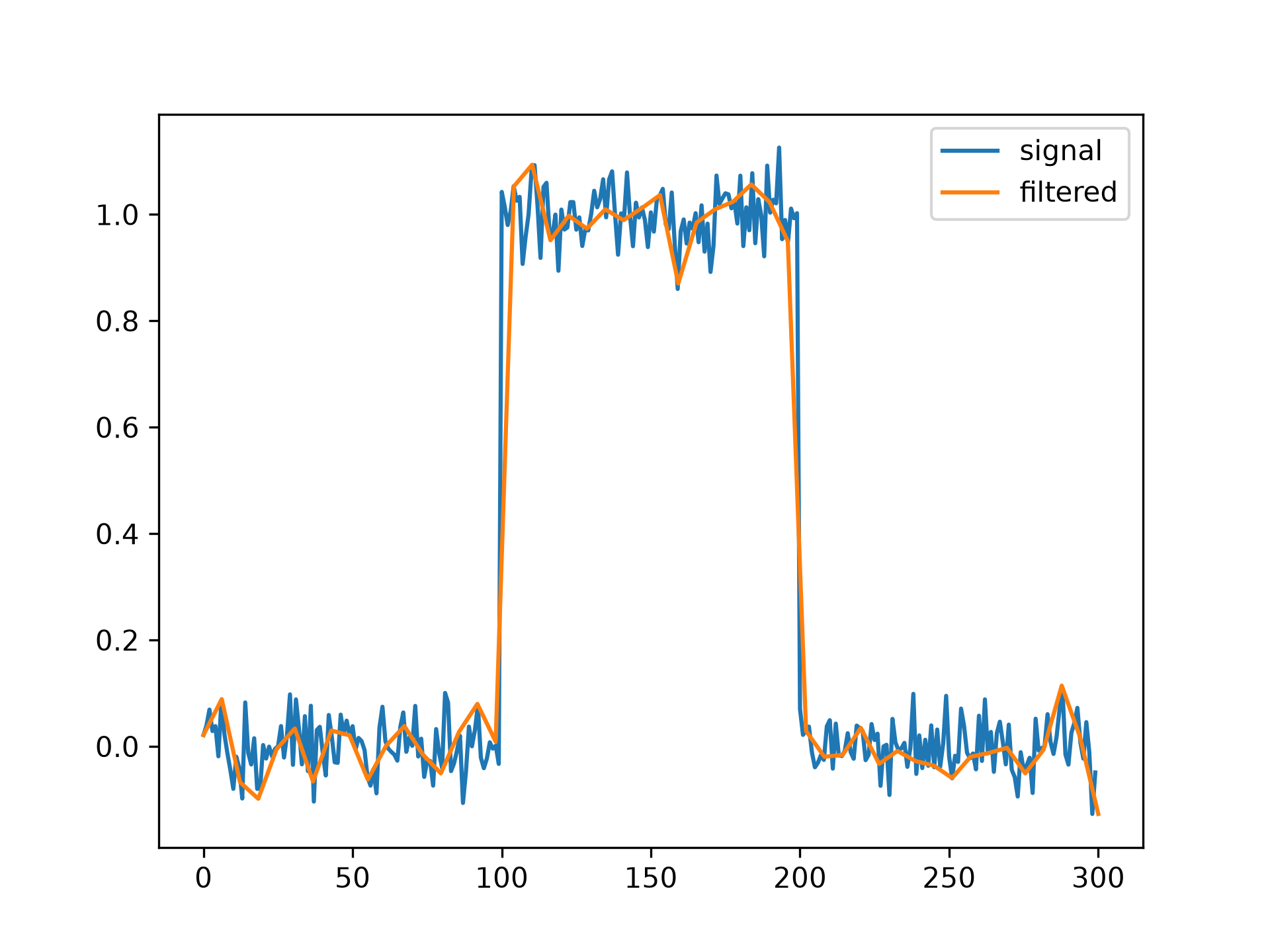
We can filter a signal to reduce and smooth out high-frequency noise with a cubic spline:import numpy as np import matplotlib.pyplot as plt from scipy.signal import cspline1d, cspline1d_eval rng = np.random.default_rng() sig = np.repeat([0., 1., 0.], 100) sig += rng.standard_normal(len(sig))*0.05 # add noise time = np.linspace(0, len(sig)) filtered = cspline1d_eval(cspline1d(sig), time)✓
plt.plot(sig, label="signal")
plt.plot(time, filtered, label="filtered")
plt.legend()
✗
<matplotlib.legend.Legend object at 0x7f3f6858ae40>
plt.show()
✓
See also
- cspline1d_eval
Evaluate a cubic spline at the new set of points.
Aliases
scipy.signal.cspline1d