bundles / scipy latest / scipy / signal / _spline_filters / spline_filter
function
scipy.signal._spline_filters:spline_filter
source: build-install/usr/lib/python3.14/site-packages/scipy/signal/_spline_filters.py:26
Signature
def spline_filter(Iin, lmbda = 5.0)Summary
Smoothing spline (cubic) filtering of a rank-2 array.
Extended Summary
Filter an input data set, Iin, using a (cubic) smoothing spline of fall-off lmbda.
Parameters
Iin: array_likeinput data set
lmbda: float, optionalspline smoothing fall-off value, default is
5.0.
Returns
res: ndarrayfiltered input data
Examples
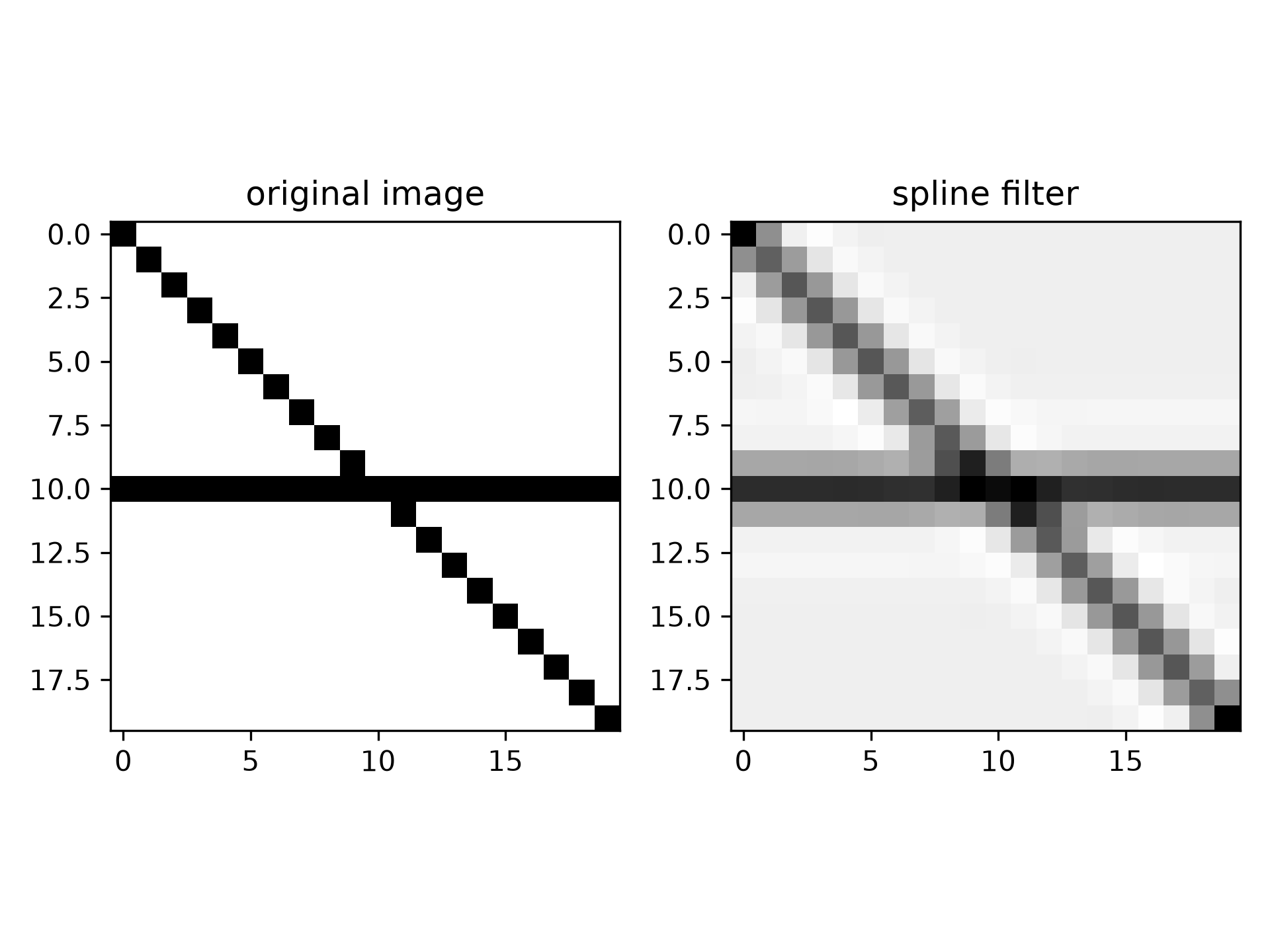
We can filter an multi dimensional signal (ex: 2D image) using cubic B-spline filter:import numpy as np from scipy.signal import spline_filter import matplotlib.pyplot as plt orig_img = np.eye(20) # create an image orig_img[10, :] = 1.0 sp_filter = spline_filter(orig_img, lmbda=0.1) f, ax = plt.subplots(1, 2, sharex=True)✓
for ind, data in enumerate([[orig_img, "original image"],
                            [sp_filter, "spline filter"]]):
    ax[ind].imshow(data[0], cmap='gray_r')
    ax[ind].set_title(data[1])
✗
<matplotlib.image.AxesImage object at 0x7f3f68130b90>
Text(0.5, 1.0, 'original image')
<matplotlib.image.AxesImage object at 0x7f3f68561bd0>
Text(0.5, 1.0, 'spline filter')
plt.tight_layout()
plt.show()
✓
Aliases
scipy.signal.spline_filter