bundles / scipy latest / scipy / special / _orthogonal / chebyu
function
scipy.special._orthogonal:chebyu
source: build-install/usr/lib/python3.14/site-packages/scipy/special/_orthogonal.py:2497
Signature
def chebyu(n, monic = False)Summary
Chebyshev polynomial of the second kind.
Extended Summary
Defined to be the solution of
is a polynomial of degree .
Parameters
n: intDegree of the polynomial.
monic: bool, optionalIf True, scale the leading coefficient to be 1. Default is False.
Returns
U: orthopoly1dChebyshev polynomial of the second kind.
Notes
The polynomials are orthogonal over with weight function .
Examples
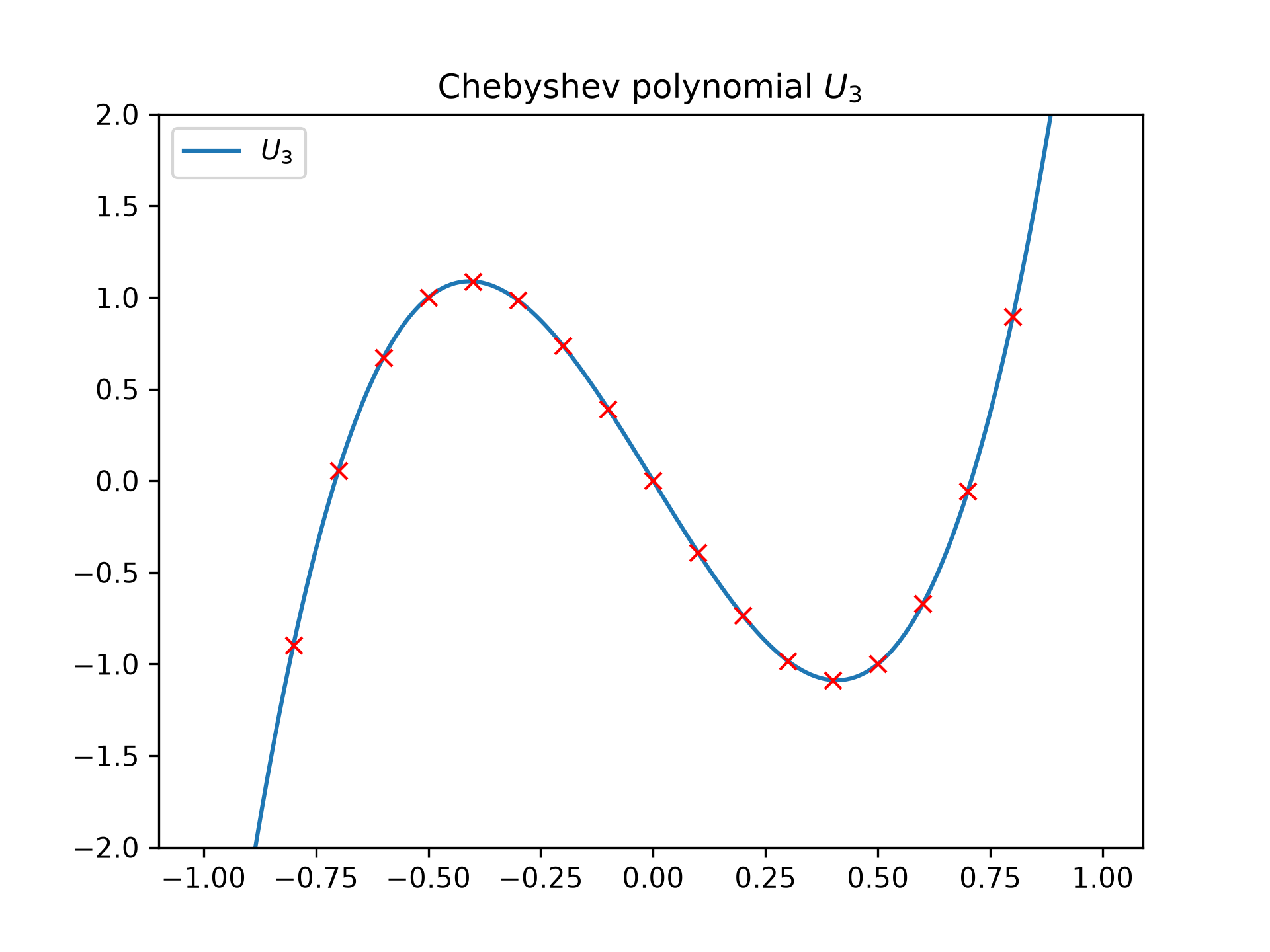
Chebyshev polynomials of the second kind of order :math:`n` can be obtained as the determinant of specific :math:`n \times n` matrices. As an example we can check how the points obtained from the determinant of the following :math:`3 \times 3` matrix lay exactly on :math:`U_3`:import numpy as np import matplotlib.pyplot as plt from scipy.linalg import det from scipy.special import chebyu x = np.arange(-1.0, 1.0, 0.01) fig, ax = plt.subplots()✓
ax.set_ylim(-2.0, 2.0)
ax.set_title(r'Chebyshev polynomial $U_3$')
ax.plot(x, chebyu(3)(x), label=rf'$U_3$')
for p in np.arange(-1.0, 1.0, 0.1):
    ax.plot(p,
            det(np.array([[2*p, 1, 0], [1, 2*p, 1], [0, 1, 2*p]])),
            'rx')
plt.legend(loc='best')
✗
<matplotlib.legend.Legend object at 0x7f3f69160ad0>
plt.show()
✓
from scipy.special import chebyt
x = np.arange(-1.0, 1.0, 0.01)
np.allclose(chebyu(3)(x), 2 * chebyt(2)(x) * chebyu(1)(x))
✓
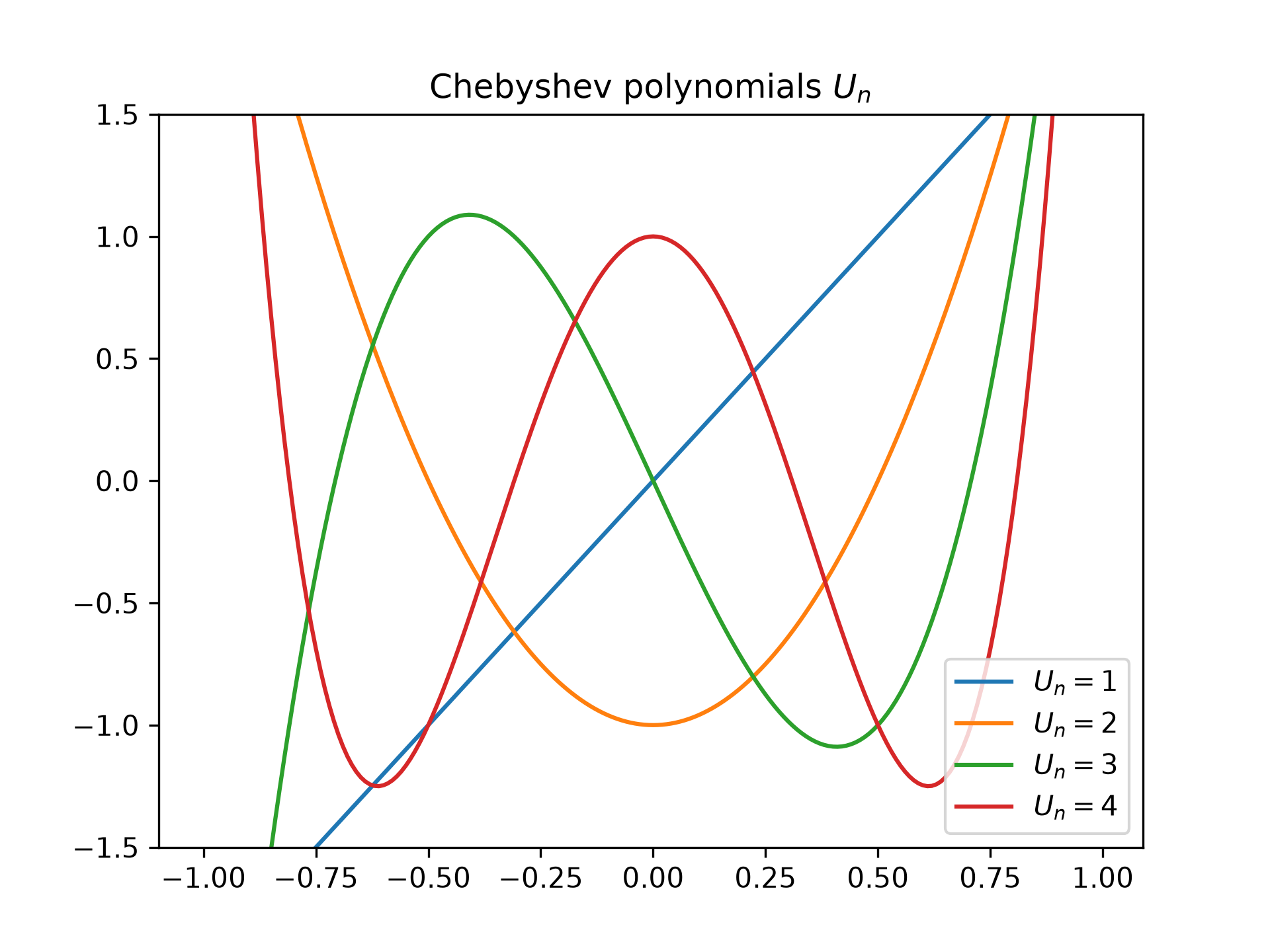
TrueWe can plot the Chebyshev polynomials :math:`U_n` for some values of :math:`n`:
x = np.arange(-1.0, 1.0, 0.01)
fig, ax = plt.subplots()
✓
ax.set_ylim(-1.5, 1.5)
ax.set_title(r'Chebyshev polynomials $U_n$')
for n in np.arange(1,5):
    ax.plot(x, chebyu(n)(x), label=rf'$U_n={n}$')
plt.legend(loc='best')
✗
<matplotlib.legend.Legend object at 0x7f3f60ecb770>
plt.show()
✓
See also
- chebyt
Chebyshev polynomial of the first kind.
Aliases
scipy.special.chebyu