bundles / scipy latest / scipy / stats / _fit / fit
function
scipy.stats._fit:fit
source: /scipy/stats/_fit.py :317
Signature
def fit ( dist , data , bounds = None , * , guess = None , method = mle , optimizer = <function differential_evolution at 0x0000> ) Summary
Fit a discrete or continuous distribution to data
Extended Summary
Given a distribution, data, and bounds on the parameters of the distribution, return maximum likelihood estimates of the parameters.
Parameters
dist: `scipy.stats.rv_continuous` or `scipy.stats.rv_discrete`The object representing the distribution to be fit to the data.
data: 1D array_likeThe data to which the distribution is to be fit. If the data contain any of
np.nan,np.inf, or -np.inf, the fit method will raise aValueError.bounds: dict or sequence of tuples, optionalIf a dictionary, each key is the name of a parameter of the distribution, and the corresponding value is a tuple containing the lower and upper bound on that parameter. If the distribution is defined only for a finite range of values of that parameter, no entry for that parameter is required; e.g., some distributions have parameters which must be on the interval [0, 1]. Bounds for parameters location (
loc) and scale (scale) are optional; by default, they are fixed to 0 and 1, respectively.If a sequence, element i is a tuple containing the lower and upper bound on the ith parameter of the distribution. In this case, bounds for all distribution shape parameters must be provided. Optionally, bounds for location and scale may follow the distribution shape parameters.
If a shape is to be held fixed (e.g. if it is known), the lower and upper bounds may be equal. If a user-provided lower or upper bound is beyond a bound of the domain for which the distribution is defined, the bound of the distribution's domain will replace the user-provided value. Similarly, parameters which must be integral will be constrained to integral values within the user-provided bounds.
guess: dict or array_like, optionalIf a dictionary, each key is the name of a parameter of the distribution, and the corresponding value is a guess for the value of the parameter.
If a sequence, element i is a guess for the ith parameter of the distribution. In this case, guesses for all distribution shape parameters must be provided.
If
guessis not provided, guesses for the decision variables will not be passed to the optimizer. Ifguessis provided, guesses for any missing parameters will be set at the mean of the lower and upper bounds. Guesses for parameters which must be integral will be rounded to integral values, and guesses that lie outside the intersection of the user-provided bounds and the domain of the distribution will be clipped.method: {'mle', 'mse'}With
method="mle"(default), the fit is computed by minimizing the negative log-likelihood function. A large, finite penalty (rather than infinite negative log-likelihood) is applied for observations beyond the support of the distribution. Withmethod="mse", the fit is computed by minimizing the negative log-product spacing function. The same penalty is applied for observations beyond the support. We follow the approach of [1], which is generalized for samples with repeated observations.optimizer: callable, optionaloptimizeris a callable that accepts the following positional argument.fun
fun
optimizermust also accept the following keyword argument.bounds
bounds
If
guessis provided,optimizermust also accept the following keyword argument.x0
x0
If the distribution has any shape parameters that must be integral or if the distribution is discrete and the location parameter is not fixed,
optimizermust also accept the following keyword argument.integrality
integrality
optimizermust return an object, such as an instance of scipy.optimize.OptimizeResult, which holds the optimal values of the decision variables in an attributex. If attributesfun,status, ormessageare provided, they will be included in the result object returned byfit.
Returns
result: `~scipy.stats._result_classes.FitResult`An object with the following fields.
params
params
success
success
message
message
The object has the following method:
nllf(params=None, data=None)
By default, the negative log-likelihood function at the fitted
paramsfor the givendata. Accepts a tuple containing alternative shapes, location, and scale of the distribution and an array of alternative data.plot(ax=None)
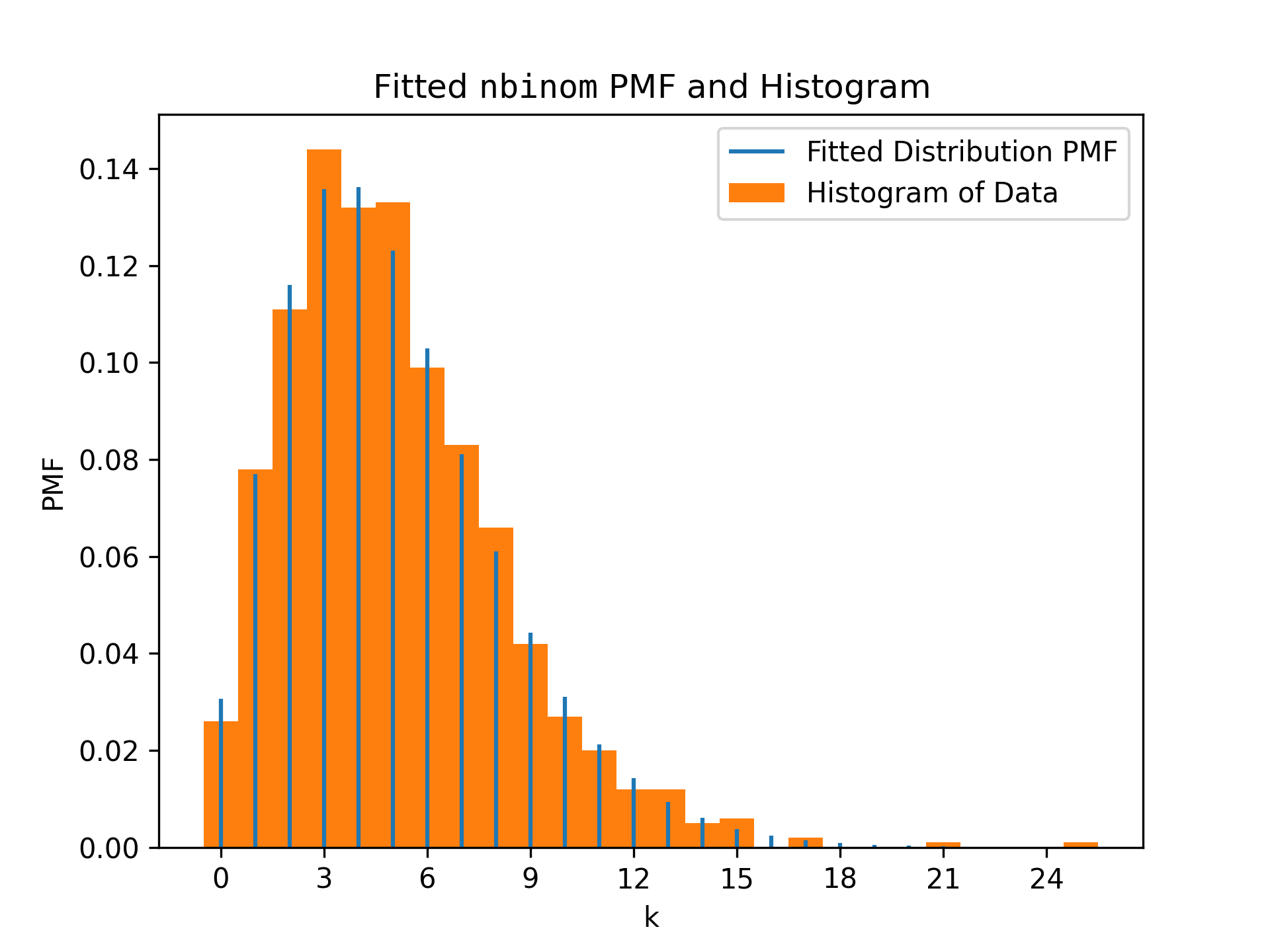
Superposes the PDF/PMF of the fitted distribution over a normalized histogram of the data.
Notes
Optimization is more likely to converge to the maximum likelihood estimate when the user provides tight bounds containing the maximum likelihood estimate. For example, when fitting a binomial distribution to data, the number of experiments underlying each sample may be known, in which case the corresponding shape parameter n can be fixed.
Array API Standard Support
fit is not in-scope for support of Python Array API Standard compatible backends other than NumPy.
See dev-arrayapi for more information.
Examples
Suppose we wish to fit a distribution to the following data.import numpy as np from scipy import stats rng = np.random.default_rng() dist = stats.nbinom shapes = (5, 0.5) data = dist.rvs(*shapes, size=1000, random_state=rng)✓
bounds = [(0, 30), (0, 1)]
res = stats.fit(dist, data, bounds)
✓
res.params
✗import matplotlib.pyplot as plt # matplotlib must be installed to plot
✓res.plot()
✗plt.show()
✓
bounds = {'n': (0, 30)}  # omit parameter p using a `dict`
res2 = stats.fit(dist, data, bounds)
✓
res2.params
✗bounds = {'n': (6, 6)} # fix parameter `n` res3 = stats.fit(dist, data, bounds)✓
res3.params
res3.nllf() > res.nllf()
✗
from scipy.optimize import differential_evolution
rng = np.random.default_rng(767585560716548)
def optimizer(fun, bounds, *, integrality):
    return differential_evolution(fun, bounds, strategy='best2bin',
                                  rng=rng, integrality=integrality)
bounds = [(0, 30), (0, 1)]
res4 = stats.fit(dist, data, bounds, optimizer=optimizer)
✓
res4.params
✗See also
- rv_continuous
- rv_discrete
Aliases
-
scipy.stats.fit