bundles / scipy latest / scipy / stats / _kde / gaussian_kde
class
scipy.stats._kde:gaussian_kde
source: build-install/usr/lib/python3.14/site-packages/scipy/stats/_kde.py:38
Signature
class gaussian_kde(dataset, bw_method = None, weights = None)Members
Summary
Representation of a kernel-density estimate using Gaussian kernels.
Extended Summary
Kernel density estimation is a way to estimate the probability density function (PDF) of a random variable in a non-parametric way. gaussian_kde works for both uni-variate and multi-variate data. It includes automatic bandwidth determination. The estimation works best for a unimodal distribution; bimodal or multi-modal distributions tend to be oversmoothed.
Parameters
dataset: array_likeDatapoints to estimate from. In case of univariate data this is a 1-D array, otherwise a 2-D array with shape (# of dims, # of data).
bw_method: str, scalar or callable, optionalThe method used to calculate the bandwidth factor. This can be 'scott', 'silverman', a scalar constant or a callable. If a scalar, this will be used directly as factor. If a callable, it should take a gaussian_kde instance as only parameter and return a scalar. If None (default), 'scott' is used. See Notes for more details.
weights: array_like, optionalweights of datapoints. This must be the same shape as dataset. If None (default), the samples are assumed to be equally weighted
Attributes
dataset: ndarrayThe dataset with which gaussian_kde was initialized.
d: intNumber of dimensions.
n: intNumber of datapoints.
neff: intEffective number of datapoints.
factor: floatThe bandwidth factor obtained from covariance_factor.
covariance: ndarrayThe kernel covariance matrix; this is the data covariance matrix multiplied by the square of the bandwidth factor, e.g.
np.cov(dataset) * factor**2.inv_cov: ndarrayThe inverse of covariance.
Methods
evaluate__call__integrate_gaussianintegrate_box_1dintegrate_boxintegrate_kdepdflogpdfresampleset_bandwidthcovariance_factormarginal
Notes
Bandwidth selection strongly influences the estimate obtained from the KDE (much more so than the actual shape of the kernel). Bandwidth selection can be done by a "rule of thumb", by cross-validation, by "plug-in methods" or by other means; see [3], [4] for reviews. gaussian_kde uses a rule of thumb, the default is Scott's Rule.
Scott's Rule [1], implemented as scotts_factor, is
n**(-1./(d+4)),with n the number of data points and d the number of dimensions. In the case of unequally weighted points, scotts_factor becomes
neff**(-1./(d+4)),with neff the effective number of datapoints. Silverman's suggestion for multivariate data [2], implemented as silverman_factor, is
(n * (d + 2) / 4.)**(-1. / (d + 4)).or in the case of unequally weighted points
(neff * (d + 2) / 4.)**(-1. / (d + 4)).Note that this is not the same as "Silverman's rule of thumb" [6], which may be more robust in the univariate case; see documentation of the set_bandwidth method for implementing a custom bandwidth rule.
Good general descriptions of kernel density estimation can be found in [1] and [2], the mathematics for this multi-dimensional implementation can be found in [1].
With a set of weighted samples, the effective number of datapoints neff is defined by
neff = sum(weights)^2 / sum(weights^2)as detailed in [5].
gaussian_kde does not currently support data that lies in a lower-dimensional subspace of the space in which it is expressed. For such data, consider performing principal component analysis / dimensionality reduction and using gaussian_kde with the transformed data.
Examples
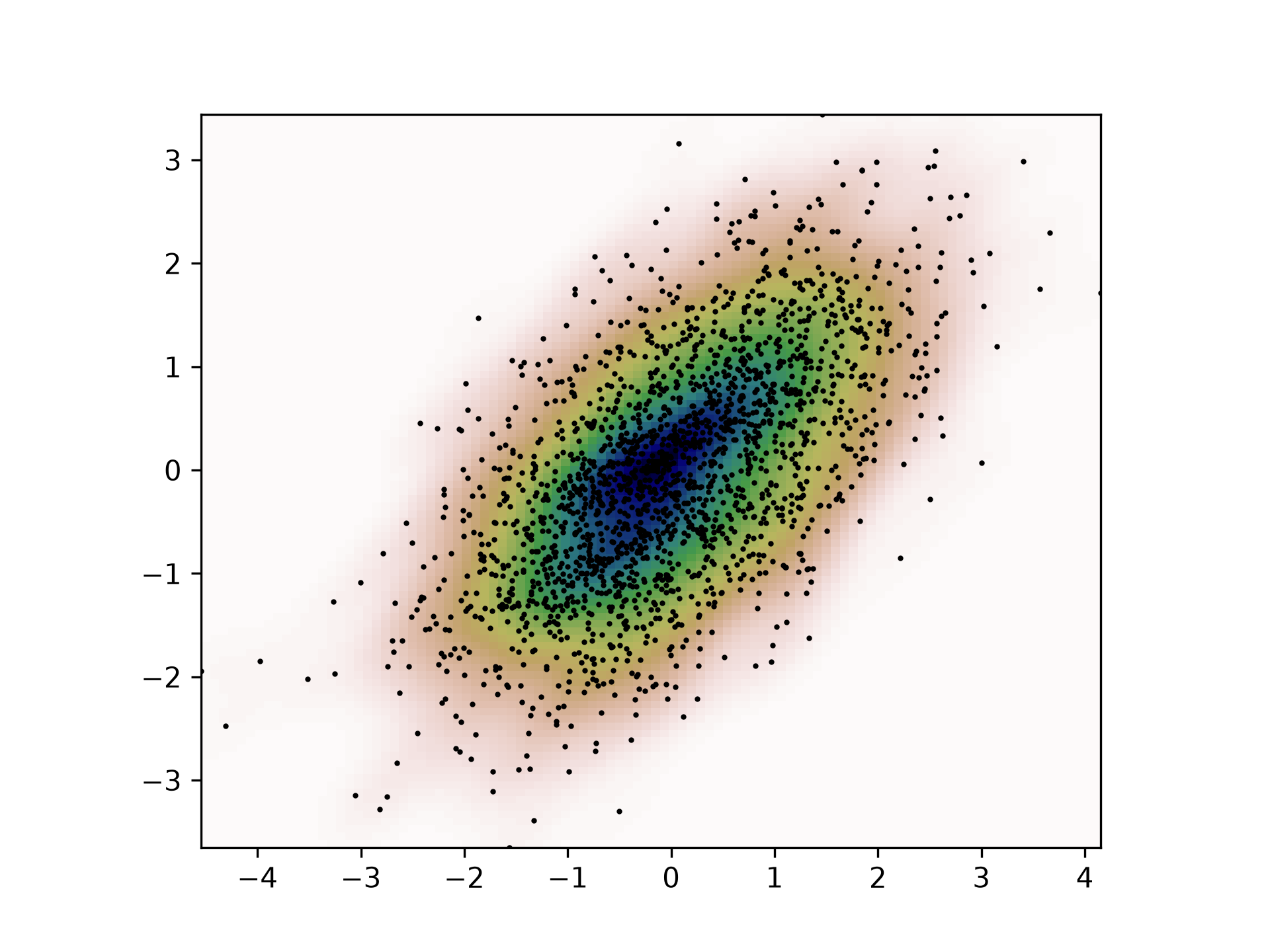
Generate some random two-dimensional data:import numpy as np from scipy import stats def measure(n): "Measurement model, return two coupled measurements." m1 = np.random.normal(size=n) m2 = np.random.normal(scale=0.5, size=n) return m1+m2, m1-m2✓
m1, m2 = measure(2000)
xmin = m1.min()
xmax = m1.max()
ymin = m2.min()
ymax = m2.max()
✓
X, Y = np.mgrid[xmin:xmax:100j, ymin:ymax:100j]
positions = np.vstack([X.ravel(), Y.ravel()])
values = np.vstack([m1, m2])
kernel = stats.gaussian_kde(values)
Z = np.reshape(kernel(positions).T, X.shape)
✓
import matplotlib.pyplot as plt
fig, ax = plt.subplots()
✓
ax.imshow(np.rot90(Z), cmap=plt.cm.gist_earth_r,
          extent=[xmin, xmax, ymin, ymax])
ax.plot(m1, m2, 'k.', markersize=2)
ax.set_xlim([xmin, xmax])
ax.set_ylim([ymin, ymax])
✗
(-3.648350699902039, 3.4427470912708973)
plt.show()
✓
point = [1, 2]
mean = values.T
cov = kernel.factor**2 * np.cov(values)
X = stats.multivariate_normal(cov=cov)
res = kernel.pdf(point)
ref = X.pdf(point - mean).sum() / len(mean)
np.allclose(res, ref)
✓
True
Aliases
scipy.stats.gaussian_kde