bundles / numpy latest / numpy / linspace
_ArrayFunctionDispatcher
numpy:linspace
source: /dev/numpy/build-install/usr/lib/python3.14/site-packages/numpy/_core/function_base.py:27
Signature
def linspace(start, stop, num = 50, endpoint = True, retstep = False, dtype = None, axis = 0, *, device = None)Summary
Return evenly spaced numbers over a specified interval.
Extended Summary
Returns num evenly spaced samples, calculated over the interval [start, stop].
The endpoint of the interval can optionally be excluded.
Parameters
start: array_likeThe starting value of the sequence.
stop: array_likeThe end value of the sequence, unless
endpointis set to False. In that case, the sequence consists of all but the last ofnum + 1evenly spaced samples, so thatstopis excluded. Note that the step size changes whenendpointis False.num: int, optionalNumber of samples to generate. Default is 50. Must be non-negative.
endpoint: bool, optionalIf True,
stopis the last sample. Otherwise, it is not included. Default is True.retstep: bool, optionalIf True, return (samples, step), where step is the spacing between samples.
dtype: dtype, optionalThe type of the output array. If
dtypeis not given, the data type is inferred fromstartandstop. The inferred dtype will never be an integer; float is chosen even if the arguments would produce an array of integers.axis: int, optionalThe axis in the result to store the samples. Relevant only if start or stop are array-like. By default (0), the samples will be along a new axis inserted at the beginning. Use -1 to get an axis at the end.
device: str, optionalThe device on which to place the created array. Default: None. For Array-API interoperability only, so must be
"cpu"if passed.
Returns
samples: ndarrayThere are
numequally spaced samples in the closed interval[start, stop]or the half-open interval[start, stop)(depending on whetherendpointis True or False).step: float, optionalOnly returned if
retstepis TrueSize of spacing between samples.
Examples
import numpy as np
np.linspace(2.0, 3.0, num=5)
✓
array([2. , 2.25, 2.5 , 2.75, 3. ])
np.linspace(2.0, 3.0, num=5, endpoint=False)
np.linspace(2.0, 3.0, num=5, retstep=True)
✗
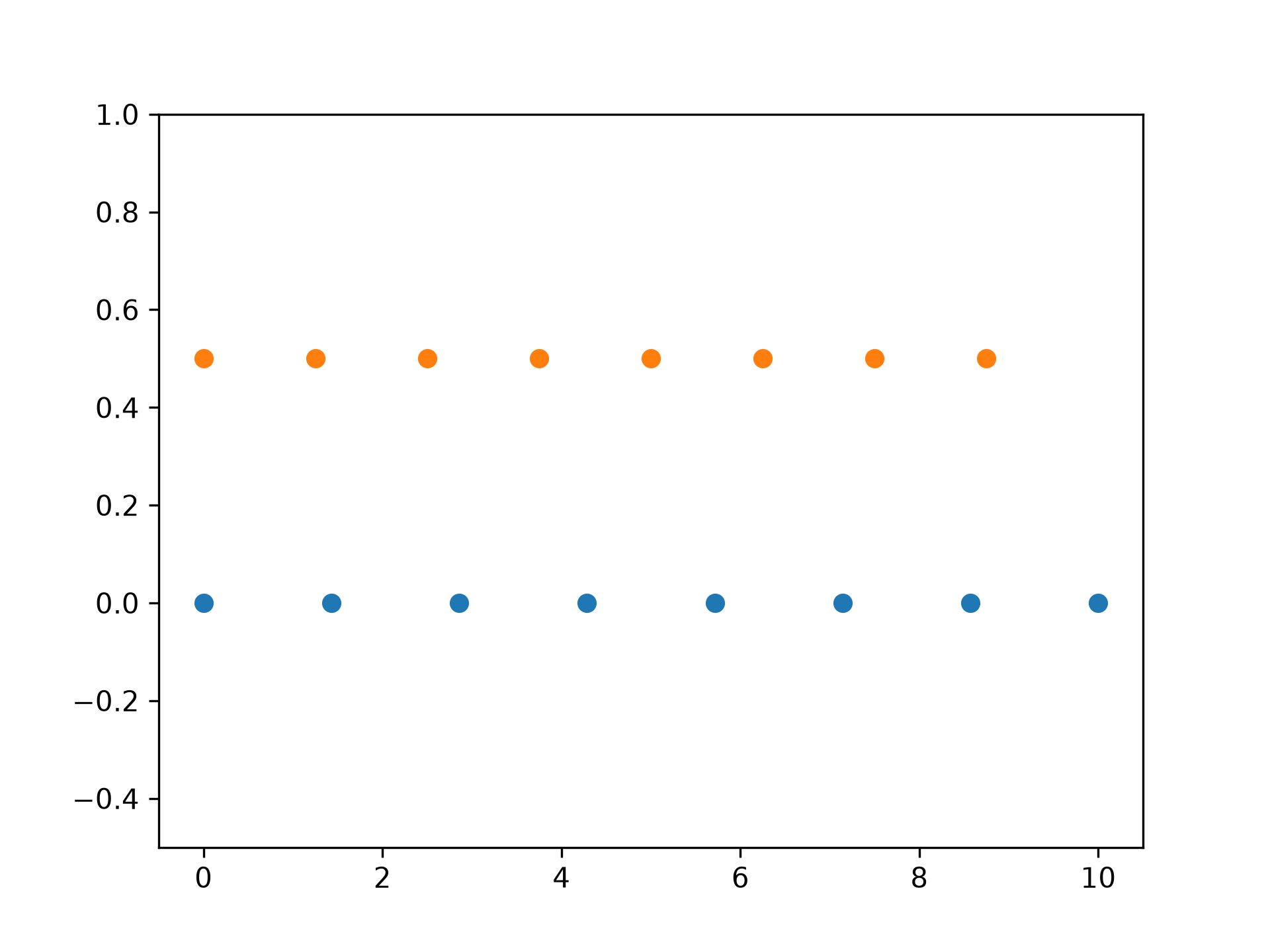
(array([2. , 2.25, 2.5 , 2.75, 3. ]), np.float64(0.25))Graphical illustration:
import matplotlib.pyplot as plt
N = 8
y = np.zeros(N)
x1 = np.linspace(0, 10, N, endpoint=True)
x2 = np.linspace(0, 10, N, endpoint=False)
plt.plot(x1, y, 'o')
plt.plot(x2, y + 0.5, 'o')
✓
[<matplotlib.lines.Line2D object at 0x7f22049a8980>]
plt.ylim([-0.5, 1])
✗(-0.5, 1.0)
plt.show()
✓
See also
Aliases
numpy.linspace