bundles / numpy latest / numpy / meshgrid
_ArrayFunctionDispatcher
numpy:meshgrid
source: /dev/numpy/build-install/usr/lib/python3.14/site-packages/numpy/lib/_function_base_impl.py:5040
Signature
def meshgrid(*xi, copy = True, sparse = False, indexing = xy)Summary
Return a tuple of coordinate matrices from coordinate vectors.
Extended Summary
Make N-D coordinate arrays for vectorized evaluations of N-D scalar/vector fields over N-D grids, given one-dimensional coordinate arrays x1, x2,..., xn.
Parameters
x1, x2,..., xn: array_like1-D arrays representing the coordinates of a grid.
indexing: {'xy', 'ij'}, optionalCartesian ('xy', default) or matrix ('ij') indexing of output. See Notes for more details.
sparse: bool, optionalIf True the shape of the returned coordinate array for dimension i is reduced from
(N1, ..., Ni, ... Nn)to(1, ..., 1, Ni, 1, ..., 1). These sparse coordinate grids are intended to be used with basics.broadcasting. When all coordinates are used in an expression, broadcasting still leads to a fully-dimensonal result array.Default is False.
copy: bool, optionalIf False, a view into the original arrays are returned in order to conserve memory. Default is True. Please note that
sparse=False, copy=Falsewill likely return non-contiguous arrays. Furthermore, more than one element of a broadcast array may refer to a single memory location. If you need to write to the arrays, make copies first.
Returns
X1, X2,..., XN: tuple of ndarraysFor vectors x1, x2,..., xn with lengths
Ni=len(xi), returns(N1, N2, N3,..., Nn)shaped arrays if indexing='ij' or(N2, N1, N3,..., Nn)shaped arrays if indexing='xy' with the elements ofxirepeated to fill the matrix along the first dimension for x1, the second for x2 and so on.
Notes
This function supports both indexing conventions through the indexing keyword argument. Giving the string 'ij' returns a meshgrid with matrix indexing, while 'xy' returns a meshgrid with Cartesian indexing. In the 2-D case with inputs of length M and N, the outputs are of shape (N, M) for 'xy' indexing and (M, N) for 'ij' indexing. In the 3-D case with inputs of length M, N and P, outputs are of shape (N, M, P) for 'xy' indexing and (M, N, P) for 'ij' indexing. The difference is illustrated by the following code snippet
xv, yv = np.meshgrid(x, y, indexing='ij')
for i in range(nx):
    for j in range(ny):
        # treat xv[i,j], yv[i,j]

xv, yv = np.meshgrid(x, y, indexing='xy')
for i in range(nx):
    for j in range(ny):
        # treat xv[j,i], yv[j,i]
In the 1-D and 0-D case, the indexing and sparse keywords have no effect.
Examples
import numpy as np
nx, ny = (3, 2)
x = np.linspace(0, 1, nx)
y = np.linspace(0, 1, ny)
xv, yv = np.meshgrid(x, y)
xv
✓
array([[0. , 0.5, 1. ],
       [0. , 0.5, 1. ]])
yv
✗array([[0., 0., 0.],
[1., 1., 1.]])
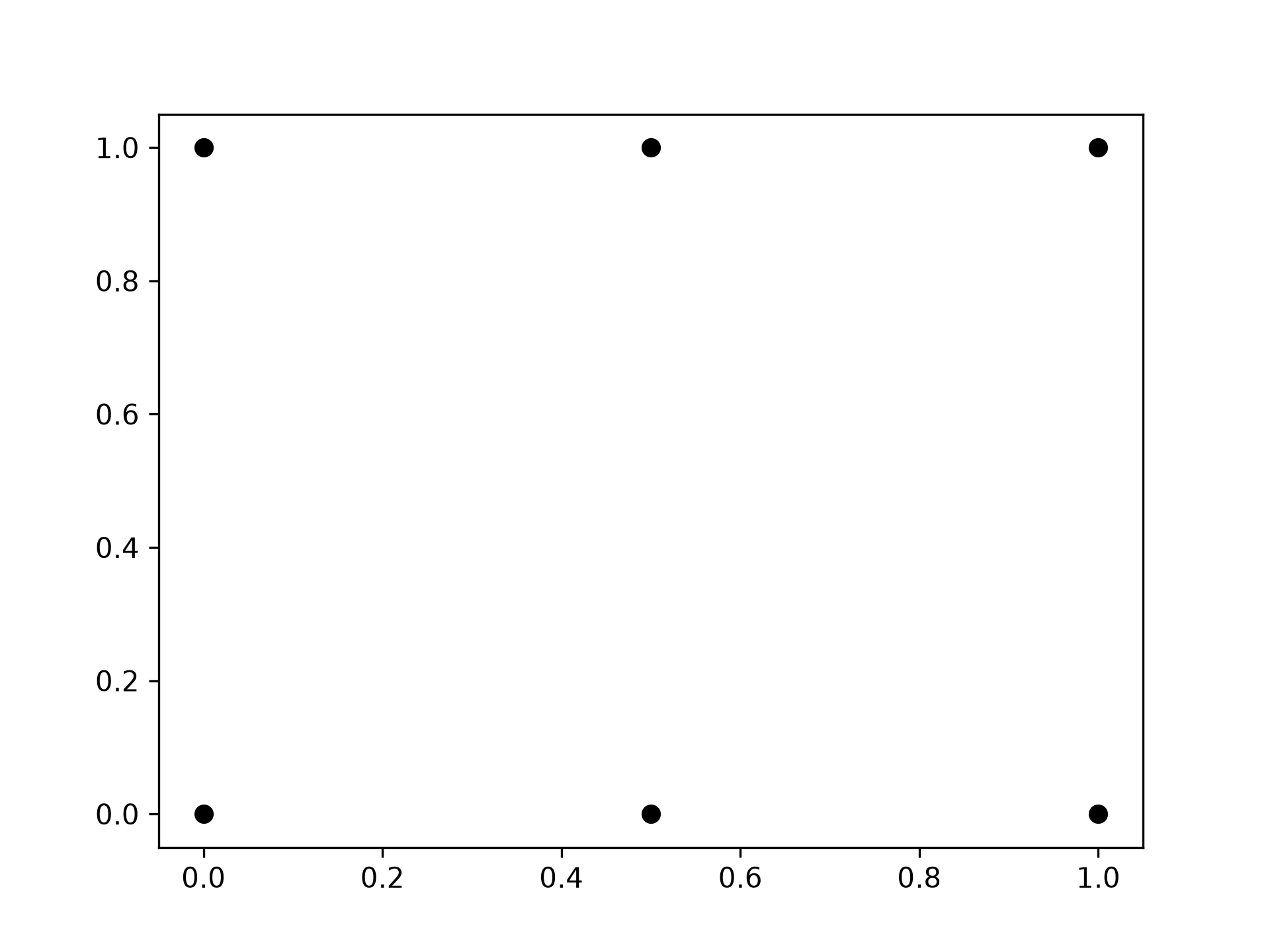
The result of `meshgrid` is a coordinate grid:
import matplotlib.pyplot as plt
✓plt.plot(xv, yv, marker='o', color='k', linestyle='none')
✗[<matplotlib.lines.Line2D object at 0x7f22049a8440>, <matplotlib.lines.Line2D object at 0x7f22049a81a0>, <matplotlib.lines.Line2D object at 0x7f22049a8050>]
plt.show()
✓
xv, yv = np.meshgrid(x, y, sparse=True)
✓xv
✗array([[0. , 0.5, 1. ]])
yv
✓array([[0.],
[1.]])
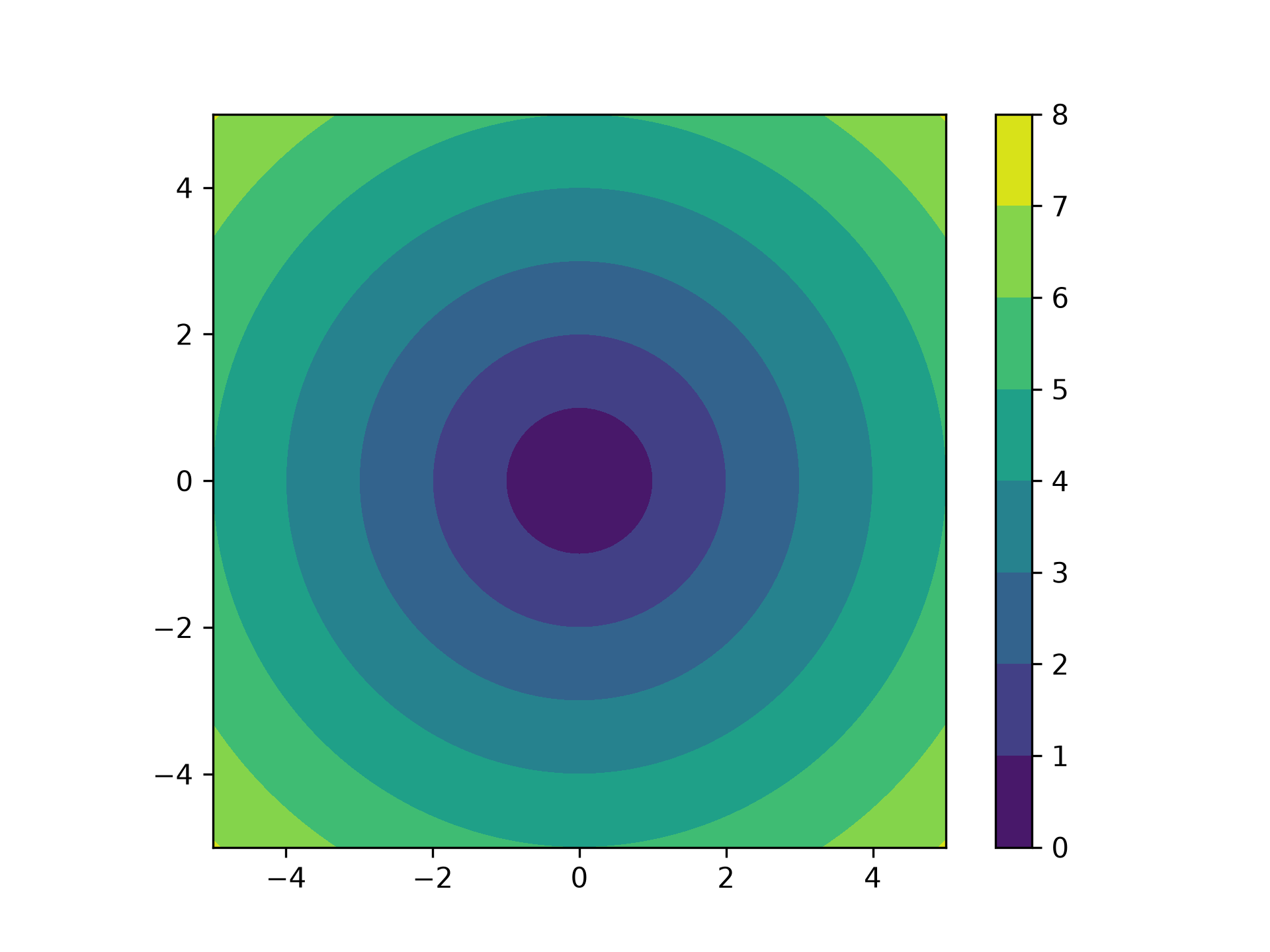
`meshgrid` is very useful to evaluate functions on a grid. If the
function depends on all coordinates, both dense and sparse outputs can be
used.
x = np.linspace(-5, 5, 101)
y = np.linspace(-5, 5, 101)
xx, yy = np.meshgrid(x, y)
zz = np.sqrt(xx**2 + yy**2)
xx.shape, yy.shape, zz.shape
xs, ys = np.meshgrid(x, y, sparse=True)
zs = np.sqrt(xs**2 + ys**2)
xs.shape, ys.shape, zs.shape
np.array_equal(zz, zs)
✓
True
h = plt.contourf(x, y, zs)
✓plt.axis('scaled') plt.colorbar()✗
<matplotlib.colorbar.Colorbar object at 0x7f22049aa510>
plt.show()
✓
See also
- how-to-index
ref
- mgrid
Construct a multi-dimensional "meshgrid" using indexing notation.
- ogrid
Construct an open multi-dimensional "meshgrid" using indexing notation.
Aliases
numpy.meshgrid