bundles / scipy 1.17.1 / scipy / signal / _filter_design / freqs_zpk
function
scipy.signal._filter_design:freqs_zpk
Signature
def freqs_zpk(z, p, k, worN = 200)Summary
Compute frequency response of analog filter.
Extended Summary
Given the zeros z, poles p, and gain k of a filter, compute its frequency response
           (jw-z[0]) * (jw-z[1]) * ... * (jw-z[-1])
H(w) = k * ----------------------------------------
           (jw-p[0]) * (jw-p[1]) * ... * (jw-p[-1])
Parameters
z: array_likeZeroes of a linear filter
p: array_likePoles of a linear filter
k: scalarGain of a linear filter
worN: {None, int, array_like}, optionalIf None, then compute at 200 frequencies around the interesting parts of the response curve (determined by pole-zero locations). If a single integer, then compute at that many frequencies. Otherwise, compute the response at the angular frequencies (e.g., rad/s) given in
worN.
Returns
w: ndarrayThe angular frequencies at which h was computed.
h: ndarrayThe frequency response.
Notes
Array API Standard Support
freqs_zpk has experimental support for Python Array API Standard compatible backends in addition to NumPy. Please consider testing these features by setting an environment variable SCIPY_ARRAY_API=1 and providing CuPy, PyTorch, JAX, or Dask arrays as array arguments. The following combinations of backend and device (or other capability) are supported.
====================  ====================  ====================
Library               CPU                   GPU
====================  ====================  ====================
NumPy                 ✅                     n/a
CuPy                  n/a                   ✅
PyTorch               ✅                     ✅
JAX                   ⚠️ no JIT             ⛔
Dask                  ⚠️ computes graph     n/a
====================  ====================  ====================
See
dev-arrayapifor more information.
Examples
import numpy as np
from scipy.signal import freqs_zpk, iirfilter
✓
z, p, k = iirfilter(4, [1, 10], 1, 60, analog=True, ftype='cheby1',
                    output='zpk')
✓
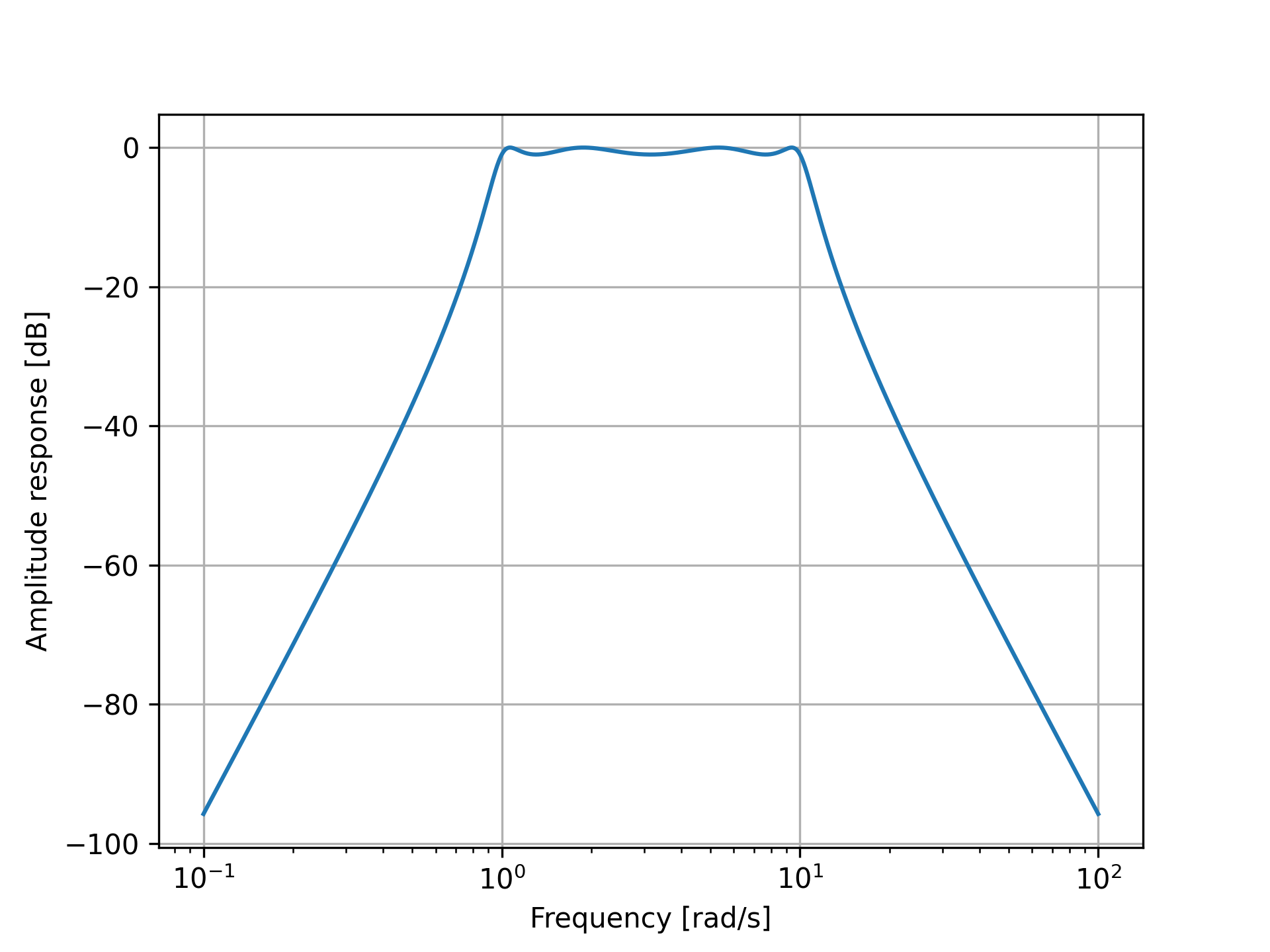
w, h = freqs_zpk(z, p, k, worN=np.logspace(-1, 2, 1000))
✓import matplotlib.pyplot as plt
✓plt.semilogx(w, 20 * np.log10(abs(h))) plt.xlabel('Frequency [rad/s]') plt.ylabel('Amplitude response [dB]')✗
plt.grid(True)
plt.show()
✓
See also
Aliases
scipy.signal.freqs_zpk