bundles / scipy 1.17.1 / scipy / signal / _spectral_py / csd
function
scipy.signal._spectral_py:csd
Signature
def csd(x, y, fs = 1.0, window = hann_periodic, nperseg = None, noverlap = None, nfft = None, detrend = constant, return_onesided = True, scaling = density, axis = -1, average = mean)Summary
Estimate the cross power spectral density, Pxy, using Welch's method.
Parameters
x: array_likeTime series of measurement values
y: array_likeTime series of measurement values
fs: float, optionalSampling frequency of the
xandytime series. Defaults to 1.0.window: str or tuple or array_like, optionalDesired window to use. If
windowis a string or tuple, it is passed to get_window to generate the window values, which are DFT-even by default. See get_window for a list of windows and required parameters. Ifwindowis array_like it will be used directly as the window and its length must be nperseg. Defaults to a periodic Hann window.nperseg: int, optionalLength of each segment. Defaults to None, but if window is str or tuple, is set to 256, and if window is array_like, is set to the length of the window.
noverlap: int, optionalNumber of points to overlap between segments. If
None,noverlap = nperseg // 2. Defaults toNoneand may not be greater thannperseg.nfft: int, optionalLength of the FFT used, if a zero padded FFT is desired. If
None, the FFT length isnperseg. Defaults toNone.detrend: str or function or `False`, optionalSpecifies how to detrend each segment. If
detrendis a string, it is passed as thetypeargument to thedetrendfunction. If it is a function, it takes a segment and returns a detrended segment. IfdetrendisFalse, no detrending is done. Defaults to 'constant'.return_onesided: bool, optionalIf
True, return a one-sided spectrum for real data. IfFalsereturn a two-sided spectrum. Defaults toTrue, but for complex data, a two-sided spectrum is always returned.scaling: { 'density', 'spectrum' }, optionalSelects between computing the cross spectral density ('density') where Pxy has units of V**2/Hz and computing the cross spectrum ('spectrum') where Pxy has units of V**2, if
xandyare measured in V andfsis measured in Hz. Defaults to 'density'axis: int, optionalAxis along which the CSD is computed for both inputs; the default is over the last axis (i.e.
axis=-1).average: { 'mean', 'median' }, optionalMethod to use when averaging periodograms. If the spectrum is complex, the average is computed separately for the real and imaginary parts. Defaults to 'mean'.
Returns
f: ndarrayArray of sample frequencies.
Pxy: ndarrayCross spectral density or cross power spectrum of x,y.
Notes
By convention, Pxy is computed with the conjugate FFT of X multiplied by the FFT of Y.
If the input series differ in length, the shorter series will be zero-padded to match.
An appropriate amount of overlap will depend on the choice of window and on your requirements. For the default Hann window an overlap of 50% is a reasonable trade-off between accurately estimating the signal power, while not over counting any of the data. Narrower windows may require a larger overlap.
The ratio of the cross spectrum (scaling='spectrum') divided by the cross spectral density (scaling='density') is the constant factor of sum(abs(window)**2)*fs / abs(sum(window))**2. If return_onesided is True, the values of the negative frequencies are added to values of the corresponding positive ones.
Consult the tutorial_SpectralAnalysis section of the user_guide for a discussion of the scalings of a spectral density and an (amplitude) spectrum.
Welch's method may be interpreted as taking the average over the time slices of a (cross-) spectrogram. Internally, this function utilizes the ShortTimeFFT to determine the required (cross-) spectrogram. An example below illustrates that it is straightforward to calculate Pxy directly with the ShortTimeFFT. However, there are some notable differences in the behavior of the ShortTimeFFT:
There is no direct ShortTimeFFT equivalent for the csd parameter combination
return_onesided=True, scaling='density', sincefft_mode='onesided2X'requires'psd'scaling. The is due to csd returning the doubled squared magnitude in this case, which does not have a sensible interpretation.ShortTimeFFT uses
float64/complex128internally, which is due to the behavior of the utilized fft module. Thus, those are the dtypes being returned. The csd function casts the return values tofloat32/complex64if the input isfloat32/complex64as well.The csd function calculates
np.conj(Sx[q,p]) * Sy[q,p], whereas~ShortTimeFFT.spectrogramcalculatesSx[q,p] * np.conj(Sy[q,p])whereSx[q,p],Sy[q,p]are the STFTs ofxandy. Also, the window positioning is different.
Array API Standard Support
csd has experimental support for Python Array API Standard compatible backends in addition to NumPy. Please consider testing these features by setting an environment variable SCIPY_ARRAY_API=1 and providing CuPy, PyTorch, JAX, or Dask arrays as array arguments. The following combinations of backend and device (or other capability) are supported.
====================  ====================  ====================
Library               CPU                   GPU
====================  ====================  ====================
NumPy                 ✅                     n/a
CuPy                  n/a                   ⛔
PyTorch               ⛔                     ⛔
JAX                   ⛔                     ⛔
Dask                  ⛔                     n/a
====================  ====================  ====================
See
dev-arrayapifor more information.
Examples
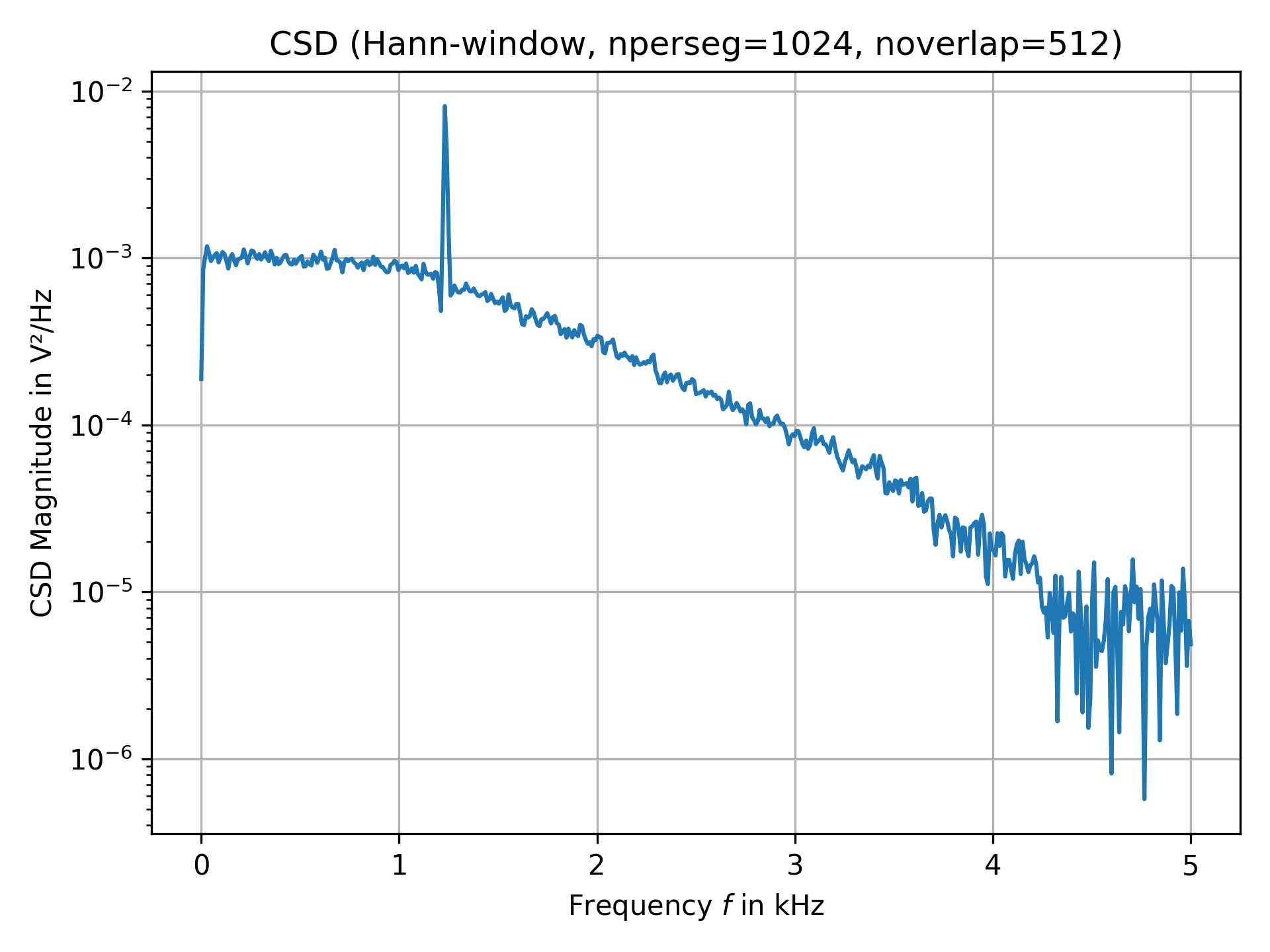
The following example plots the cross power spectral density of two signals with some common features:import numpy as np from scipy import signal import matplotlib.pyplot as plt rng = np.random.default_rng() # Generate two test signals with some common features: N, fs = 100_000, 10e3 # number of samples and sampling frequency amp, freq = 20, 1234.0 # amplitude and frequency of utilized sine signal noise_power = 0.001 * fs / 2 time = np.arange(N) / fs b, a = signal.butter(2, 0.25, 'low') x = rng.normal(scale=np.sqrt(noise_power), size=time.shape) y = signal.lfilter(b, a, x) x += amp*np.sin(2*np.pi*freq*time) y += rng.normal(scale=0.1*np.sqrt(noise_power), size=time.shape) # Compute and plot the magnitude of the cross spectral density: nperseg, noverlap, win = 1024, 512, 'hann' f, Pxy = signal.csd(x, y, fs, win, nperseg, noverlap) fig0, ax0 = plt.subplots(tight_layout=True)✓
ax0.set_title(f"CSD ({win.title()}-window, {nperseg=}, {noverlap=})")
ax0.set(xlabel="Frequency $f$ in kHz", ylabel="CSD Magnitude in V²/Hz")
ax0.semilogy(f/1e3, np.abs(Pxy))
✗
ax0.grid()
plt.show()
✓
SFT = signal.ShortTimeFFT.from_window('hann', fs, nperseg, noverlap,
                                      scale_to='psd', fft_mode='onesided2X',
                                      phase_shift=None)
Sxy1 = SFT.spectrogram(y, x, detr='constant', k_offset=nperseg//2,
                       p0=0, p1=(N-noverlap) // SFT.hop)
Pxy1 = Sxy1.mean(axis=-1)
np.allclose(Pxy, Pxy1)  # same result as with csd()
✓
See also
- coherence
Magnitude squared coherence by Welch's method.
- lombscargle
Lomb-Scargle periodogram for unevenly sampled data
- periodogram
Simple, optionally modified periodogram
- welch
Power spectral density by Welch's method. [Equivalent to csd(x,x)]
Aliases
scipy.signal.csd