bundles / scipy latest / scipy / ndimage / _filters / sobel
function
scipy.ndimage._filters:sobel
source: build-install/usr/lib/python3.14/site-packages/scipy/ndimage/_filters.py:936
Signature
def sobel(input, axis = -1, output = None, mode = reflect, cval = 0.0)Summary
Calculate a Sobel filter.
Parameters
input: array_likeThe input array.
axis: int, optionalThe axis of
inputalong which to calculate. Default is -1.output: array or dtype, optionalThe array in which to place the output, or the dtype of the returned array. By default an array of the same dtype as input will be created.
mode: str or sequence, optionalThe
modeparameter determines how the input array is extended when the filter overlaps a border. By passing a sequence of modes with length equal to the number of dimensions of the input array, different modes can be specified along each axis. Default value is 'reflect'. The valid values and their behavior is as follows:'reflect' (
d c b a | a b c d | d c b a)The input is extended by reflecting about the edge of the last pixel. This mode is also sometimes referred to as half-sample symmetric.
'constant' (
k k k k | a b c d | k k k k)The input is extended by filling all values beyond the edge with the same constant value, defined by the
cvalparameter.'nearest' (
a a a a | a b c d | d d d d)The input is extended by replicating the last pixel.
'mirror' (
d c b | a b c d | c b a)The input is extended by reflecting about the center of the last pixel. This mode is also sometimes referred to as whole-sample symmetric.
'wrap' (
a b c d | a b c d | a b c d)The input is extended by wrapping around to the opposite edge.
For consistency with the interpolation functions, the following mode names can also be used:
'grid-constant'
This is a synonym for 'constant'.
'grid-mirror'
This is a synonym for 'reflect'.
'grid-wrap'
This is a synonym for 'wrap'.
cval: scalar, optionalValue to fill past edges of input if
modeis 'constant'. Default is 0.0.
Returns
sobel: ndarrayFiltered array. Has the same shape as
input.
Notes
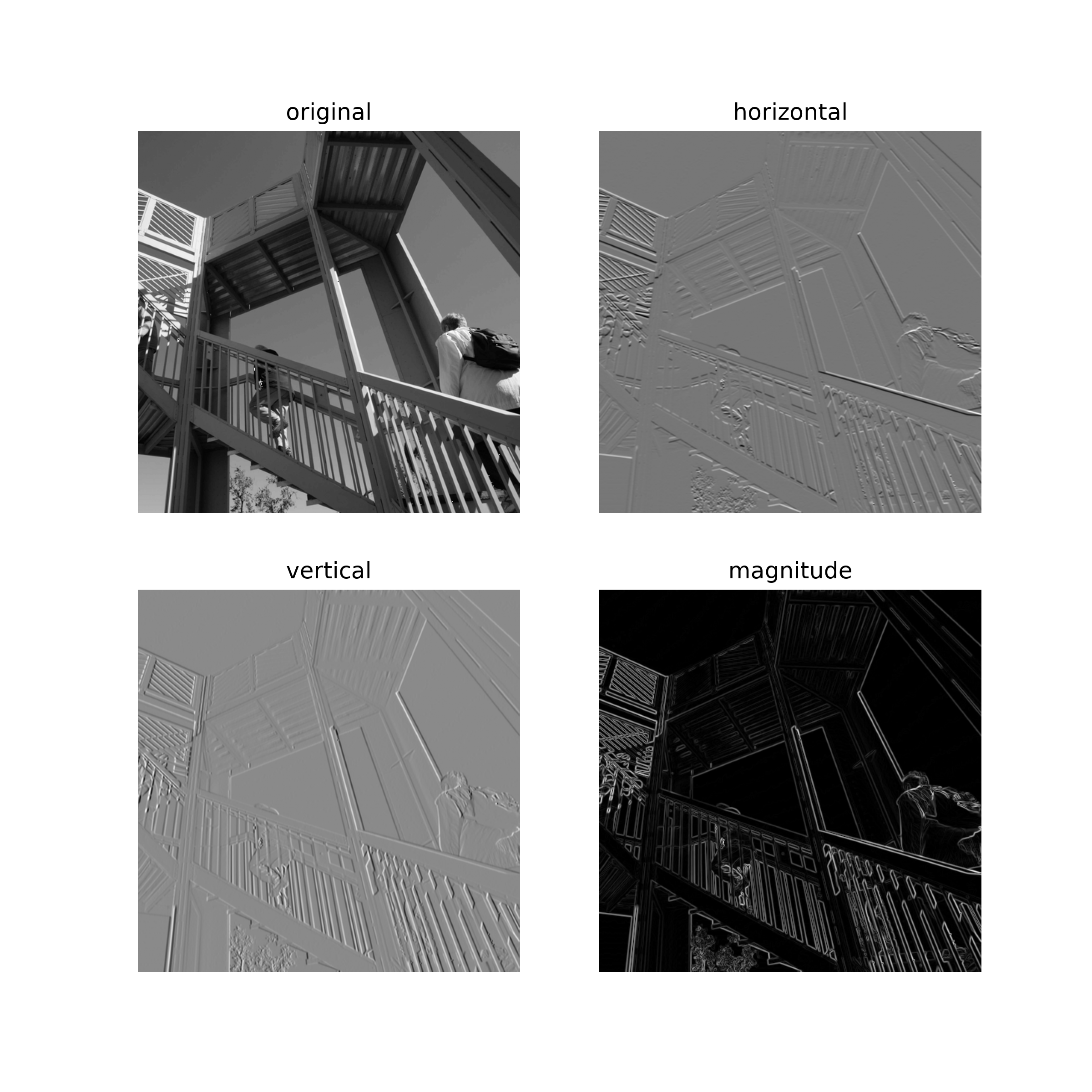
This function computes the axis-specific Sobel gradient. The horizontal edges can be emphasised with the horizontal transform (axis=0), the vertical edges with the vertical transform (axis=1) and so on for higher dimensions. These can be combined to give the magnitude.
Examples
from scipy import ndimage, datasets
import matplotlib.pyplot as plt
import numpy as np
ascent = datasets.ascent().astype('int32')
sobel_h = ndimage.sobel(ascent, 0)  # horizontal gradient
sobel_v = ndimage.sobel(ascent, 1)  # vertical gradient
magnitude = np.sqrt(sobel_h**2 + sobel_v**2)
magnitude *= 255.0 / np.max(magnitude)  # normalization
fig, axs = plt.subplots(2, 2, figsize=(8, 8))
plt.gray()  # show the filtered result in grayscale
✓
axs[0, 0].imshow(ascent)
axs[0, 1].imshow(sobel_h)
axs[1, 0].imshow(sobel_v)
axs[1, 1].imshow(magnitude)
✗
<matplotlib.image.AxesImage object at 0x7f3f691191d0>
titles = ["original", "horizontal", "vertical", "magnitude"]
✓for i, ax in enumerate(axs.ravel()): ax.set_title(titles[i]) ax.axis("off")✗
Text(0.5, 1.0, 'original')
(np.float64(-0.5), np.float64(511.5), np.float64(511.5), np.float64(-0.5))
Text(0.5, 1.0, 'horizontal')
(np.float64(-0.5), np.float64(511.5), np.float64(511.5), np.float64(-0.5))
Text(0.5, 1.0, 'vertical')
(np.float64(-0.5), np.float64(511.5), np.float64(511.5), np.float64(-0.5))
Text(0.5, 1.0, 'magnitude')
(np.float64(-0.5), np.float64(511.5), np.float64(511.5), np.float64(-0.5))
plt.show()
✓
Aliases
scipy.ndimage.sobel