bundles / scipy latest / scipy / signal / _fir_filter_design / firls
function
scipy.signal._fir_filter_design:firls
source: build-install/usr/lib/python3.14/site-packages/scipy/signal/_fir_filter_design.py:960
Signature
def firls(numtaps, bands, desired, *, weight = None, fs = None)Summary
FIR filter design using least-squares error minimization.
Extended Summary
Calculate the filter coefficients for the linear-phase finite impulse response (FIR) filter which has the best approximation to the desired frequency response described by bands and desired in the least squares sense (i.e., the integral of the weighted mean-squared error within the specified bands is minimized).
Parameters
numtaps: intThe number of taps in the FIR filter.
numtapsmust be odd.bands: array_likeA monotonic nondecreasing sequence containing the band edges in Hz. All elements must be non-negative and less than or equal to the Nyquist frequency given by
nyq. The bands are specified as frequency pairs, thus, if using a 1D array, its length must be even, e.g.,np.array([0, 1, 2, 3, 4, 5]). Alternatively, the bands can be specified as an nx2 sized 2D array, where n is the number of bands, e.g,np.array([[0, 1], [2, 3], [4, 5]]).desired: array_likeA sequence the same size as
bandscontaining the desired gain at the start and end point of each band.weight: array_like, optionalA relative weighting to give to each band region when solving the least squares problem.
weighthas to be half the size ofbands.fs: float, optionalThe sampling frequency of the signal. Each frequency in
bandsmust be between 0 andfs/2(inclusive). Default is 2.
Returns
coeffs: ndarrayCoefficients of the optimal (in a least squares sense) FIR filter.
Notes
This implementation follows the algorithm given in [1]. As noted there, least squares design has multiple advantages:
Optimal in a least-squares sense.
Simple, non-iterative method.
The general solution can obtained by solving a linear system of equations.
Allows the use of a frequency dependent weighting function.
This function constructs a Type I linear phase FIR filter, which contains an odd number of coeffs satisfying for :
The odd number of coefficients and filter symmetry avoid boundary conditions that could otherwise occur at the Nyquist and 0 frequencies (e.g., for Type II, III, or IV variants).
Examples
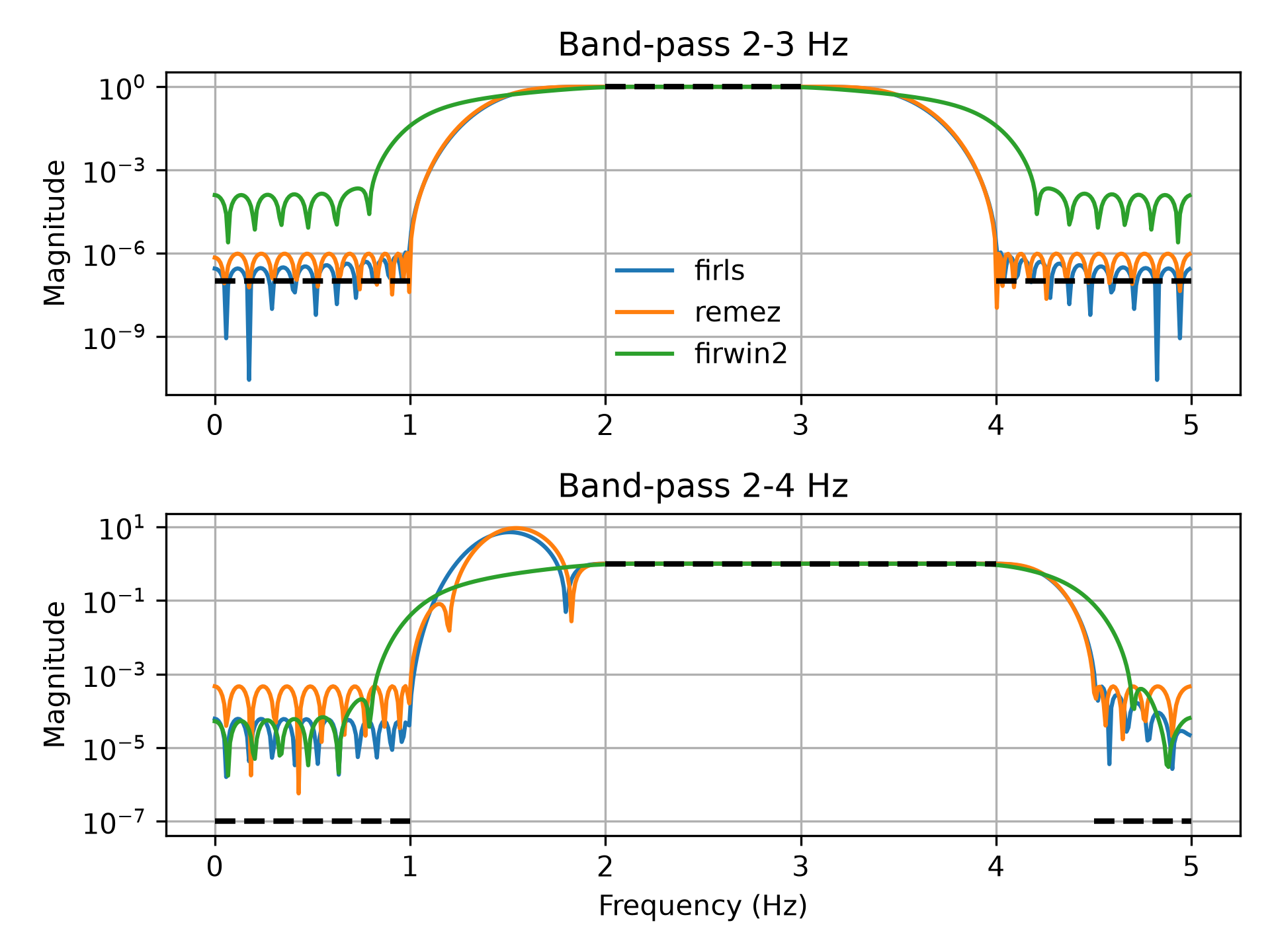
We want to construct a band-pass filter. Note that the behavior in the frequency ranges between our stop bands and pass bands is unspecified, and thus may overshoot depending on the parameters of our filter:import numpy as np from scipy import signal import matplotlib.pyplot as plt fig, axs = plt.subplots(2) fs = 10.0 # Hz desired = (0, 0, 1, 1, 0, 0)✓
for bi, bands in enumerate(((0, 1, 2, 3, 4, 5), (0, 1, 2, 4, 4.5, 5))):
    fir_firls = signal.firls(73, bands, desired, fs=fs)
    fir_remez = signal.remez(73, bands, desired[::2], fs=fs)
    fir_firwin2 = signal.firwin2(73, bands, desired, fs=fs)
    hs = list()
    ax = axs[bi]
    for fir in (fir_firls, fir_remez, fir_firwin2):
        freq, response = signal.freqz(fir)
        hs.append(ax.semilogy(0.5*fs*freq/np.pi, np.abs(response))[0])
    for band, gains in zip(zip(bands[::2], bands[1::2]),
                           zip(desired[::2], desired[1::2])):
        ax.semilogy(band, np.maximum(gains, 1e-7), 'k--', linewidth=2)
    if bi == 0:
        ax.legend(hs, ('firls', 'remez', 'firwin2'),
                  loc='lower center', frameon=False)
    else:
        ax.set_xlabel('Frequency (Hz)')
    ax.grid(True)
    ax.set(title='Band-pass %d-%d Hz' % bands[2:4], ylabel='Magnitude')
✗
[<matplotlib.lines.Line2D object at 0x7f3f68553770>]
[<matplotlib.lines.Line2D object at 0x7f3f685538c0>]
[<matplotlib.lines.Line2D object at 0x7f3f68553a10>]
<matplotlib.legend.Legend object at 0x7f3f685530e0>
[Text(0.5, 1.0, 'Band-pass 2-3 Hz'), Text(0, 0.5, 'Magnitude')]
[<matplotlib.lines.Line2D object at 0x7f3f685492b0>]
[<matplotlib.lines.Line2D object at 0x7f3f68548980>]
[<matplotlib.lines.Line2D object at 0x7f3f68549010>]
Text(0.5, 0, 'Frequency (Hz)')
[Text(0.5, 1.0, 'Band-pass 2-4 Hz'), Text(0, 0.5, 'Magnitude')]
fig.tight_layout()
plt.show()
✓
See also
Aliases
scipy.signal.firls