bundles / scipy latest / scipy / signal / _ltisys / bode
function
scipy.signal._ltisys:bode
source: build-install/usr/lib/python3.14/site-packages/scipy/signal/_ltisys.py:2449
Signature
def bode(system, w = None, n = 100)Summary
Calculate Bode magnitude and phase data of a continuous-time system.
Parameters
system: an instance of the LTI class or a tuple describing the systemThe following gives the number of elements in the tuple and the interpretation:
1 (instance of lti)
2 (num, den)
3 (zeros, poles, gain)
4 (A, B, C, D)
w: array_like, optionalArray of frequencies (in rad/s). Magnitude and phase data is calculated for every value in this array. If not given a reasonable set will be calculated.
n: int, optionalNumber of frequency points to compute if
wis not given. Thenfrequencies are logarithmically spaced in an interval chosen to include the influence of the poles and zeros of the system.
Returns
w: 1D ndarrayFrequency array [rad/s]
mag: 1D ndarrayMagnitude array [dB]
phase: 1D ndarrayPhase array [deg]
Notes
If (num, den) is passed in for system, coefficients for both the numerator and denominator should be specified in descending exponent order (e.g. s^2 + 3s + 5 would be represented as [1, 3, 5]).
Examples
from scipy import signal
import matplotlib.pyplot as plt
✓
sys = signal.TransferFunction([1], [1, 1])
w, mag, phase = signal.bode(sys)
✓
plt.figure()
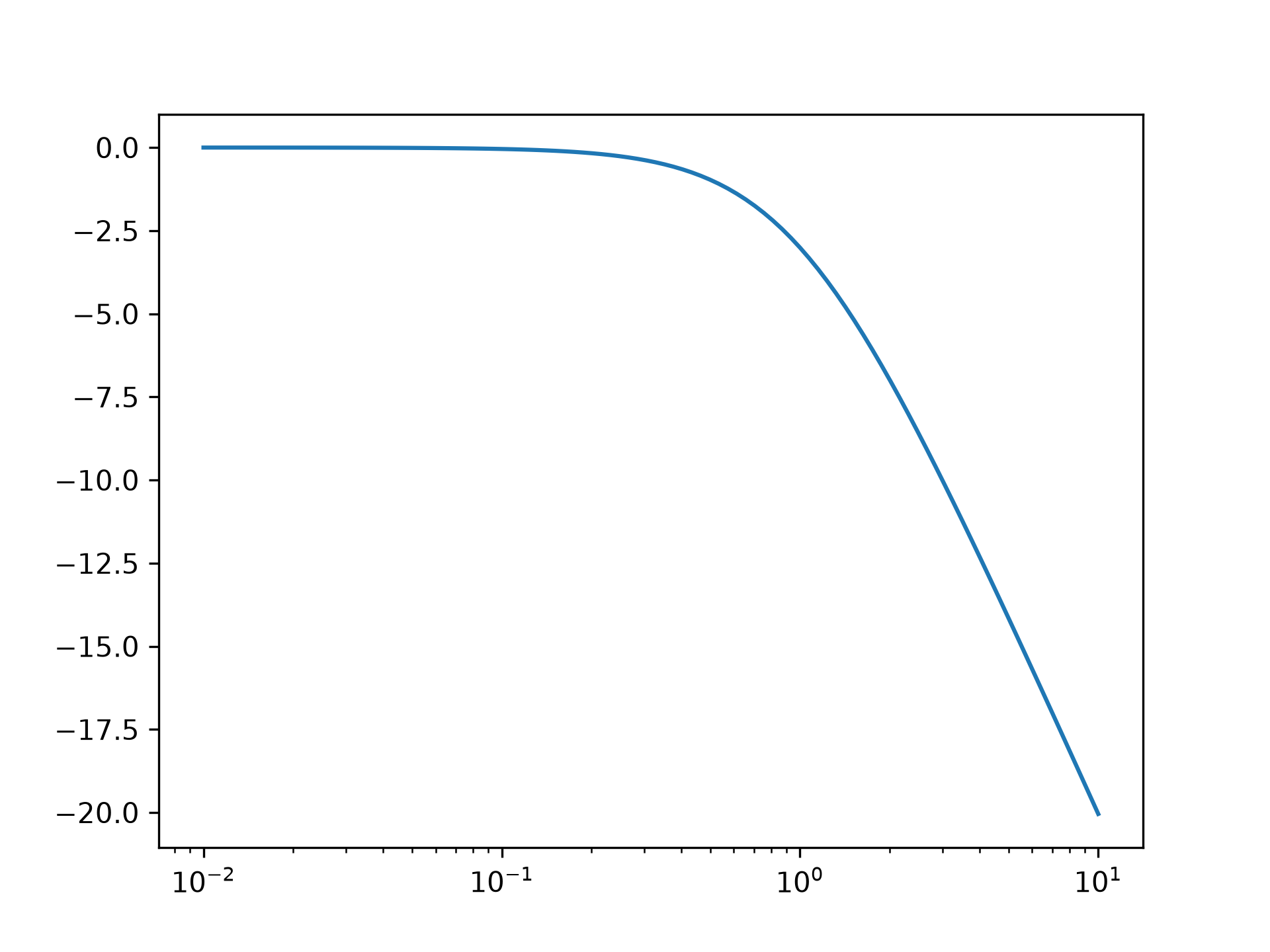
plt.semilogx(w, mag)    # Bode magnitude plot
plt.figure()
plt.semilogx(w, phase)  # Bode phase plot
✗
[<matplotlib.lines.Line2D object at 0x7f3f604623c0>]
plt.show()
✓
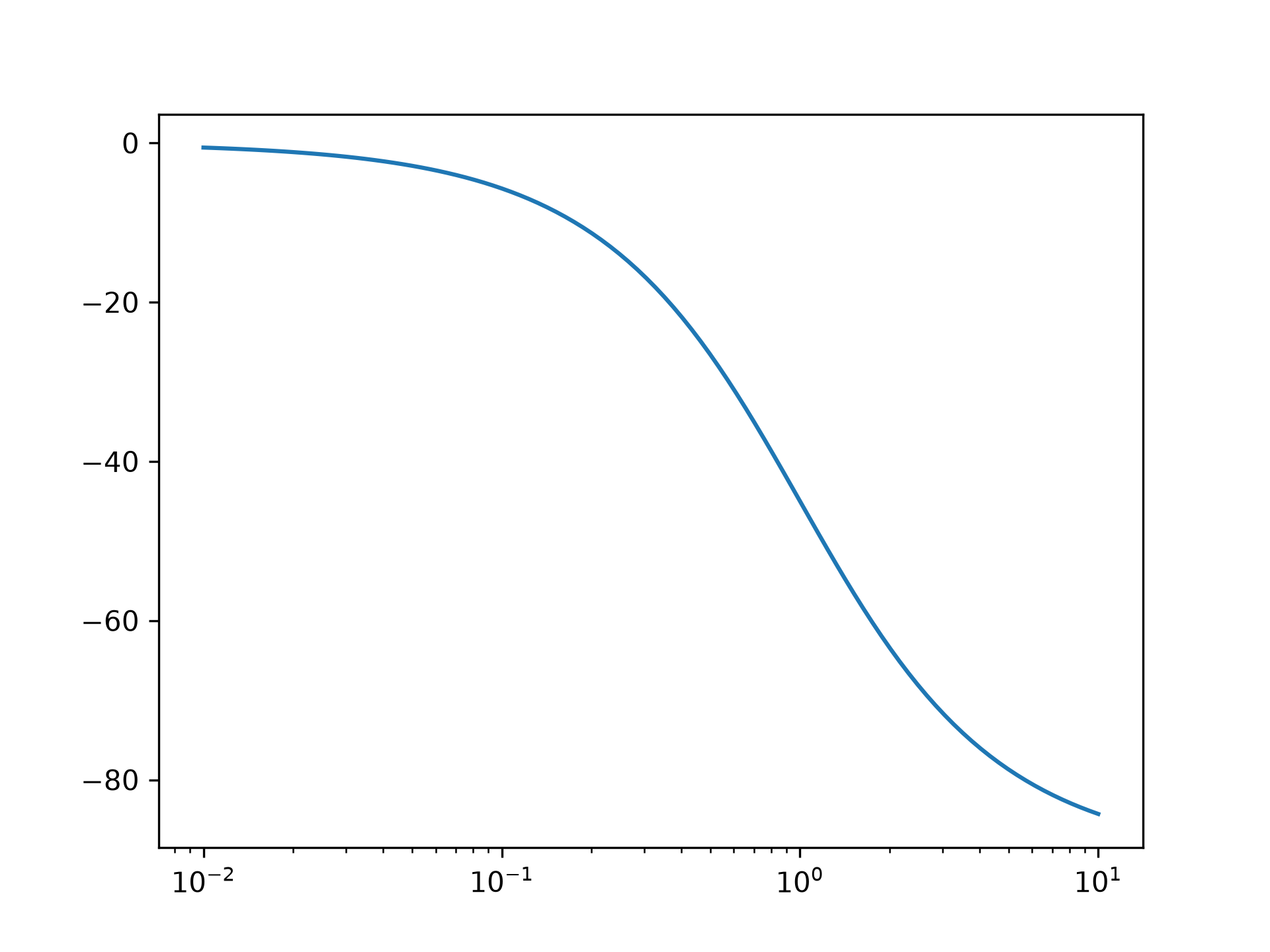
Aliases
scipy.signal.bode