bundles / scipy latest / scipy / signal / _ltisys / dimpulse
function
scipy.signal._ltisys:dimpulse
source: build-install/usr/lib/python3.14/site-packages/scipy/signal/_ltisys.py:3463
Signature
def dimpulse(system, x0 = None, t = None, n = None)Summary
Impulse response of discrete-time system.
Parameters
system: dlti | tupleAn instance of the LTI class dlti or a tuple describing the system. The number of elements in the tuple determine the interpretation. I.e.:
system: Instance of LTI class dlti. Note that derived instances, such as instances of TransferFunction, ZerosPolesGain, or StateSpace, are allowed as well.(num, den, dt): Rational polynomial as described in TransferFunction. The coefficients of the polynomials should be specified in descending exponent order, e.g., z² + 3z + 5 would be represented as[1, 3, 5].(zeros, poles, gain, dt): Zeros, poles, gain form as described in ZerosPolesGain.(A, B, C, D, dt): State-space form as described in StateSpace.
x0: array_like, optionalInitial state-vector. Defaults to zero.
t: array_like, optionalTime points. Computed if not given.
n: int, optionalThe number of time points to compute (if
tis not given).
Returns
tout: ndarrayTime values for the output, as a 1-D array.
yout: tuple of ndarrayImpulse response of system. Each element of the tuple represents the output of the system based on an impulse in each input.
Examples
import numpy as np
from scipy import signal
import matplotlib.pyplot as plt
dt = 1  # sampling interval is one => time unit is sample number
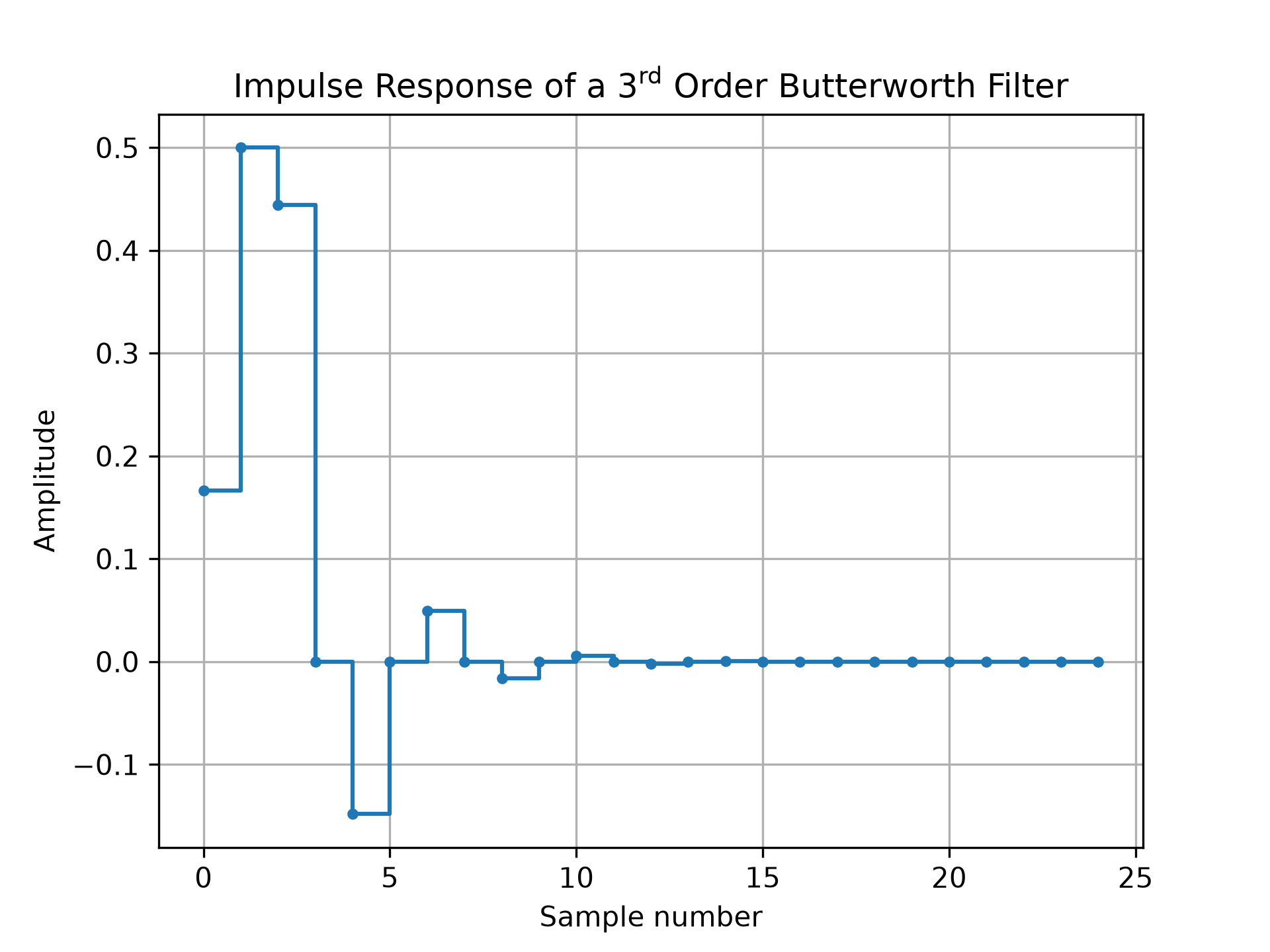
bb, aa = signal.butter(3, 0.25, fs=1/dt)
t, y = signal.dimpulse((bb, aa, dt), n=25)
fig0, ax0 = plt.subplots()
✓
ax0.step(t, np.squeeze(y), '.-', where='post')
ax0.set_title(r"Impulse Response of a $3^\text{rd}$ Order Butterworth Filter")
ax0.set(xlabel='Sample number', ylabel='Amplitude')
✗
[Text(0.5, 0, 'Sample number'), Text(0, 0.5, 'Amplitude')]
ax0.grid()
plt.show()
✓
See also
Aliases
scipy.signal.dimpulse