bundles / scipy latest / scipy / stats / _morestats / boxcox_normmax
function
scipy.stats._morestats:boxcox_normmax
source: build-install/usr/lib/python3.14/site-packages/scipy/stats/_morestats.py:1260
Signature
def boxcox_normmax(x, brack = None, method = pearsonr, optimizer = None, *, ymax = BIG_FLOAT, nan_policy = propagate)Summary
Compute optimal Box-Cox transform parameter for input data.
Parameters
x: array_likeInput array. All entries must be positive, finite, real numbers.
brack: 2-tuple, optional, default (-2.0, 2.0)The starting interval for a downhill bracket search for the default
optimize.brentsolver. Note that this is in most cases not critical; the final result is allowed to be outside this bracket. Ifoptimizeris passed,brackmust be None.method: str, optionalThe method to determine the optimal transform parameter (boxcox
lmbdaparameter). Options are:'pearsonr' (default)
Maximizes the Pearson correlation coefficient between
y = boxcox(x)and the expected values foryifxwould be normally-distributed.'mle'
Maximizes the log-likelihood boxcox_llf. This is the method used in boxcox.
'all'
Use all optimization methods available, and return all results. Useful to compare different methods.
optimizer: callable, optionaloptimizeris a callable that accepts one argument:fun
The objective function to be minimized.
funaccepts one argument, the Box-Cox transform parameter lmbda, and returns the value of the function (e.g., the negative log-likelihood) at the provided argument. The job ofoptimizeris to find the value of lmbda that minimizesfun.
and returns an object, such as an instance of scipy.optimize.OptimizeResult, which holds the optimal value of lmbda in an attribute
x.See the example below or the documentation of scipy.optimize.minimize_scalar for more information.
ymax: float, optionalThe unconstrained optimal transform parameter may cause Box-Cox transformed data to have extreme magnitude or even overflow. This parameter constrains MLE optimization such that the magnitude of the transformed
xdoes not exceedymax. The default is the maximum value of the input dtype. If set to infinity, boxcox_normmax returns the unconstrained optimal lambda. Ignored whenmethod='pearsonr'.nan_policy: {'propagate', 'omit', 'raise'}Defines how to handle input NaNs.
propagate: if a NaN is present in the input, the output will be NaN.omit: NaNs will be omitted when performing the calculation.raise: if a NaN is present, aValueErrorwill be raised.
Returns
maxlog: float or ndarrayThe optimal transform parameter found. An array instead of a scalar for
method='all'.
Examples
import numpy as np
from scipy import stats
import matplotlib.pyplot as plt
✓
rng = np.random.default_rng()
x = stats.loggamma.rvs(5, size=30, random_state=rng) + 5
y, lmax_mle = stats.boxcox(x)
lmax_pearsonr = stats.boxcox_normmax(x)
✓
lmax_mle
lmax_pearsonr
stats.boxcox_normmax(x, method='all')
✗
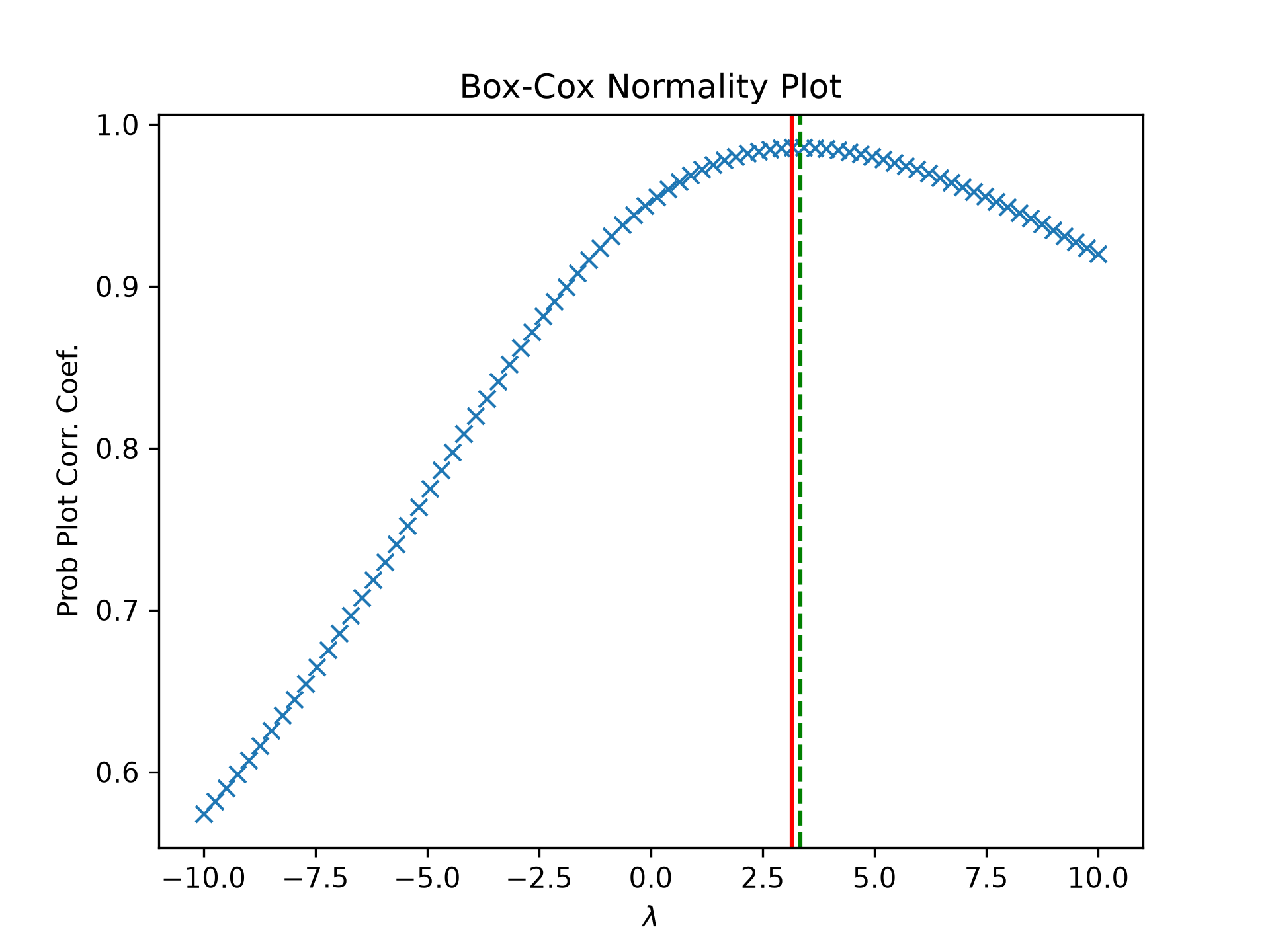
array([3.34704, 3.1428 ])
fig = plt.figure()
ax = fig.add_subplot(111)
prob = stats.boxcox_normplot(x, -10, 10, plot=ax)
✓
ax.axvline(lmax_mle, color='r')
ax.axvline(lmax_pearsonr, color='g', ls='--')
✗
<matplotlib.lines.Line2D object at 0x7f3f68548ad0>
plt.show()
✓
from scipy import optimize
options = {'xatol': 1e-12}  # absolute tolerance on `x`
def optimizer(fun):
    return optimize.minimize_scalar(fun, bounds=(6, 7),
                                    method="bounded", options=options)
✓
stats.boxcox_normmax(x, optimizer=optimizer)
✗np.float64(6.000000116308384)
See also
Aliases
scipy.stats.boxcox_normmax