bundles / scipy latest / scipy / stats / _morestats / boxcox_normplot
function
scipy.stats._morestats:boxcox_normplot
source: build-install/usr/lib/python3.14/site-packages/scipy/stats/_morestats.py:1544
Signature
def boxcox_normplot(x, la, lb, plot = None, N = 80)Summary
Compute parameters for a Box-Cox normality plot, optionally show it.
Extended Summary
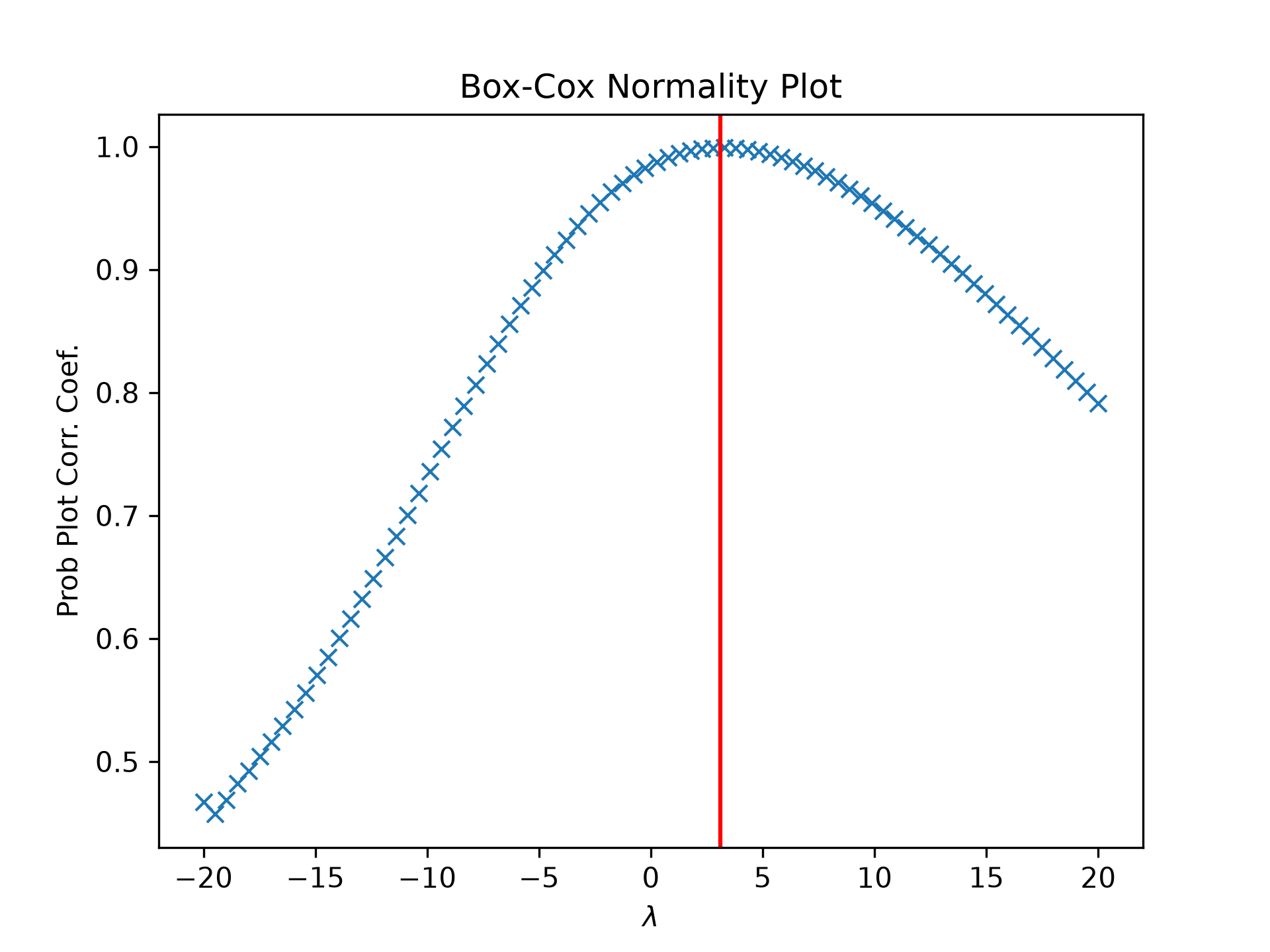
A Box-Cox normality plot shows graphically what the best transformation parameter is to use in boxcox to obtain a distribution that is close to normal.
Parameters
x: array_likeInput array.
la, lb: scalarThe lower and upper bounds for the
lmbdavalues to pass to boxcox for Box-Cox transformations. These are also the limits of the horizontal axis of the plot if that is generated.plot: object, optionalIf given, plots the quantiles and least squares fit.
plotis an object that has to have methods "plot" and "text". The matplotlib.pyplot module or a Matplotlib Axes object can be used, or a custom object with the same methods. Default is None, which means that no plot is created.N: int, optionalNumber of points on the horizontal axis (equally distributed from
latolb).
Returns
lmbdas: ndarrayThe
lmbdavalues for which a Box-Cox transform was done.ppcc: ndarrayProbability Plot Correlation Coefficient, as obtained from probplot when fitting the Box-Cox transformed input
xagainst a normal distribution.
Notes
Even if plot is given, the figure is not shown or saved by boxcox_normplot; plt.show() or plt.savefig('figname.png') should be used after calling probplot.
Examples
from scipy import stats
import matplotlib.pyplot as plt
✓
x = stats.loggamma.rvs(5, size=500) + 5
fig = plt.figure()
ax = fig.add_subplot(111)
prob = stats.boxcox_normplot(x, -20, 20, plot=ax)
✓
_, maxlog = stats.boxcox(x)
✓ax.axvline(maxlog, color='r')
✗<matplotlib.lines.Line2D object at 0x7f3f68fd8d70>
plt.show()
✓
See also
Aliases
scipy.stats.boxcox_normplot