bundles / numpy 2.4.4 / numpy / cosh
ufunc
numpy:cosh
source: /numpy/__init__.py
Summary
Hyperbolic cosine, element-wise.
Extended Summary
Equivalent to 1/2 * (np.exp(x) + np.exp(-x)) and np.cos(1j*x).
Parameters
x: array_likeInput array.
out: ndarray, None, or tuple of ndarray and None, optionalA location into which the result is stored. If provided, it must have a shape that the inputs broadcast to. If not provided or None, a freshly-allocated array is returned. A tuple (possible only as a keyword argument) must have length equal to the number of outputs.
where: array_like, optionalThis condition is broadcast over the input. At locations where the condition is True, the out array will be set to the ufunc result. Elsewhere, the out array will retain its original value. Note that if an uninitialized out array is created via the default
out=None, locations within it where the condition is False will remain uninitialized.**kwargsFor other keyword-only arguments, see the ufunc docs.
Returns
out: ndarray or scalarOutput array of same shape as x. This is a scalar if x is a scalar.
Examples
import numpy as np
✓np.cosh(0)
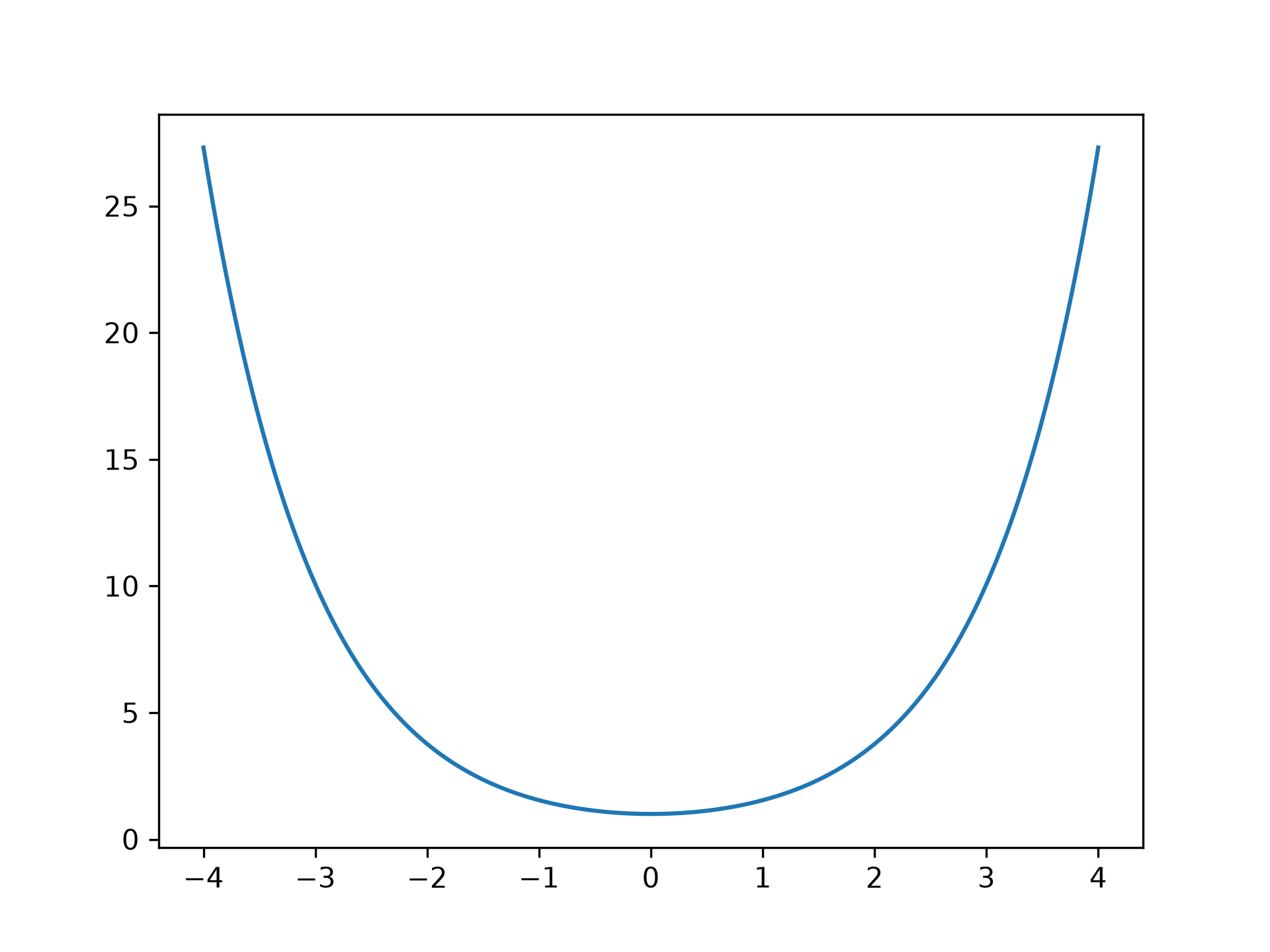
✗np.float64(1.0)The hyperbolic cosine describes the shape of a hanging cable:
import matplotlib.pyplot as plt
x = np.linspace(-4, 4, 1000)
✓
plt.plot(x, np.cosh(x))
✗[<matplotlib.lines.Line2D object at 0x7fe9872f74d0>]
plt.show()
✓
Aliases
numpy.cosh